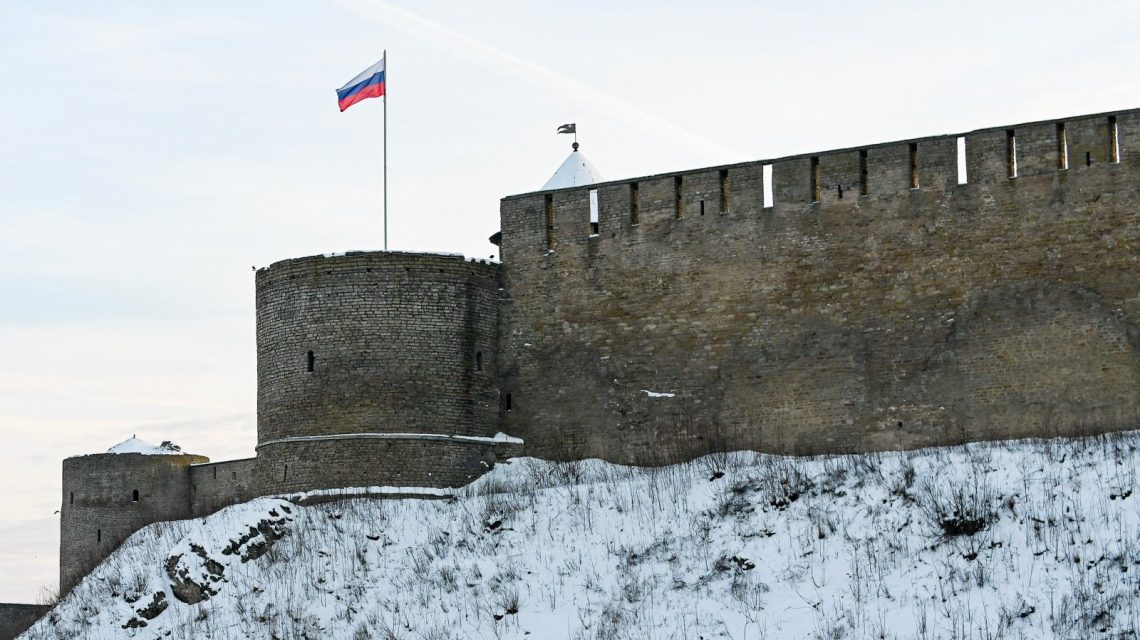
The Institute for the Study of War (ISW) has presented a scenario in which Russia might conduct a limited incursion into Estonia to test NATO’s resilience. This comes amid increasing tensions between Moscow and Tallinn. Recently, Russia’s FSB intelligence services imposed restrictions on two Russian districts in the Leningrad oblast bordering Estonia, namely Kingisepp and Slantsy, limiting nighttime movement and access to parts of the Narva River shared by both countries.
Estonia announced a potential border shutdown with Russia if President Vladimir Putin orders a mass mobilization to offset losses in the Ukraine conflict, a move that could result in a mass exodus. Alarm from officials across the Baltic region have been expressed over Russian drone incursions, airspace violations, sabotage, and other hybrid threats. The ISW highlighted Narva, a predominantly Russian-speaking border town, as a potential focus of Moscow’s move on NATO. This would test NATO’s Article 5 clause of mutual defense, asserting that an attack on one member is deemed an attack on all.
The Washington, D.C., think tank emphasized the absence of current Russian buildup by the Baltic states, making a Russian invasion of NATO unlikely while Putin is militarily engaged in Ukraine. Nonetheless, such a scenario would pose complicated challenges and decision-making requirements for NATO’s military structures. The ISW pointed to ongoing Russian propaganda campaigns against Estonia, suggesting efforts to depict Estonia as oppressive toward Russian-speaking citizens or as aiding Kyiv in its strikes against Russia.
The ISW said Russia’s military could gather FPV drones from drone units within range of Narva and the nearby military base in Johvi, utilizing long-range and radio-controlled drones for possible strikes on NATO positions.
In Narva, Russian agents might seize municipal buildings and potentially declare a “Narva People’s Republic” (NPR). Russia could then intervene with drones and air defense units pre-positioned near Estonia. While refraining from entering Estonian territory, Russia could insist on de-escalation by demanding recognition of NPR control in Narva. If Estonia does not comply, Moscow could threaten to expand its drone strike campaign.
Estonia may seek NATO activation of Article 5, or request assistance from NATO members. However, alliance members might be reluctant to do so over a limited incursion, fearing escalation into full-scale war with Russia. Failure to activate Article 5 might diminish its significance, providing Putin an opportunity to exploit internal NATO divisions. U.S.-European tensions over defending NATO territory might also slow U.S. involvement. Russian cognitive warfare could deepen discord between the U.S. and Europe.
Should NATO intervene, Putin might face choosing between confronting the alliance or continuing efforts in Ukraine. The ISW’s scenario is not a prediction, but a hypothetical situation outlining potential Russian tactics against NATO. It shares similarities with the book “If Russia Wins: A Scenario” by German political scientist Carlo Masala, who envisions potential Kremlin disinformation campaigns leading to military moves on Narva and the Estonian island of Hiiumaa.
Masala’s book places the attack scenario in 2028, postulating an outcome where Moscow claims victory, Ukraine cedes 20 percent of its territory, and is barred from NATO membership. Masala noted growing skepticism within Moscow regarding NATO’s Article 5 commitment, with attempts to drive a divide between European members and NATO. “The Russians are becoming more reckless in their efforts to test NATO’s deterrence,” he said.
 British Police Arrest Man Suspected of Terror Plot
  Activists Push for Nationwide Ban on Child Marriage in the U.S.
  Investigation into Alleged Incident at Cornell University
  Rising Drone Threats Highlight Vulnerabilities in Moldova’s Airspace Defense
  Bolivia Faces Security Test Amid Unrest
  Incident on FlyDubai Flight Raises Security Concerns