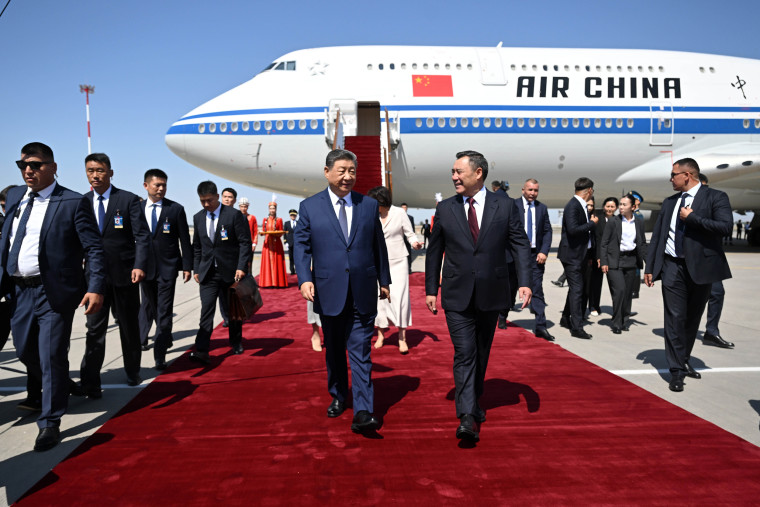
The Shanghai Cooperation Organization (SCO) summit began in Kyrgyzstan on Monday, gathering leaders from China, Russia, India, and others to discuss global influence. This summit, held in Bishkek, serves as a platform countering U.S. dominance in global affairs.
Chinese President Xi Jinping, Russian President Vladimir Putin, and Indian Prime Minister Narendra Modi are among the key figures present. Putin met separately with Xi and Modi, reaffirming Russia’s intent to establish a permanent visa-free regime with China and strengthen ties with India. Talks with Iranian President Masoud Pezeshkian are also scheduled for Tuesday during the official SCO sessions.
Russia and Iran see the summit as crucial for enhancing relationships with non-Western partners amid ongoing conflicts. Modi expressed India’s commitment to ending the war in Ukraine, emphasizing the need to halt hostilities for humanity’s benefit.
Founded in 2001 by China, Russia, and four Central Asian states, the SCO has expanded its influence over the years despite having vague goals and limited recognition. It now includes ten countries: Russia, China, India, Iran, Pakistan, Belarus, Kazakhstan, Kyrgyzstan, Tajikistan, and Uzbekistan, with several others as dialogue partners.
China and Russia present the SCO as an alternative to Western-aligned organizations like the G7. China aims to broaden the organization’s scope and influence through development and financial assistance, promoting a new path for regional cooperation.
The summit provides members an opportunity to display strong international ties despite strained relations with the West. However, the SCO is not a unified bloc; significant disagreements exist among members. Analysts suggest India’s participation is more about strategic signaling than concrete outcomes, given its rivalry with China and Pakistan.
India’s inclusion offers a chance to track geopolitical shifts and maintain strategic interests in the region. Turkey, possessing partner status, seeks to bolster its regional influence through the SCO while balancing traditional Western ties.
“While it may not entirely shape the agenda, it gives New Delhi a first-hand view of the region and allows it to hedge its position with others,” Dinakar Peri from Carnegie India stated.
Turkey aims to transition from dialogue partner to permanent member, despite stalled EU membership prospects.
Security precautions in Bishkek include closures of major malls and markets and restrictions on flights to and from Manas Airport. Traffic is limited in central Bishkek, with the school year postponed and Tuesday designated as a public holiday. This aims to ensure smooth operations and safety during the summit.
 British Police Arrest Man Suspected of Terror Plot
  Activists Push for Nationwide Ban on Child Marriage in the U.S.
  Investigation into Alleged Incident at Cornell University
  Rising Drone Threats Highlight Vulnerabilities in Moldova’s Airspace Defense
  Bolivia Faces Security Test Amid Unrest
  Incident on FlyDubai Flight Raises Security Concerns