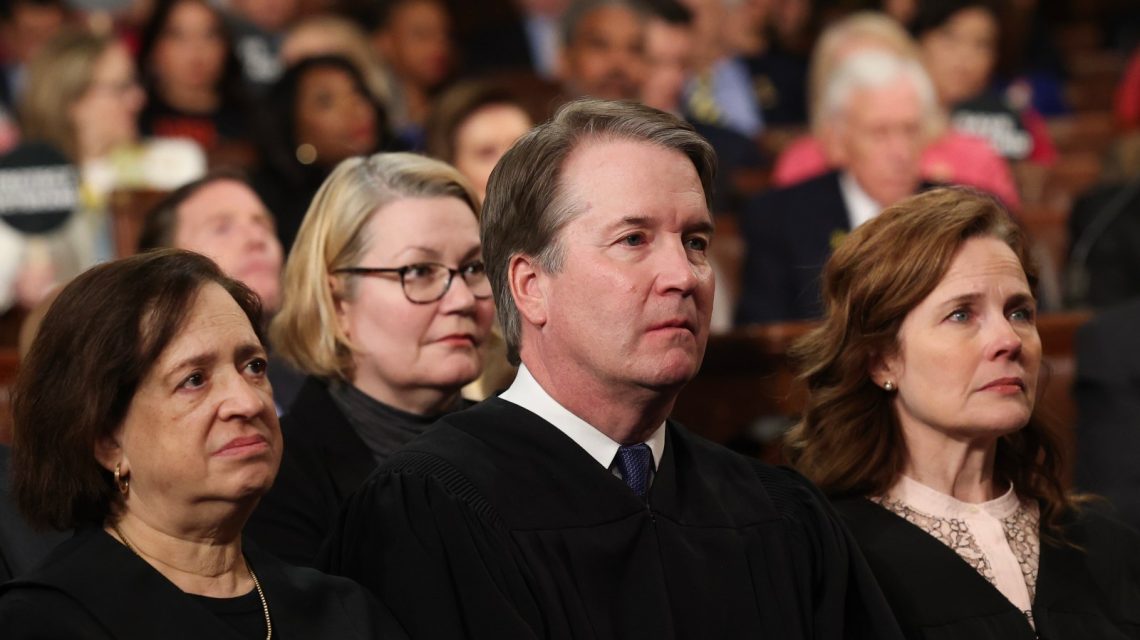
Gallup Poll Reveals Plummeting Approval
The United States Supreme Court has witnessed a significant drop in approval ratings among independent voters. The latest Gallup poll reveals that the approval rate has fallen to 31 percent, marking the lowest in Gallup’s recorded history. Comparatively, the approval stood at 35 percent in July 2026 and at 38 percent in September 2025.
Recent years have seen a decline in public trust towards the Court. Many Americans have expressed concerns over its impartiality. Democrats particularly criticize the Court’s conservative leaning, especially following the overturning of Roe v. Wade and perceived weakening of the Voting Rights Act. Former President Donald Trump has also voiced his dissatisfaction with certain rulings, notably those hampering his moves to end birthright citizenship.
Expert Insight on Public Opinion
Constitutional law professor Stephen Wermiel from American University notes that the Court faces considerable criticism. “Liberals see the Court as a conservative entity. Trump believes his appointees have betrayed him, expressing it vehemently. Such widespread dissatisfaction could weaken the Court’s standing,” he commented to Newsweek.
Overall, approval for the Supreme Court stands at 34 percent, close to the record low of 33 percent recorded in July 2026. A year prior, in September 2025, approval was slightly higher at 42 percent.
Varied Perspectives Among Political Groups
Republicans have shown a rebound in approval, increasing from 58 percent in July to 65 percent in September according to Gallup. Democratic approval remains static at 12 percent, nearing the historic low of 11 percent in July 2025.
Gallup’s data from past years shows fluctuating support. In July 2020, approval peaked at 58 percent, dropping to 40 percent by September 2021. Since then, it’s struggled to recover, hitting below 40 percent for the first time in July 2025 at 39 percent, rising slightly in September to 42 percent, and dropping again to 33 percent in July 2026.
The Court’s conservative majority of 6-3 aligns with favorable views among Republicans compared to Democrats. The last favorable Democratic view was recorded in July 2016, with 60 percent approval.
Current statistics indicate that 43 percent of Americans consider the Court too conservative. Meanwhile, 35 percent believe its ideology is balanced, with 17 percent perceiving it as too liberal. The poll surveyed 1,000 adults from September 1 to 17, 2026, with a margin of error of plus or minus 4 percentage points.
Justice Response to Declining Approval
Some Justices have publicly addressed the declining approval ratings for the Court. Justice Ketanji Brown Jackson, a liberal, recently criticized the Court’s use of the emergency docket during an event at the University of the District of Columbia’s law school, as reported by The Hill. The emergency docket allows quick decisions without oral arguments, leading to questions about the legal reasoning behind decisions. Jackson raised concerns over its fairness.
Justice Elena Kagan acknowledged improvements in handling the emergency docket during the summer. The Trump administration frequently utilized this docket for quick intervention in ongoing lower court cases. Last year, the Court sided with Trump’s administration in several measures to override lower court decisions.
Wermiel highlights that the emergency docket contributes to the diminishing status of the Court. He suggests increased transparency in shadow docket actions and high-profile rulings against Trump could restore some confidence in the Court.
Justice John Roberts has also commented on the importance of cautious overrule of precedent. He warned against overturning precedent too readily, emphasizing potential harm to the justice system.
Noteworthy Rulings from Previous Term
The Court’s term included significant rulings often unfavorable to Trump. It ruled 6-3 against the attempt to end birthright citizenship, undermined by a Trump executive order. Trump also faced rulings against tariff impositions and an effort to remove Federal Reserve Governor Lisa Cook.
However, Trump gained favorable decisions regarding executive authority and transgender athletes’ participation in sports.
The Court also invalidated Louisiana’s congressional districting in Louisiana v. Callais, affecting the Voting Rights Act. Republican-led states like Alabama and Tennessee subsequently redrew district maps, reducing Black voting influence.
Trump Criticizes Recent Court Decisions
Trump expressed discontent via social media over the Court’s recent ruling against using Missouri’s Republican-backed congressional map for midterms. He accused the Court of repeatedly undermining judicial decisions he believed were correct.
In other online comments, Trump cited decisions on tariffs and birthright citizenship as costly and damaging to U.S. citizenship policies.
Additional Poll Data Reflects Supreme Court Image
Other polling aligns with Gallup’s findings on the Court’s public image. A Marquette Law School Poll indicates net approval at -14 points, with 43 percent approving and 57 percent disapproving. This survey involved 1,023 adults and holds a margin of error of plus or minus 3.3 percentage points.
Additionally, a YouGov and The Economist poll showed -22 points net approval, revealing 34 percent approval and 56 percent disapproval. They identified that 49 percent view the Court as conservative in ideology as opposed to 10 percent who see it as liberal, surveying 1,469 registered voters.
 State Department Simplifies Passport Process with Online Applications
  Becerra and Hilton Clash in California Gubernatorial Debate
  California Voters to Decide on $7.5 Billion State Research Fund
  Highlights from the California Gubernatorial Debate: Becerra vs. Hilton
  Becerra vs. Hilton: The Debate and Key Issues in the California Governor Race
  Senate Confirms New Labor Secretary