Examining AI’s Potential in Healthcare
Laura Ingraham explores the impact of AI on healthcare, particularly on the role of doctors. The CEO of a major public hospital system plans to use AI instead of radiologists for breast cancer screening, aiming to cut costs. However, Dr. Marc Siegel from Fox News believes AI should enhance, not replace, human doctors. He stresses the importance of personal interaction and oversight in diagnostic processes.
Enhancing Diagnosis with AI
Uncertainty at medical appointments can be frustrating. Patients might leave with unanswered questions and inconclusive test results. Microsoft claims its AI could help solve tough diagnostic challenges. According to a study in the journal Science, Microsoft’s AI accurately diagnosed 83% of complex cases, significantly outperforming generalist physicians who consulted reference materials.
However, these promising results arise from simulations, not real patient interactions. The study raises questions about AI’s potential to transform future medical visits.
Microsoft’s MAI Diagnostic Orchestrator
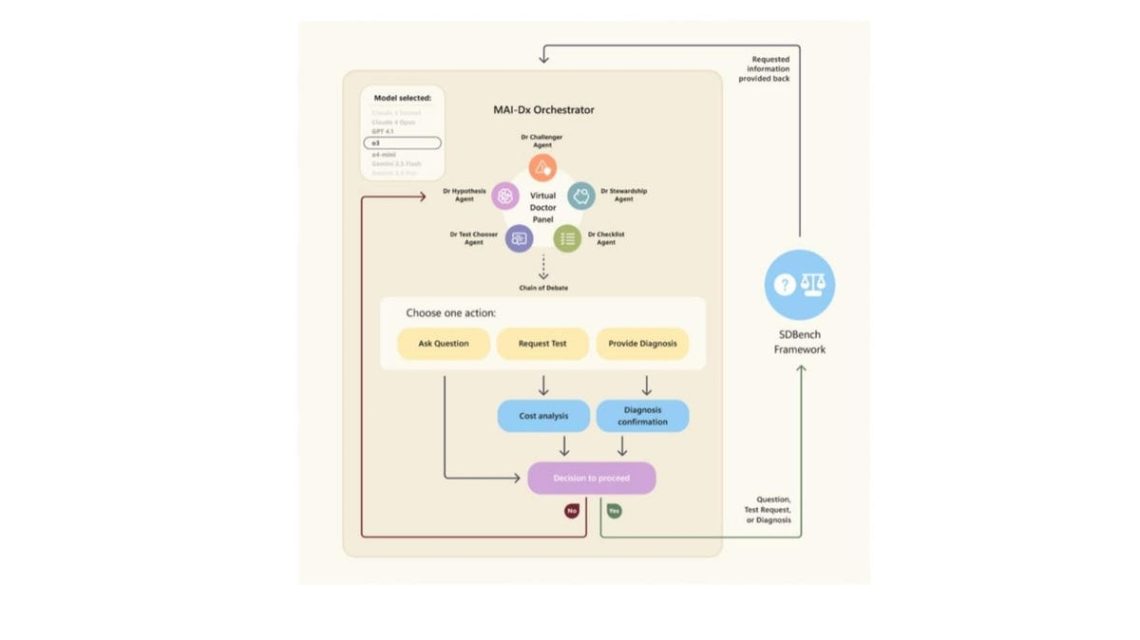
Microsoft’s MAI-DxO uses multiple AI agents to evaluate symptoms and suggest tests before forming diagnoses. Like a panel of doctors, these agents challenge each other’s conclusions as more information becomes available. This method may be especially valuable where symptoms overlap different diseases.
Researchers tested MAI-DxO using 304 complex cases from The New England Journal of Medicine. It succeeded in diagnosing 83% of cases, compared with 36% accuracy by general physicians with reference materials.
Understanding AI vs. Doctors
The comparison involved generalists working individually, rather than specialists collaborating on challenging cases. Furthermore, Microsoft’s AI faced 304 cases, while physicians assessed 56, complicating direct outcome comparisons.
Doctors treat patients amid unpredictability, dealing with incomplete records and vague symptoms. While simulations tested AI’s capabilities, real-world medical care presents unexpected challenges.
AI’s Role Beyond Diagnosis
Identifying correct diagnoses is one aspect of care. Doctors must decide on treatments, considering unique patient circumstances. The study authors work for Microsoft, highlighting the need for independent trials before adopting this technology widely.
The Advantages of Microsoft’s AI
Microsoft aims for “medical superintelligence,” looking to surpass current medical teams in clinical reasoning. Collaborations with Mayo Clinic target predictions of patient condition developments.
Overly expensive tests can burden patients. Microsoft reported cost-saving potential, estimating lower diagnostic expenses per case with MAI-DxO.
Testing AI in Clinical Settings
Microsoft plans real-hospital evaluations with Beth Israel Deaconess Medical Center. The AI will interact with patients, comparing its recommendations to doctor assessments, maintaining doctors’ treatment responsibilities.
Implications for Patients
Currently, AI remains a research tool, not a replacement for medical visits. Progress in AI systems may soon support doctors as assistants, especially for unresolved patient symptoms. Despite improved diagnostic capabilities, AI must handle data responsibly and transparently.
Patients exploring AI for health advice should use its insights to enhance their interactions with physicians. Protecting sensitive medical data and understanding AI limitations are paramount.
In summary, while AI advances hold promise, the balance between technology and human care requires careful consideration.
 The Daily Routine of Klook’s CEO Focused on Fitness and Efficiency
 The Jensen Huang Controversy: Silicon Valley’s Divided Opinion
 California Lawsuit Against OpenAI: Key Details and Implications
 Updates on Key International and Domestic Events
 E.l.f. Cosmetics Breaks Makeup World Record at TwitchCon
 Understanding Credit Freeze, Fraud Alert, and Identity Monitoring