
In Washington, President Donald Trump declared that upcoming discussions between the United States and Iran might be Iran’s ‘last chance’ to negotiate a deal and avoid further U.S. military strikes. Speaking from the Oval Office, Trump expressed hope that negotiations would soon address U.S. concerns over Iran’s nuclear ambitions and help open the Strait of Hormuz. According to him, the initial focus will be on reopening the Strait, followed by steps towards denuclearization.
Despite Trump’s satisfaction with the U.S. military’s impact on Iranian leadership and forces, Iran seems prepared to endure, betting on Trump’s political challenges as the midterm elections approach. With resources stretched, executing unpopular military action might prove difficult.
“This the last chance for them to sign a good document,” Trump told reporters.
Talks are reportedly set to begin soon. Contextualizing the tension, Trump mentioned that Gulf allies, including Qatar, Saudi Arabia, and the United Arab Emirates, requested a pause in military actions. Trump acknowledged delaying a significant strike, initially planned to be extensive, to allow diplomacy more time – this decision followed consultations with Middle Eastern leaders and unnamed Iranian officials.
On social media earlier, Trump labeled Iran as ‘unbelievably duplicitous’ after claims about discussions with Oman focused solely on navigation routes. He emphasized that concrete talks on nuclear weapons prevention are ongoing despite Iran’s denials.
Throughout these events, Trump’s approach alternated between threats and retreat, often citing diplomatic progress or interruptions due to Gulf influence. Instances include calling off a major strike in May due to ongoing negotiations, and another in June, when potential military actions were aborted on the premise of advancing discussions with Iranian officials.
Domestic political pressures mount as the American public expresses doubt about the conflict’s value. Polling data shows a majority disapproval across party lines, with significant Republican discontent. While Trump claims midterms aren’t shaping his policies, the political implications are clear to his party members.
Republican Sen. John Kennedy advocated caution, suggesting that sanctions and a measured nuclear focus could be more effective than military escalation, which could exacerbate economic pressures through energy price spikes and inflation.
Trump acknowledged a conversation with Saudi Arabia’s Crown Prince Mohammed bin Salman influenced his decision to halt recent military actions, pointing to economic ramifications if regional conflicts harmed ally infrastructures. Gulf nations, except potentially vulnerable Kuwait, claim readiness to defend against Iranian actions.
 New Jersey Voter Fraud Prompts Renewed Push for SAVE Act
  Concerns Over Changes to Voter-Registration Form for Americans Abroad
  Trump’s 2024 Campaign Targets Young Men Through Cryptocurrency
  Trump’s White House Visitor Center Proposal Gains Bipartisan Support
  State Department Simplifies Passport Process with Online Applications
 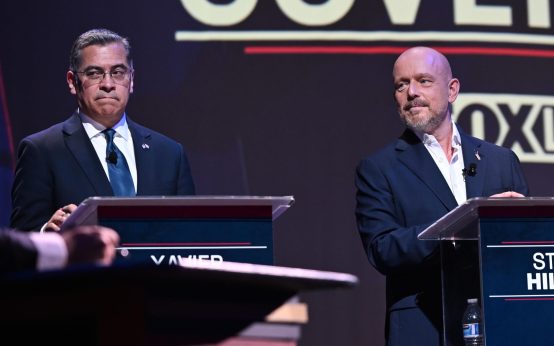 Becerra and Hilton Clash in California Gubernatorial Debate