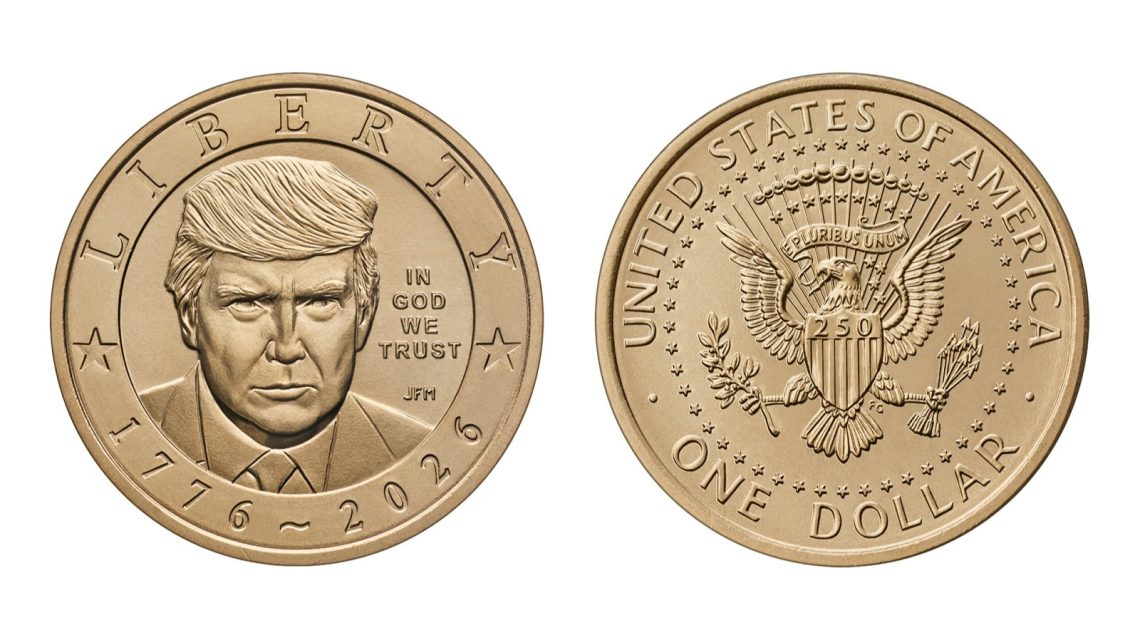
On Wednesday morning, the United States Mint placed visitors on a waiting list as a new $1 commemorative coin featuring President Donald Trump’s portrait went on sale. The Mint’s website, an arm of the U.S. Treasury Department, initially showed a wait time of about 20 minutes for visitors, which later increased to an hour. This site is the primary platform for collectors interested in purchasing the coin.
The Mint attributed the delay to high traffic, stating, “Due to extraordinarily high traffic, we are using a virtual waiting room.” Visitors were informed they would have 10 minutes to complete their purchase once they gained access.
Although the Trump coin has a legal tender value of $1, collectors buying directly from the Mint will pay significantly more. Rolls containing 25 coins are priced at $61, equating to $2.44 per coin, while bags of 100 coins cost $154.50, approximately $1.55 each. The release is part of the nation’s 250th anniversary celebrations and features Trump’s likeness on one side, touted as a special semiquincentennial collectible. Newsweek contacted the U.S. Treasury for comments on this matter.
Why Does a $1 Coin Cost More Than $1?
For collectors, the face value on a coin often holds little significance in its overall cost. When the Mint sells coins to the public, the price includes more than just the coin’s spending value. Factors like production costs, collector packaging, distribution expenses, and the coin’s appeal to numismatists all contribute to its retail price.
The Trump coin fits this model. Despite its status as a legal-tender dollar coin, meant for spending like any other dollar, it is marketed as a collectible item sold in rolls and bags rather than circulated generally. It features a unique gold-colored finish but is made from non-precious metals instead of actual gold. Similar pricing applies to many other Mint products, where uncirculated coins in official packaging are sold above face value.
Comparison with Other Coins
The Trump dollar is not the first to be priced significantly above its denomination. A recent example is the 2025 U.S. Marine Corps 250th Anniversary Silver Dollar. Priced for collectors, this coin reflects the value of its silver content and its status as a commemoration.
Similarly, the 2025 Morgan and Peace Silver Dollars, although carrying a $1 denomination, sold at much higher prices due to their silver content and collector demand. Even numismatic products without precious metals often sell above face value, including the Mint’s 2026 American Innovation $1 Coin rolls and bags.
Bullion products also follow this trend. American Gold Eagle and Gold Buffalo coins, despite face values like $50, have market prices linked to their gold content, reaching into thousands of dollars.
Legal and Political Debate Surrounding the Trump Coin
While the coin’s pricing aligns with typical collector products, its design has stirred controversy. Announced by the Trump administration as part of the 250th-anniversary celebration, the coin shows Trump’s portrait on one side with a presidential-seal-inspired eagle on the reverse. The Mint reported producing 250,000 coins available for purchase in 25-coin rolls and 100-coin bags.
Critics argue that featuring Trump’s likeness on a U.S. coin breaches a longstanding rule against depicting living individuals on American currency. Democratic Senator Chris Van Hollen from Maryland has expressed concern that such representation could turn U.S. currency into a vehicle for political admiration, eroding public trust in national institutions. Van Hollen emphasized that currency should symbolize the nation as a collective, not individual leaders.
The administration challenges this view, citing that the coin is authorized under legislation related to the 250th anniversary of American independence. Officials refer to historical instances, such as a 1926 commemorative half-dollar featuring then-President Calvin Coolidge, and argue that separate congressional approval was not necessary for the coin’s release.
 New Jersey Voter Fraud Prompts Renewed Push for SAVE Act
  Concerns Over Changes to Voter-Registration Form for Americans Abroad
  Trump’s 2024 Campaign Targets Young Men Through Cryptocurrency
  Trump’s White House Visitor Center Proposal Gains Bipartisan Support
  State Department Simplifies Passport Process with Online Applications
  Becerra and Hilton Clash in California Gubernatorial Debate