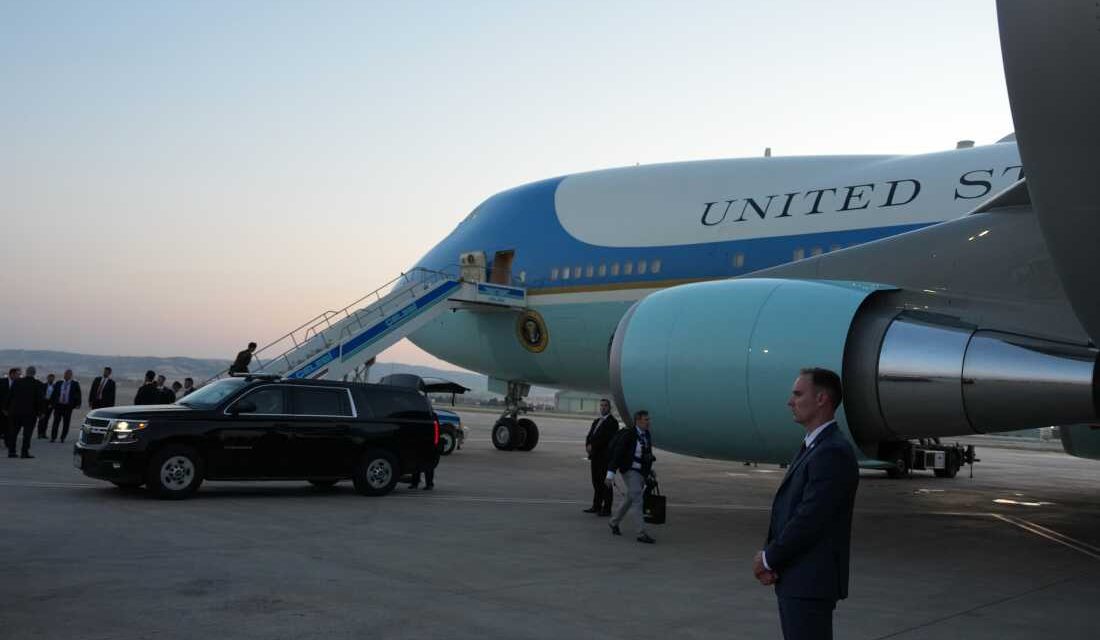
Air Force One sat on the runway as President Donald Trump prepared to leave following a NATO summit at Ankara International Airport, Turkey, on July 8, 2026. The president’s departure sparked interest due to an unexpected swap from the new Qatari-gifted jet to an older model.
Trump’s decision to travel partway home on the old Air Force One instead of the newly retrofitted aircraft led to speculation regarding security, especially amidst renewed tensions between the U.S. and Iran. Despite questions, Trump offered little explanation, citing nostalgia for flying on the legacy jet. Both planes made an unscheduled stop at Royal Air Force Mildenhall in the UK, a base used by U.S. troops, offering service members a tour of the new aircraft.
Security Concerns and Missing Systems
Images of the Qatari-gifted jet show it lacks some missile detection systems present in older models. This fueled apprehension about its security capabilities after a $400 million retrofit. During the stop at Mildenhall, before boarding the new jet again, Trump met with service members. He commented on social media about the excitement among the troops at seeing the new Air Force One.
When asked if security issues prompted the switch, Trump dismissed concerns related to Iran. He mentioned being a high-priority target for Iranian attacks, but denied any specific threats against Air Force One.
Reporters inquired why window blinds aboard the older plane were kept closed. Trump attributed this to the potential threat from Iran, although he did not experience the same measure in his compartment.
Military Strikes and Aircraft Confusion
The aircraft swap announcement came shortly after U.S. strikes in Iran, responding to regional hostilities. Trump used social media to explain the decision to visit the UK base, stating that military personnel requested to view the aircraft.
Further scrutiny arose about the aircraft’s missing countermeasure systems. Steven Cheung, a White House spokesperson, noted the new jet’s state-of-the-art security but emphasized using tactical strategies against enemies threatening the president’s safety.
Transponder and Flight Logistics
During Trump’s departure from Turkey on the older Boeing VC-25A, its transponder was temporarily disabled — a common practice in high-risk scenarios. Flight trackers observed other leaders’ flights departing with active transponders.
The luxury Boeing 747-800 from Qatar, modified for presidential use, traveled earlier from Turkey, landing at RAF Mildenhall hours ahead of Trump’s visit.
Iran’s missile capabilities provide enough range to reach Turkey, but not the UK. The U.S. Air Force previously prioritized essential upgrades for the Qatari jet, acknowledging some complex modifications were deferred for expedited service entry.
Jeremiah Gertler, an analyst from Teal Group, noted the absence of countermeasure systems and fewer communication antennas, indicating the Qatari plane suits domestic travel better.
Trump’s first flight on the new jet was to North Dakota. The initial jets were equipped with advanced security features, like missile countermeasures and in-flight refueling, designed during the Cold War.
Delays persist with the permanent upgrades to the Air Force One fleet. These modifications are anticipated by 2028.
 Dutch Review Board’s Euthanasia Ruling and International Debate
  Israeli PM Commends Heroic Actions in Flight Emergency
  Rabbi and Jewish Leaders Criticize Adam Brody for ‘Genocide’ Comment
  Flydubai’s Emergency Landing Highlights Cockpit Security
  Former Israeli PM Naftali Bennett Commends Passengers and Crew for In-Flight Heroism
  Diplomatic Complexities Unfold at U.S. National Archives Visit