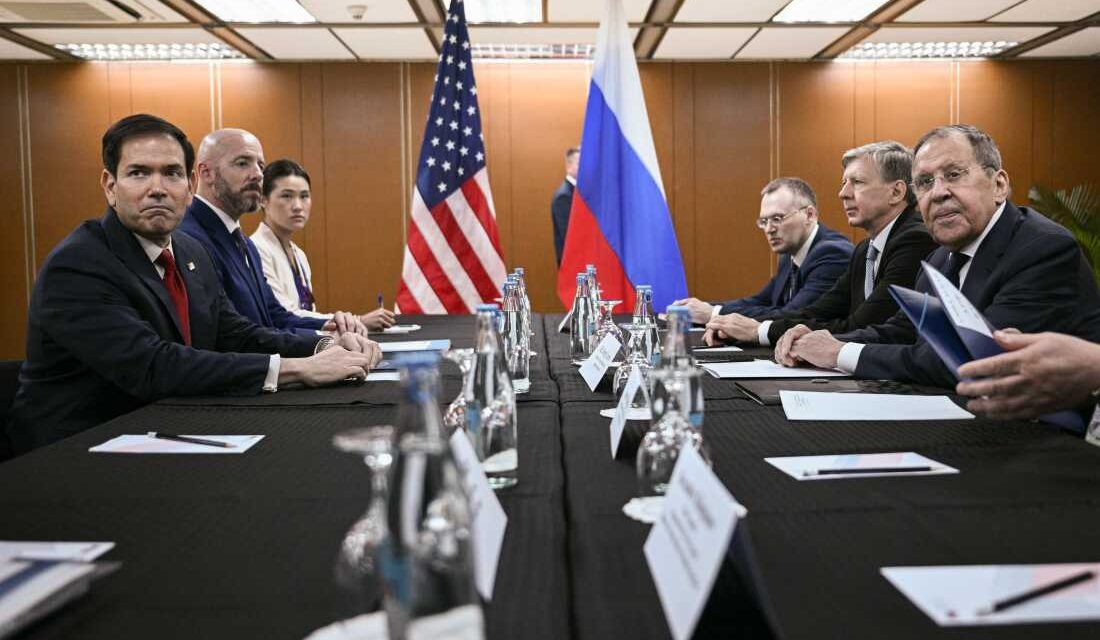
At the Association of Southeast Asian Nations (ASEAN) Foreign Ministers Meeting in Manila on July 23, 2026, U.S. Secretary of State Marco Rubio met with Russian Foreign Minister Sergey Lavrov. They discussed potential resolutions to the ongoing conflict in Ukraine. Rubio acknowledged the need for sustained diplomatic efforts and fresh ideas to bring about a resolution.
The Trump administration, according to Rubio, is committed to ending what he described as the “senseless war” in Ukraine. However, he recognized the complexities involved in achieving a mutually acceptable agreement. Despite previous unsuccessful talks, President Donald Trump is willing to continue working towards a solution if changing conditions allow.
In discussing diplomacy, Rubio noted the challenge of finding common ground between Ukraine and Russia. He expressed the United States’ readiness to facilitate negotiations if opportunities arise. Rubio’s meeting with Lavrov was part of a series of discussions with several leaders, including China’s foreign minister, focusing on broader international conflicts.
U.S. Commitment to Asia
During the ASEAN meeting, discussions also centered on ongoing issues in the Middle East and tensions in the South China Sea. Rubio reassured that the U.S. remains engaged in Asia, highlighting strong regional partnerships and economic ties. He addressed concerns about America’s ability to focus on multiple global issues simultaneously.
Lavrov, in response, emphasized Russia’s stance against arming Ukraine and stressed Moscow’s pursuit of diplomatic solutions. He reiterated Russia’s readiness for a political resolution, supported by past agreements between Trump and Russian President Vladimir Putin.
Focus on Iran and Military Readiness
U.S. efforts to mediate an end to the Ukraine conflict have been complicated by tensions with Iran. Rubio highlighted the ongoing hostilities following collapsed ceasefire agreements, with the Trump administration taking a firm stance. Washington has warned of retaliatory measures should Iran continue its aggressive actions.
Iranian foreign policy remains aggressive, with its officials insisting on a reciprocal defense doctrine. Rubio described Trump’s policy in dealing with Iran as decisive, stressing the heavy consequences Iran would face for continued aggression.
Concerns About Chinese Military Actions
In related discussions, Australia’s Foreign Minister Penny Wong voiced concerns over a recent Chinese missile test from a nuclear submarine, which lacked notification to nearby countries. This action was seen as destabilizing, given China’s rapid military expansion without transparency.
Rubio’s recent meeting with Chinese Foreign Minister Wang Yi included talks about a recent altercation in the South China Sea involving Chinese and Filipino forces. Rubio stressed the need for careful management of such incidents to prevent significant global conflicts. The Chinese coast guard defended its actions as lawful, while the Philippine coast guard labeled China’s maneuvers as aggressive.
The U.S. administration continues to challenge China’s assertive territorial claims in the South China Sea, standing by smaller nations like the Philippines. Ongoing negotiations aim to develop a code of conduct to avert major conflicts in the region, which holds one of the world’s critical trade routes.
 The Trump Team’s Challenge to the Military Leadership
  Cargo Plane Crash at Miami International Airport
  Maryland First State to Restrict Electronic Pricing in Grocery Stores
  British Police Arrest Man Suspected of Terror Plot
  Activists Push for Nationwide Ban on Child Marriage in the U.S.
  Marine Veteran Suing Oregon School District Over Curriculum Reimbursement