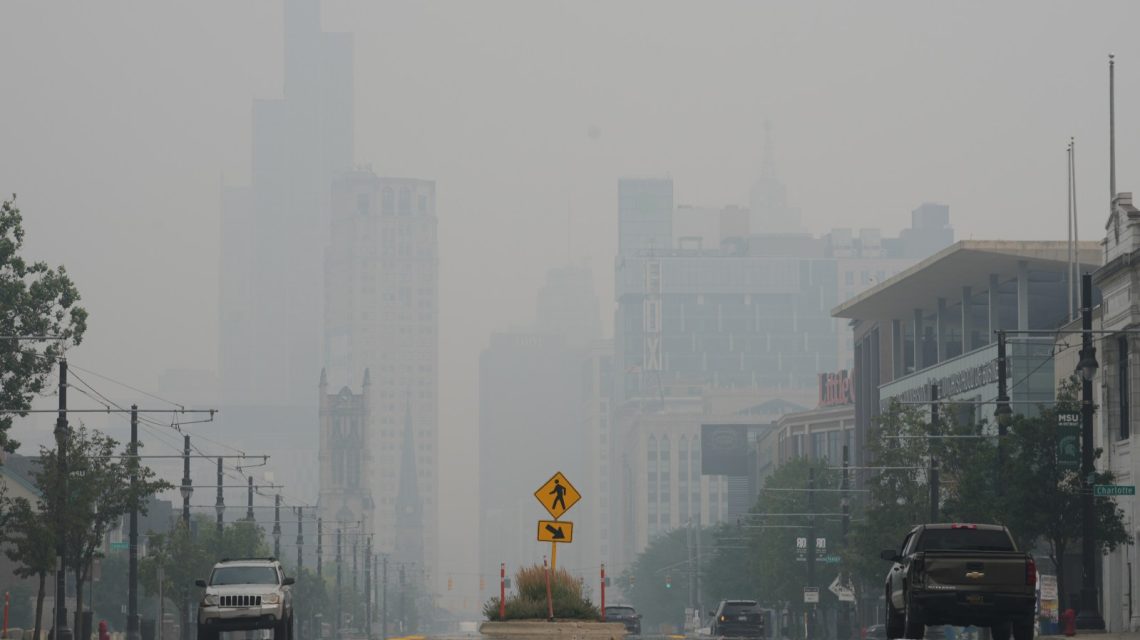
Impact of Canadian Wildfires on U.S. Air Quality
On Friday, U.S. cities faced severe air quality challenges due to smoke from Canadian wildfires affecting the Midwest and Northeast. Detroit registered a concerning “very unhealthy” Air Quality Index (AQI) of 240 between 1 and 2 p.m. ET, topping the list tracked by IQAir. Chicago recorded an “unhealthy” reading of 199, while Washington, D.C., had a reading of 172. New York City was ranked eighth with a moderate AQI of 131.
Global Air Quality Rankings
Beyond the U.S., Kinshasa in the Democratic Republic of the Congo marked an AQI of 186. In New Delhi, India, recognized for longstanding pollution issues, the AQI reached 163. Jakarta, Indonesia, recorded a level of 144, categorized as “unhealthy for sensitive groups.” New Delhi’s residents frequently encounter high pollution levels, with an average PM2.5 concentration of 99.6 µg/m3.
Understanding PM2.5 Pollution
PM2.5 is a primary pollutant due to its small size and persistence. Sources include vehicles, industry, and natural occurrences like wildfires. Its microscopic size allows penetration into buildings and deep lung areas, creating immediate and long-term health risks. Regularly highlighted in AQI reports, PM2.5 is a common pollutant exceeding safety limits, impacting vast populations.
Variability in AQI Monitoring
The rankings reflect real-time air quality snapshots across major cities, influenced by shifting pollution and weather conditions. Though U.S. cities registered severe AQI levels, these figures reflect temporary smoke effects rather than typical air quality.
Weather Impacts and Forecasts
Persistent smoke around Detroit resulted in AQI readings ranging from 300 to 500, leading to a “hazardous” designation, with advisories affecting visibility on nearby lakes. Changes in winds anticipated improvement by Friday night, directing dense smoke northeast. Ongoing Canadian fires continue to pose risks of further smoke influx.
Protective Measures Against Air Pollution
Health experts recommend the use of N95 or KN95 respirators to minimize wildfire smoke exposure. These masks effectively filter fine particles, unlike looser masks. Fit is crucial to prevent leaks that reduce mask efficacy.
For safety, the Public Health Agency of Canada advises masks should fit closely without gaps. Restrictions apply to children under 2, those facing breathing difficulties, and individuals unable to remove them unaided.
Newsweek has provided additional details on this situation.
 Marine Veteran Suing Oregon School District Over Curriculum Reimbursement
  Tennessee Execution Halted as Issues Persist with Lethal Injection Protocol
  Atlantic Ends September Without a Hurricane for First Time Since 1994
  Bobcat Sightings and Conservation Efforts in Illinois
  2026 El Niño: A Historical Comparison and Future Projections
  Judge Dismisses Case Against Former Olympian Over Lincoln Memorial Incident