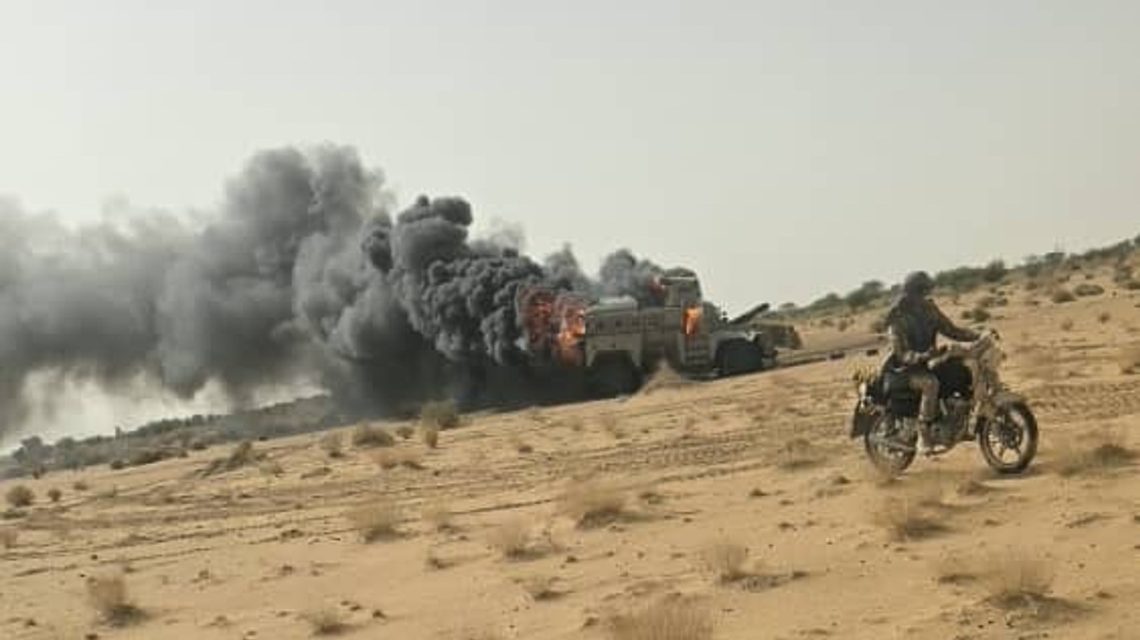
As the United States prepares to commemorate the 25th anniversary of 9/11, militant groups linked to Al-Qaeda and the Islamic State (ISIS) are increasing their influence in Africa’s Sahel region, a territory often overlooked by Washington. Over the past decade, more than 59,700 lives have been lost to violence perpetrated by these groups, as reported by the Africa Center for Strategic Studies, which used data from the Armed Conflict Location & Event Data (ACLED) monitor. According to the Institute for Economics & Peace, the region accounted for more than half of the world’s terrorism-related deaths last year.
The U.S. Africa Command (AFRICOM) now views Africa as the “epicenter of global terrorism,” with spokespersons explaining the intent of Al-Qaeda and ISIS affiliates in the Sahel and Lake Chad Basin to strike the U.S. and its interests. The growing threat emerges from these groups exploiting local grievances and achieving battlefield successes, thus consolidating and expanding their reach.
Al-Qaeda’s Resurgence
Jama’at Nusrat al-Islam wal-Muslimin (JNIM), affiliated with Al-Qaeda, is noted for its significant influence in the Sahel, particularly in Burkina Faso, Mali, and Niger. This group continues to destabilize the region and potentially beyond, employing tactics like siege and economic blockades. Historically, Africa has served as a base for Al-Qaeda since its inception by Osama bin Laden during the Afghan-Soviet conflict. Over the years, the group has expanded its networks, including a significant attack on U.S. embassies in Kenya and Tanzania in 1998.
According to Liam Karr of the American Enterprise Institute’s Critical Threats Project, JNIM poses a significant regional threat, leveraging support networks in coastal countries adjacent to the Sahel. Though its primary focus remains on local conflicts involving Sahelian militaries, JNIM coordinates with other non-state actors, such as the Tuareg separatists, against Malian troops and Russian military operators. Additionally, JNIM has allied with other factions like Ansarul Islam and Katiba Macina.
ISIS Expands Its Reach
ISIS, having emerged from Al-Qaeda in Iraq, has also focused on expanding in Africa following its diminished presence in the Middle East. The Islamic State Sahel Province (ISSP) now poses a growing, albeit nascent, threat to Europe and the U.S., according to Karr. ISSP’s regional base, particularly along the Niger-Nigeria border, poses a challenge even as JNIM contains some of its expansion.
There is evidence of ISIS’ African networks exporting violence to the West, with past attacks in Europe, such as the Berlin and Manchester incidents, having African ties. Beyond Sahel, ISIS maintains affiliates in Central Africa, Mozambique, and Somalia, with smaller cells in North Africa. The rivalry between Al-Qaeda-affiliated groups and ISIS in the Sahel often turns the region into a battleground, especially in Western Niger.
While ISIS’ current impact remains regional, its potential to resume external operations is concerning. AFRICOM sees the group’s West Africa affiliate as particularly threatening, especially if it gains coastal access, which would broaden its resource base and influence, increasing the risk to U.S. interests.
Factors Contributing to the Sahel’s Instability
The central Sahel states present conditions reminiscent of pre-9/11 Afghanistan and post-invasion Iraq. Governance failures, frequent coups, poverty, drug trade, and ethnic divides create a fertile environment for Al-Qaeda and ISIS. Regional security struggles include France’s military interventions and Russia’s growing involvement, both failing to neutralize these groups. The faction’s decentralization and adaptability have only entrenched them further.
The U.S. Role
There is U.S. interest in a stable Sahel, especially due to the region’s mineral resources. Discussions on ground indicate a preference for mixed approaches involving military, peace, and partnership opportunities. Recently, U.S.-Nigerian coordination led to the elimination of ISWAP leader Abu Bilal al-Minuki. AFRICOM focuses on partnerships as essential to countering terrorism.
Despite longstanding U.S. involvement, dating back before the “Global War on Terror,” armed groups linked to Al-Qaeda and ISIS maintain significant influence. Factors such as socio-economic vulnerabilities and ineffective local military responses have exacerbated the situation.
While a military response is critical, the U.S. must address underlying regional crises to prevent further escalation and insurgence. Without careful consideration, expanded U.S. involvement risks intensifying the conflict, warns William Assanvo of the Institute for Security Studies.
 British Police Arrest Man Suspected of Terror Plot
  Activists Push for Nationwide Ban on Child Marriage in the U.S.
  Investigation into Alleged Incident at Cornell University
  Rising Drone Threats Highlight Vulnerabilities in Moldova’s Airspace Defense
  Bolivia Faces Security Test Amid Unrest
  Incident on FlyDubai Flight Raises Security Concerns