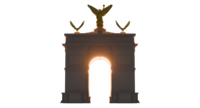
The heart of Washington, D.C., is marked by precise geometry and intentional sight lines. Arlington National Cemetery rises beyond the Potomac River from the Lincoln Memorial. A proposed 250-foot arch by President Donald Trump would introduce a new, towering element in this landscape. The Washington Post developed a digital 3D model to gauge its impact.
Throughout a year, this arch’s shadow would cover burial sites in Arlington Cemetery on 284 days. It would touch Kennedy’s eternal flame on 18 days and shade his memorial on 50. The Military Women’s Memorial would be shaded on 109 days. The shadow would move across graves from various wars, including Vietnam and both World Wars, affecting more than 75,000 graves. On most days, the shadow would recede by 8 a.m., the cemetery’s opening time, but it would linger past this time on 26 days.
White House spokesman Davis Ingle noted that the arch would enhance visitor experiences, calling it an iconic landmark. The Interior Department claimed limited impact from the arch’s shadow, mainly due to its lengthened appearance during early morning hours. However, their simulations are limited and do not fully detail the methodologies used.
Historians and architects express concerns that the arch could disrupt the deliberate design of Washington’s landmarks. Neil Flanagan, an architect and historian, emphasized the value placed on open spaces by city planners, including the McMillan Commission in 1902, to ensure Washington’s distinctive character.
Micki McElya, a University of Connecticut history professor, highlighted the uncomfortable symbolism of Trump’s arch shadowing the cemetery. She argued it’s less about the visibility of shadows and more about their presence.
The Post analysis found the shadow reaching far beyond the cemetery in the evenings, including the Arlington Memorial Bridge and monuments to the east. Across seasons, it would move between Kennedy’s grave in spring and summer and Lincoln’s memorial in the fall and winter.
The shadow would also cover parts of the Martin Luther King Jr. Memorial, affecting where he delivered his famous speech, along with memorials for Vietnam and Korean war veterans.
Critics argue the monument’s shadow on veterans’ graves is disrespectful. Retired Major General Paul Eaton, whose parents are buried at Arlington, opposes the project, describing it as overshadowing significant sites.
VoteVets, a veterans’ advocacy group, joined The Post in examining the shadow using AI. The group’s concerns were heightened by Trump’s comments linking the monument to honoring his presidency.
Nigel Flanagan and Columbia University’s Karla Rothstein voiced concern over the shadow’s experiential and political significance. Rothstein noted that while shadows aren’t inherently negative, their source matters.
Despite critique, Trump remains committed to the arch’s size and design. His administration is fighting a lawsuit by Vietnam veterans and preservationists who claim the arch harms their cemetery experience.
Trump aims to surpass the Arc de Triomphe’s height, inspiring the proposal. The National Capital Planning Commission is expected to approve the project soon, with groundbreaking following shortly.
The shadow’s impact might rise if year-round daylight saving is achieved, shifting clocks forward one hour in winter. Concerns include its impact on Kennedy’s memorial and eternal flame, which his widow Jacqueline Kennedy valued.
The administration plans to place an eternal flame on the arch, visible at times even as Trump’s monument shadows Kennedy’s grave and flame.
Methodology
The Post’s 3D model, based on Trump’s arch plans, used data from the U.S. Geological Survey and other sources for accuracy. The model, constructed using QGIS and Blender, simulated the sun’s position using NOAA data. Tests ensured alignment with real-world shadow positions. The model excluded tree shadows for clarity in identifying shadow locations, although a May 12 depiction of tree shadows was included, acknowledging their dappled and seasonal imperfections. Grave counts were determined using data from the Arlington National Cemetery Explorer.
About this story
Editing by Nadine Ajaka, Maureen Linke, and Eric Rich. Video editing by Peter Stevenson. Copy editing by Alli Hausman. Video by Luis Velarde for The Washington Post.
 Mayor Mamdani’s Policing Reform Plans
 Gen Z Voter Shifts and Their Impact on the 2026 Midterm Elections
 Disappearance of US Senate Candidate Raises Questions
 DOJ Rule Change Reduces Appeal Time for Immigrants Facing Deportation
 Hakeem Jeffries’ Bid for House Speaker Faces Progressive Hurdles
 Ohio Judge Dismisses Defamation Lawsuit by Rep. Max Miller