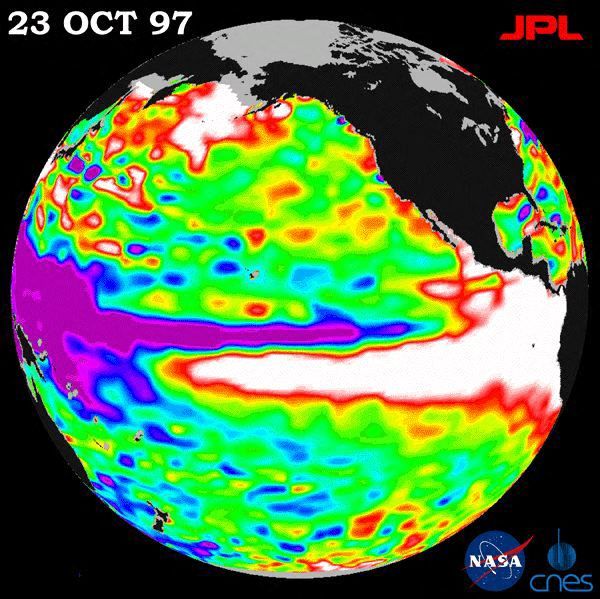
Current analyses indicate that this year’s El Niño could surpass all previous records. To find comparable instances, we should reflect on trends from 30 years ago. According to Columbia University climate scientist Azhar Ehsan, this year’s atmospheric developments resemble the 1997 scenario, known for being one of the most intense El Niño events. A report from the National Climatic Data Center in April 1998 highlighted that winter for its extraordinary records. It was the second warmest and seventh wettest winter in the U.S. since 1895.
The strong El Niño event brought widespread weather chaos across the country. While the Northeast faced ice storms, the Southeast and California endured heavy rainfall and flooding. In Florida, deadly tornadoes struck. NASA released an image in October 1997 showing sea surface height changes due to El Niño, illustrating warm water moving north along the North American coast.
During typical El Niño winters, the southern U.S. experiences increased rainfall, while northern states become warmer and drier. This was evident during the 1997-1998 winter, where many states, including California and North Dakota, experienced their rainiest winters. Florida, Maryland, Nevada, Rhode Island, and Virginia had the second wettest winters. Torrential rain hit specific regions in December, with Tampa experiencing over 15 inches, and in January, New Orleans saw more than 19 inches of rainfall.
An intense storm in early January led to widespread flooding, ice storms, and tornadoes across Eastern North America. This resulted in 56 fatalities in the U.S. and Canada, the destruction of many homes, and power outages affecting millions. The subsequent weeks inflicted further storm damage in California and the Southwest, marked by ongoing storm conditions resulting in mudslides and flooding. Some areas experienced prolonged cloudy days. Des Moines had an 11-day cloudy period in December, while Albuquerque saw little sun before Christmas. Regions accustomed to cold winters encountered unseasonably warm conditions.
The report noted that February set heat records in several Midwestern and Eastern states, including Minnesota, Wisconsin, Illinois, Michigan, Ohio, Pennsylvania, and Connecticut. Northern Montana recorded no sub-freezing temperatures in December 1997, a first. Lake Erie near Buffalo remained unfrozen by late February, with water temperatures at 36 degrees. An unexpected benefit was a 10% reduction in nationwide heating costs due to the warm winter, which might provide some savings amidst climbing energy prices in 2026.
Looking Ahead to 2026-2027
Forecasts for the 2026-2027 period suggest that the upcoming El Niño may exceed the intensity of the 1997-1998 event. It is anticipated to bring diverse weather impacts, including droughts in certain regions and floods in others. Up to 451,000 global weather-related fatalities might occur. A ‘super’ El Niño typically enhances the probability of warm and dry northern U.S. weather while producing colder, wetter conditions in the southern regions. The exact division depends on jet stream positioning.
The ongoing strengthening of this year’s El Niño since summer has raised the likelihood of a significant climate event by 75%, potentially surpassing all El Niño events since 1950. While peak strength usually manifests in winter, impacts have been observed as early as late summer and early fall, contributing to a subdued Atlantic hurricane season and heightened Pacific storm activity. Current forecasts for temperature and precipitation conform to traditional El Niño patterns.
 Drought Drives Black Bears Closer to Human Activity
  Atlantic Ends September Without a Hurricane for First Time Since 1994
  Bobcat Sightings and Conservation Efforts in Illinois
  U.S. Records Warmest September in History
  Swiss Glaciers Show Effects of Ice Loss Amid Global Warming
  Climate-Resistant Rock Glaciers: Hidden Water Resources