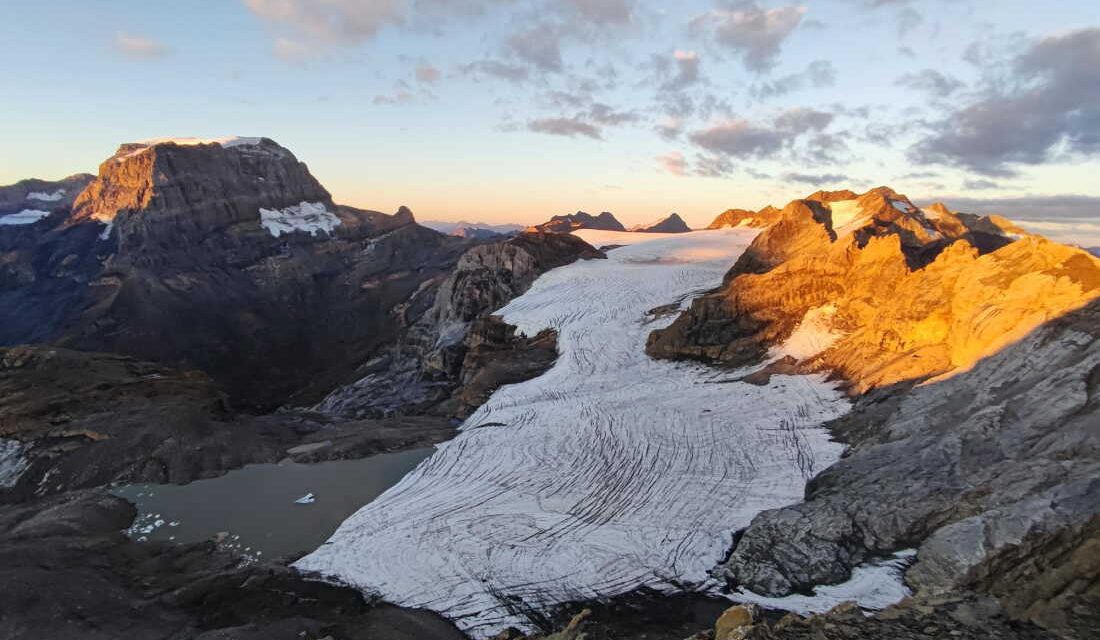
The glaciers in Switzerland have experienced over 5% ice loss in 2026, highlighting a persistent trend of rapid decline. This is part of a broader global pattern where glaciers are shrinking at accelerating rates, linked directly to global warming.
Extensive Ice Loss Observed
Matthias Huss, who leads Switzerland’s glacier monitoring network, GLAMOS, has been documenting this decline. Each summer, he assesses the ice fields in the high mountains. The peak loss of 6% occurred in 2022, and although 2026’s loss slightly reduced to 5.5%, it’s due to a marginal increase in winter snow covering the ice.
This year’s findings revealed exposed rocks where ice once stood, transforming the landscape drastically. Huss described the areas as lifeless, with merely fragments of ice blocks scattered over heated rocks. According to him, some alpine plants are now taking root in regions previously buried under thick glacier ice.
The Importance of Glaciers
Glaciers are crucial for Europe as they act as ‘water towers’, storing winter snow and releasing it slowly throughout spring and summer. This process feeds major rivers like the Rhine and the Danube, essential for Europe’s food supply and transport networks. Low river levels this summer halted freight transport and necessitated partial shutdowns of nuclear power plants, which use river water for cooling. Growing glacier melt could worsen these issues.
Europe’s rivers did receive water this summer, but it was primarily from glacier melt rather than seasonal snowmelt. Without glaciers, which are continuously disappearing, droughts might threaten European agriculture.
Risks Posed by Melting Glaciers
Beyond the water supply, glaciers and alpine permafrost contribute to regional stability. They help to hold mountains together, reducing landslide risks. Without them, landslides and flooding become more likely. In the previous year, the Swiss village of Blatten suffered a catastrophic landslide when a glacier collapse brought an estimated 9 million cubic meters of ice, rock, and mud down the mountain. Fortunately, the instability had been tracked, allowing for evacuation before the disaster struck.
Similar catastrophic events have occurred globally, such as a glacier collapse on Nepal’s border with Tibet, which resulted in floods killing at least 1,400 individuals.
The Link to Climate Change
Matthias Huss is cautious about directly attributing such disasters solely to climate change, as mountain regions have always been inherently risky. However, the warming of permafrost and ice disappearance likely serve as catalysts, exacerbating natural occurrences.
Huss emphasizes the urgency of acknowledging climate change, urging action to address it. He warns that if the current warming trend persists, the glacier monitoring unit predicts all glaciers could vanish by the end of this century.
 Climate-Resistant Rock Glaciers: Hidden Water Resources
  Senators Reach Bipartisan Agreement on Permitting Reform
  Experts Warn of Critical Period for the Colorado River
  Future Cities: Ambitious Projects Aiming for Innovation and Sustainability
  Supreme Court Case Suncor vs. Boulder: Implications for Accountability in Climate Change
  Hawaii Faces Impact of Record El Niño Through Recent Hurricanes