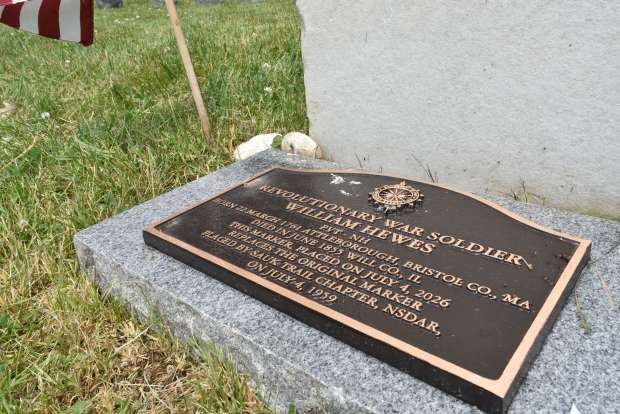
William Hewes, born in 1761, lived through transformative times for what would become the United States. His life spanned from the pre-Revolutionary period to an era when the nation faced internal strife over slavery. Hewes wore a soldier’s uniform as he fought against the British, contributed to the foundation of a new nation, and eventually moved westward with his family, settling in Crete, Illinois. Today, the memory of Hewes is honored in Will County.
A ceremony to rededicate Hewes’ grave plaque was held recently in Crete. Family members, local historians, and National Society Daughters of the American Revolution members attended the event. The first plaque, installed in 1959, had weathered over the decades. Melody Paris-Rush, a representative of the Daughters of the American Revolution, stated that the nation’s 250th anniversary and the plaque’s deteriorated state prompted the replacement. “It’s important to honor his service,” she said.
The newly installed metal marker notes Hewes’ participation in the Revolutionary War, his birth, and his death, but does not capture the full scope of his contributions. At the rededication, Tim DeMuth, a descendant of Hewes, spoke about his forebear’s life. As a private, Hewes joined the war at 18, witnessing key events such as the hanging of John Andre, a significant moment within the larger context of the war.
Despite his modest rank, Hewes played a role in the efforts that secured American independence. “Every soldier was crucial in winning the war,” DeMuth noted. After the war, Hewes traveled via the Erie Canal and through the Great Lakes, eventually settling in Crete. He migrated on difficult paths with one of his sons, a testament to his resilience and determination.
Five of Hewes’ twelve children moved to Illinois, where they established their lives in Crete. They became local politicians, ministers, farmers, and shopkeepers, ingraining their roots in the area. DeMuth expressed that the land became part of their identity, with family homes passed down through five generations.
Jesse Wright contributed reporting for the Daily Southtown.
 The Quest for the Knuckleball Dream
  Navigating Grief After a Sibling’s Overdose
  Tragedy and Immigration: The Impact on a Family
 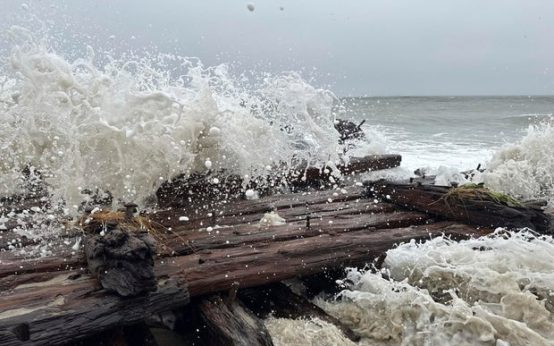 Possible 19th-Century Shipwreck Exposed by Nor’easter in Nantucket
  The Journey of a Fox News Correspondent: From Infectious Diseases to On-Air Reporting and Beyond
 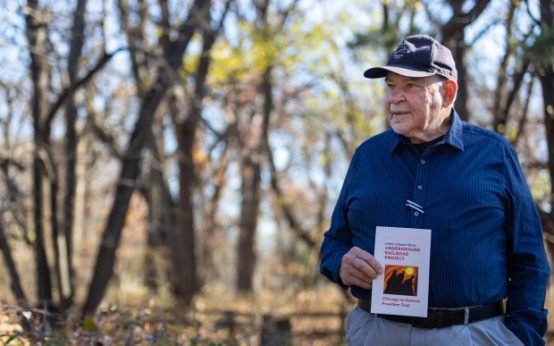 Midwest Underground Railroad Network Gains National Recognition