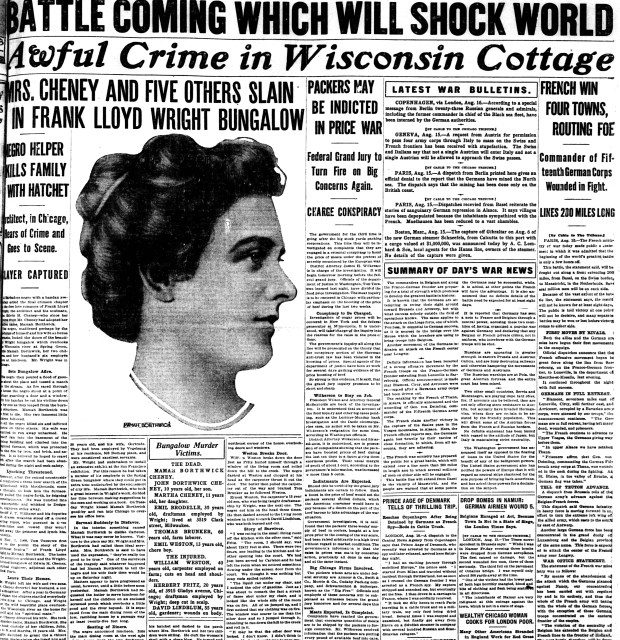
Tragic Events at Frank Lloyd Wright’s Taliesin
On August 15, 1914, a horrific event unfolded at Taliesin, the renowned estate of architect Frank Lloyd Wright located in Spring Green, Wisconsin. A servant committed a brutal attack. The perpetrator set the residence on fire and assaulted the fleeing residents with a hatchet. Tragically, seven individuals lost their lives in this incident. The victims included Martha “Mamah” Borthwick Cheney, her children Martha and John, and four others. Julian Carlton, the servant responsible, ingested acid and subsequently died.
Weather Extremes Recorded in Chicago
The National Weather Service documents that August 15 has seen extreme weather conditions in Chicago. The record high for this date is 98 degrees, noted in 1944. Meanwhile, the lowest recorded temperature is 48 degrees, observed in 2004. In 1993, precipitation reached 1.87 inches. No snowfall has been recorded on this date.
Historical Battle of Fort Dearborn
In 1812, a conflict arose on August 15 when approximately 500 Potawatomi and their allies surrounded 110 individuals who had vacated Fort Dearborn, aiming to reach Fort Wayne in the Indiana Territory. The soldiers formed a line and clashed with the Native Americans. The engagement resulted in the deaths of 68 individuals from Fort Dearborn. Potawatomi casualties are unrecorded but considered fewer. On the following day, the Potawatomi destroyed Fort Dearborn by fire.
This event, traditionally known as the Fort Dearborn Massacre, has been recently recast as the Battle of Fort Dearborn. This reclassification acknowledges acts of violence by both Native Americans and European settlers. An insight from Simon Pokagon, a Potawatomi author, suggests that when white settlers were killed it was often termed a massacre, whereas the killing of Native Americans was typically described as a fight.
Unveiling of Chicago’s Picasso
On August 15, 1967, an iconic moment for Chicago transpired. A sculpture by Pablo Picasso was unveiled. Although Picasso himself never visited Chicago, his contribution was celebrated at the Civic Center Plaza. Approximately 50,000 people attended the reveal, enjoying a Chicago Symphony Orchestra performance and poetry by Gwendolyn Brooks. The 50-foot steel artwork spurred diverse opinions. Reactions ranged from children labeling it confusing to others describing it as meaningless. The Tribune summarized the piece as a long-debated, semi-abstract head of a woman, possibly becoming an object of eventual admiration.
Elvira Arellano’s Stand in Chicago
In 2006, Elvira Arellano took refuge in Chicago’s Adalberto United Methodist Church, defying deportation orders. Along with her U.S.-born son, she sought sanctuary following her arrest at O’Hare International Airport. Authorities discovered she had used a false Social Security number, having previously deported her to Mexico. Arellano spent a year residing in the church, her story gaining national attention.
 Tennessee Execution Halted as Issues Persist with Lethal Injection Protocol
  Judge Dismisses Case Against Former Olympian Over Lincoln Memorial Incident
  Minnesota Family Files Civil Rights Lawsuit Over ICE Agent Shooting
  California Bans Child Marriage, Protecting Minors
  U.S. States Extend Gas Tax Waivers Amid Rising Fuel Costs Due to Iran Conflict
  Historical Events in Chicago on October 1st