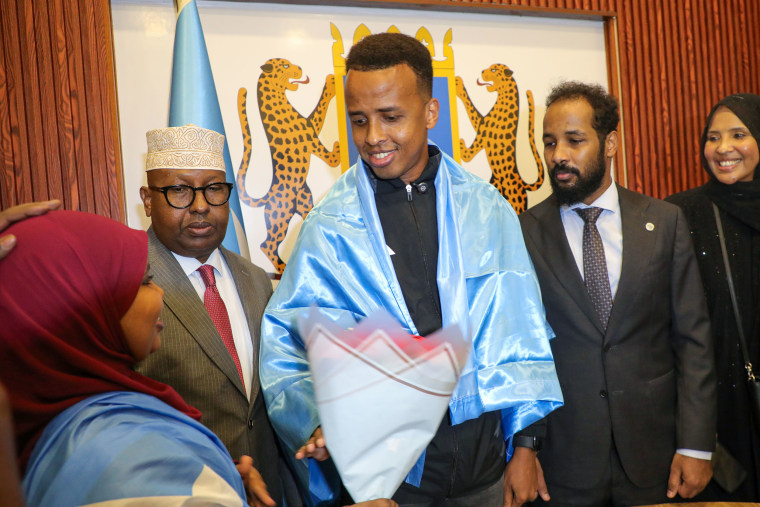
Although Somalia is not participating in the World Cup, scenes at Mogadishu’s airport painted a different picture. The excitement resembled that of a nation celebrating a trophy win. Crowds, including supporters, police, and journalists, gathered eagerly near a plane that had just arrived at the terminal. Omar Artan, a central figure in this story, emerged not as a victorious soccer player, but as a symbol of a clash between strict U.S. immigration policies and the global sports event.
Omar Artan, a 34-year-old referee, was set to make history by being the first Somali referee to officiate at a World Cup. Selected for the tournament held in the United States, Canada, and Mexico, his journey came to an abrupt halt. After arriving on Saturday in Miami, the base for referees’ training, he says he was detained and questioned for 11 hours before being sent back home. This incident is not isolated. Iranian state media reported that 15 Iranian officials and the official Iraqi team photographer also faced entry denials. An Iraqi player, Aymen Hussein, and other teams reported undergoing intensive searches at the border.
Years ago, the U.S. government assured FIFA that “eligible athletes, officials, and fans from all countries” could attend the tournament. However, travel bans and restrictions first imposed under President Donald Trump have raised significant concerns about accessibility. These policies affect citizens from 39 countries, casting uncertainty on preparations for the competition.
While previous World Cup tournaments had their flaws, refusing entry to an accredited referee stands out as unprecedented in contemporary times. Such actions have sparked criticism both domestically and internationally. Hillary Clinton, former Secretary of State, deemed the act as “terribly backward.” Meanwhile, retired Arsenal and England player Ian Wright expressed concerns about the event morphing into a “World Cup of chaos.”
Andrew Giuliani, heading the White House World Cup task force, defended the decision to deny Artan entry, citing a “very good reason,” without further elaboration. A U.S. Customs and Border Protection representative linked the denial to “vetting concerns.” An unnamed Trump administration official mentioned “association with suspected members of terror organizations” as a reason, though no evidence was provided.
In response, Artan reiterated he knew nothing about Somalia’s al-Shabab militant group. The Somali Sports Ministry and the Somali Football Federation publicly supported him while refraining from premature conclusions. Concurrently, the CBP noted that two members of the Iraqi contingent underwent additional inspections. While one, unnamed, was admitted to the U.S., another faced denial due to vetting issues.
Trump’s emphasis on ensuring the World Cup’s safety, as relayed by White House spokesperson Davis Ingle, contrasts sharply with accusations of “ridiculous scare tactics.” FIFA’s absence of a response further fuels discussions around mishandling.
Among the criticisms, Jules Boykoff, a politics professor at Pacific University, described the searches as abnormal and contrary to the tournament’s spirit. Players and fans share concerns about harsh border controls, compounded by escalating costs, effectively making this World Cup the priciest for fans.
Ronan Evain from Football Supporters Europe described a “moral obligation” to allow international entry, reflecting the tournament’s universality. With the majority of matches occurring in the U.S., the visa complexities underscore past fears tied to Trump’s revived travel ban policy.
While some players bypass restrictions, fan experiences remain less predictable. For supporters from Iran and Ivory Coast, ensuring entry has become improbable. Trump’s administration defends these moves as vital for national security, despite Amnesty International’s denunciation of the policy as discriminatory.
In previous World Cups, Qatar and Russia eased visa processes. In contrast, exorbitant fees and denied applications mark the U.S. event this year. The “FIFA Pass” was introduced to streamline entry, yet its efficacy remains disputed.
Sarah Pierce of Third Way warns of the negative precedent these policies set for future international events. She hopes a significant backlash might prompt nations to adopt a more inclusive approach.
 Challenges in Managing Advanced AI Models
  The Risky Foundations of AI’s Economic Impact
  Dan Fouts Reflects on Violent Football Incident
  Dodgers Begin NLDS Against Braves: Key Details and Roster Decisions
  The Threat of Melting Glaciers: A Call to Action
  High School Football Tensions Flare in Central Florida