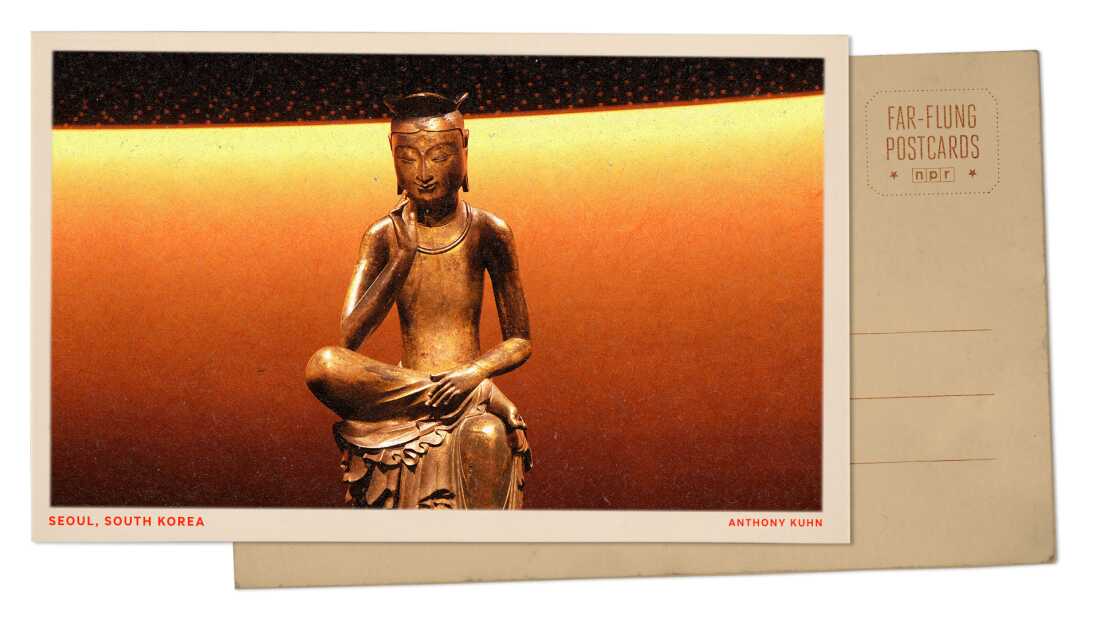
The National Museum of Korea, located a short distance from local bamboo groves and pagodas, features the Room of Quiet Contemplation. Here, visitors encounter two of Korea’s most cherished artworks. These are gilt-bronze bodhisattva statues, one from the early seventh century and the other from the sixth century.
Placed on a round platform in a dimly lit space, these statues are accompanied by ambient sounds, creating an atmosphere reminiscent of deep space or inward reflection. The statues’ elegance is evident in their graceful contours and the cascading folds of their garments. Their eyes are half-closed, their mouths displaying a faint smile. Two fingers rest against their right cheeks, while their right legs are folded, and their left legs extend toward the floor.
Experts on Buddhism and Buddhist art explain that the statues’ expressions symbolize contemplation of life’s fleeting nature. The gentle smiles signify a realization of truth, and the posture signifies readiness to take action in liberating all sentient beings.
Visitors have the opportunity to listen to Blackpink singer Jisoo’s interpretation through a scannable code. She explains, “This Buddhist statue captures the aspirations of people who sought salvation through quiet reflection and enlightenment during a turbulent era filled with change and anxiety. That is why, even to this day, it holds the power to naturally soothe and calm the minds of those who look upon it.”
The National Museum of Korea has leveraged the appeal of South Korean pop culture along with innovative digital and physical displays. As a result, it ranked as the world’s third-most visited museum last year, following only the Louvre in Paris and the Vatican Museums.
 Readers React to Miss Manners Column
  Troy Swanson: Award-Winning Librarian Transforming Academic Libraries
  Lisdoonvarna Matchmaking Festival: A Unique Tradition
  Midwest Underground Railroad Network Gains National Recognition
  Art Collective Critiques Administration with Mall Installation
  American Hagwon: A Tale of Family and the Korean Diaspora