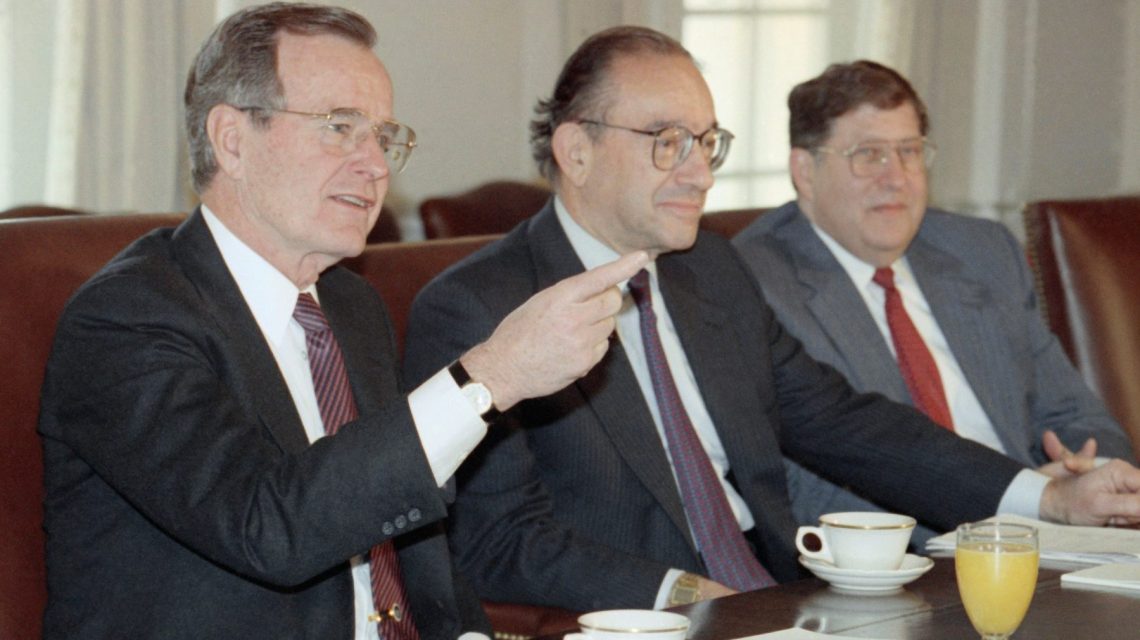
Alan Greenspan, Former Federal Reserve Chair, Dies at 100
Alan Greenspan, renowned for his tenure as the U.S. Federal Reserve Chair, passed away at the age of 100 due to complications from Parkinson’s disease. His wife, Andrea Mitchell, confirmed his death. Mitchell recalls Greenspan’s profound influence on her life, describing him as a man with ‘irrational exuberance’ for baseball, tennis, golf, and jazz music.
Impact on U.S. Economic Growth
Greenspan served as Fed Chair for 18½ years, overseeing a significant period of American economic expansion. Known as the “Oracle” and “Maestro,” his leadership included a notable stock surge and a decade-long economic boom starting in March 1991. Greenspan’s statements often influenced markets, with investors eager for his insights. His tenure was marked by the Fed’s achievement in maintaining price stability and public confidence.
Challenges and Criticisms
Greenspan’s departure from the Fed was followed by the 2008 financial crisis, raising questions about his policies. Critics argued that the crisis was partly due to his easy-money approach and inadequate regulatory oversight. Greenspan later admitted to overestimating banks’ ability to self-regulate. The crash led to widespread foreclosure and the Great Recession, affecting economies globally, including in Europe and China.
Greenspan’s Worldwide Influence
“I know you believe you understand what you think I said, but I am not sure you realize that what you heard is not what I meant.” – Alan Greenspan
Greenspan was revered globally, with many fearing his Fed departure. His influence extended beyond the U.S., affecting international economic policy, as demonstrated by his comment on “irrational exuberance” which affected stock prices worldwide.
Early Life and Career
Born in New York City’s Washington Heights, Greenspan was known for his mathematical prowess. He dropped out of Juilliard to pursue economics, earning a doctorate from New York University. Greenspan founded an economic consulting firm and gained political influence during Gerald Ford’s presidency, with Ayn Rand by his side.
Challenges as Fed Chair
Appointed by President Ronald Reagan in 1987, Greenspan faced immediate challenges such as “Black Monday.” The Dow Jones dropped significantly, but Greenspan’s crisis management stabilized the market. Later international crises further tested his leadership, with successes in mitigating global economic threats.
Economic Philosophy and Criticism
Greenspan believed in self-regulating markets, resisting government oversight of derivatives. However, following the 2008 crisis, he faced scrutiny regarding his deregulation policies. The Financial Crisis Inquiry Commission criticized his long-standing deregulation efforts, linking them to the financial collapse.
Continued Influence After Leadership
Greenspan remained active post-retirement, consulting and speaking on economic matters. He defended the Fed’s independence amidst political pressures, criticized actions against the Fed’s integrity, and reflected on economic trends in his writings.
Legacy and Reflections
Greenspan’s tenure was marked by challenges and successes, with many viewing his leadership as a cornerstone of economic policy. Though critics assign blame for the 2008 meltdown, Greenspan’s impact remains significant, illustrating challenges in predicting economic behaviors.
Contributions from AP Economics Writers Christopher Rugaber and Martin Crutsinger.
 Cargo Plane Crash at Miami International Airport
  Marine Veteran Suing Oregon School District Over Curriculum Reimbursement
  Tennessee Execution Halted as Issues Persist with Lethal Injection Protocol
  Judge Dismisses Case Against Former Olympian Over Lincoln Memorial Incident
  Minnesota Family Files Civil Rights Lawsuit Over ICE Agent Shooting
  California Bans Child Marriage, Protecting Minors