The plan to auction over 100 artifacts from the Titanic’s wreckage is facing resistance from the U.S. government. According to recently unsealed court documents, RMS Titanic Inc., which holds exclusive salvage rights to the wreck in the North Atlantic, intends to sell them for the first time, despite earlier agreements limiting their display to museums and exhibitions.
RMS Titanic’s Auction Plans
RMS Titanic Inc., headquartered in Georgia, proposed auctioning artifacts and showcasing them in a global tour across four cities, though the specific locations remain undisclosed. U.S. court documents outline the company’s desire to sell items like a bronze cherub, a gold nugget necklace, and a heart-shaped pendant.
The National Oceanic and Atmospheric Administration (NOAA), responsible for U.S. interests at the wreck site, argues this sale would breach RMS Titanic’s legal obligations, as highlighted in documents recently made public by a judge.
The government stated that RMS Titanic Inc. does not seek court approval nor believes it necessary, claiming unrestricted ability to sell the artifacts.
RMS Titanic Inc. representatives have yet to comment. Their attorneys previously asserted in federal court that the auction wouldn’t contravene existing court orders and agreements.
Previous Attempts to Sell Artifacts
Since 1987, salvaging efforts have retrieved thousands of items, including sections of Titanic’s hull. RMS Titanic Inc. profits by exhibiting these artifacts. Over time, the company has attempted artifact sales to finance future explorations amid financial difficulties, facing strong opposition from U.S. courts, preservation groups, and relatives of victims.
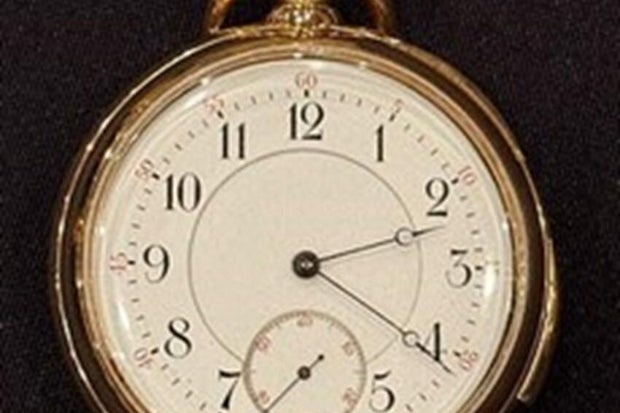
Conversely, artifacts rescued by survivors or salvaged by rescuers can be sold at auctions, often fetching high prices. For instance, a Titanic passenger’s life jacket sold for $906,000 in April, while a lifeboat seat cushion sold for $527,000. In 2025, a collector paid over $2 million for a Titanic-linked gold pocket watch, originally gifted to Isidor Straus by his wife, Ida Straus.
Other auctions have included items such as a menu from the first meal, launch tickets, and an Oscar Holverson-written waterlogged letter. In 2013, a violin played on the Titanic fetched $1.45 million.
International Dispute Over Artifacts
RMS Titanic aims to auction some of the first salvaged artifacts. These items were initially brought to France, which granted ownership to the salvager. The French oceanographic institute IFREMER, along with Woods Hole Oceanographic Institution, discovered the wreck.
Following expeditions, salvage claims were filed in Norfolk, Virginia’s U.S. District Court. NOAA insists all 5,000 items must remain a collective unit, based on U.S. court conditions, irrespective of French or U.S. claims. NOAA also highlights a French court’s stipulations requiring artifacts to remain unsold and unified.
RMS Titanic argues that the U.S. court lacks jurisdiction over the items claimed in France. There has been no response from French government representatives regarding the matter.
Preserving Pieces of History
Some ocean explorers oppose selling Titanic artifacts, believing they should be publicly displayed. Greg Stone, an ocean explorer and scientist, supports artifact recovery with proper archaeological techniques, ideally managed by nonprofits.
Richard Daynard, a law professor at Northeastern University specializing in public interest advocacy, emphasizes that rules for displaying and selling Titanic artifacts aim to preserve the wreckage for public benefit, avoiding acquisition by wealthy individuals.
If individuals can boast about purchasing original Titanic pieces for excessive prices, that detracts from preserving history.
 Readers React to Miss Manners Column
  Troy Swanson: Award-Winning Librarian Transforming Academic Libraries
  Lisdoonvarna Matchmaking Festival: A Unique Tradition
  Possible 19th-Century Shipwreck Exposed by Nor’easter in Nantucket
  Midwest Underground Railroad Network Gains National Recognition
  Art Collective Critiques Administration with Mall Installation