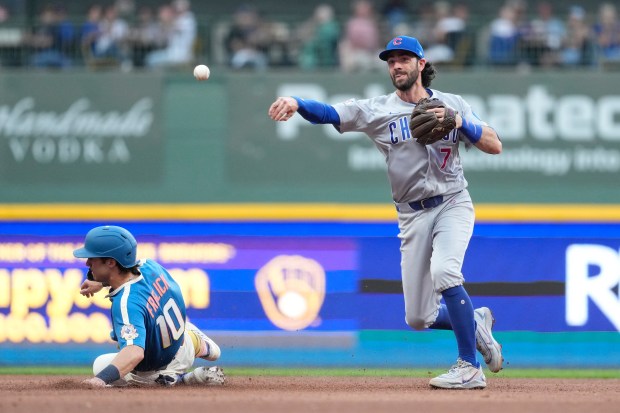
Milwaukee: David Peterson joined the Chicago Cubs through a rare June trade, offering a high ground-ball rate that was ideal for a team struggling with home runs allowed. His 51.1% ground-ball percentage ranks eighth in MLB, a much-needed asset for the Cubs. President of baseball operations Jed Hoyer emphasized the left-hander’s strengths, noting, “He throws strikes, keeps the ball on the ground, which is something we haven’t done particularly well.” The Cubs’ defense, adept at fielding ground balls, was expected to bolster Peterson’s performance.
In his Cubs debut against the Milwaukee Brewers, Peterson’s first pitch was disheartening as it landed over the center-field wall. Undeterred, Peterson focused on his strengths. “Obviously not how I wanted to start, but give me another ball and see how it goes,” he stated post-game. He settled in and allowed two runs over 5 2/3 innings, contributing to an 8-2 Cubs victory.
Manager Craig Counsell praised Peterson, saying, “They were aggressive, but he threw a ton of strikes and didn’t back down after a bad first result.” Peterson kept the Brewers to five hits without walking a batter and struck out two on 69 pitches. His efforts were recognized by both Counsell and cheering Cubs fans at American Family Field.
Peterson expressed his joy at the supportive environment, stating, “The guys have welcomed me in with open arms…fun to get out there, start and play with a good defense behind me.” He stuck to his approach and relied on the Cubs’ offense, which maintained pressure on the Brewers.
The Cubs defense proved instrumental, especially in the fifth inning following Brewer Sal Frelick’s RBI single. A crucial double play initiated by Nico Hoerner and swiftly executed by Dansby Swanson underscored their defensive proficiency. This support differed from Peterson’s experience with the New York Mets, where he had only three ground-ball double plays in 68 innings.
Peterson, reflecting on the Cubs’ defense, remarked, “You look around the infield…a lot of fun. It gives you a lot of confidence as a ground-ball guy.” The game plan was straightforward due to Peterson’s recent trade, yet catcher Carson Kelly’s astute game calling proved valuable.
Carson Kelly’s preparation with Peterson involved quick strategizing without practicing a bullpen session. Kelly prioritized understanding Peterson’s go-to pitch and his method to regain mechanical focus during outings. “Want him to have confidence in his pitch choices,” Counsell explained.
Throughout the game, the Cubs’ offense shined, especially with Seiya Suzuki’s two-run homer in the fourth and Ian Happ’s three-run homer in the sixth. Suzuki’s homer came against Brewers lefty Kyle Harrison and pushed the Brewers to the bullpen after five innings. The Cubs capitalized on a different pitching style, ensuring Peterson had the support needed.
Following a crucial win and snapping a losing streak to the Brewers, the Cubs planned a bullpen game for the series finale. Despite recent pitching injuries, the Cubs secured five wins in six games. “The offense has done a great job over the last week just putting up a ton of runs,” Ian Happ remarked, emphasizing confidence in the pitching staff amidst challenges.
 Nick Saban’s Comments on ESPN Spark Debate Over College Sports Regulations
  Freddy’s American Adventure: From Soccer to College Football
  Brock Purdy’s Impressive Start in the 2026 NFL Season
  The Value of Retaining Miles McBride for the Knicks
  Penguins Make History with Dominant Season Opener
  Sonny Gray Expresses Frustration After Game Against Yankees