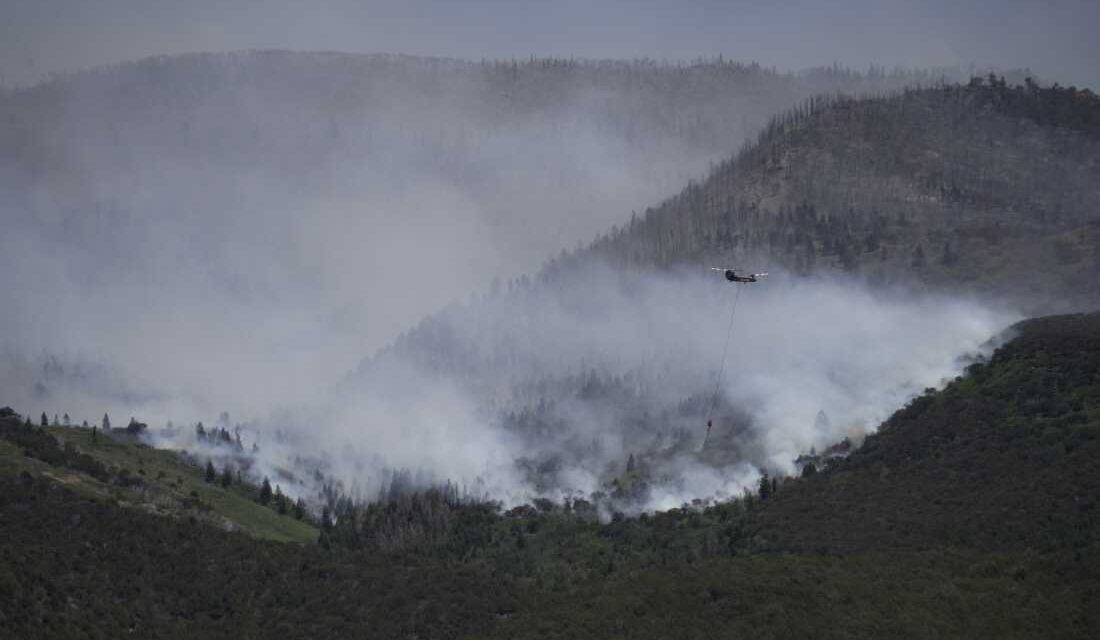
A helicopter deployed to tackle the Cottonwood Fire was seen dropping water over Beaver, Utah, on Saturday, June 27, 2026. The tragic incident occurred when three firefighters lost their lives while combating the growing wildfires on the Colorado-Utah border. Additionally, two other firefighters sustained injuries during this operation, as announced by the U.S. Wildland Fire Service.
The affected firefighters were part of a coordinated effort addressing the Knowles and Gore fires. In a public statement on Facebook, the U.S. Wildland Fire Service expressed support for the families of the deceased and praised the bravery and sacrifice of those involved. The Department of the Interior revealed that the group faced a ‘burnover incident’, an emergency situation where escaping becomes impossible, forcing officials to seek shelter from the fire overhead. The two surviving firefighters are currently receiving medical treatment for burn injuries.
Intensifying fires across Utah, Colorado, and Arizona have been fueled by a combination of low humidity, high temperatures, and strong winds, leading to unprecedented fire activity. As a result, the governors of Utah and Colorado have declared emergencies due to strained resources.
The Current Status of the Cottonwood Fire
The Cottonwood Fire, occupying more than 144 square miles in Beaver County, remains uncontained, marking it the largest wildfire in the U.S. It has already caused substantial damage to the Eagle Point ski resort and destroyed summer cabins. Damage assessments are ongoing, but no final figures have been reported.
Residents from Marysvale, Junction, and Circleville have been advised to evacuate as conditions worsen. Meanwhile, another threat comes from the Snyder Fire, which spans over 28,000 acres after merging with Jones and Knowles Fires originating in Colorado.
Alyssa Mason, a spokesperson for the Cottonwood Fire, provided insight regarding the challenges faced by firefighting crews due to minimal humidity levels and wind speeds reaching 45 miles per hour. Fuel moisture readings between 2 and 8 percent have temporarily grounded aerial firefighting efforts.
The terrain, characterized by steep cliffs and canyons, adds to the difficulty in positioning heavy equipment and engines, further complicating the response.
Utah’s Governor’s Response
Governor Spencer Cox of Utah commented through social media, depicting the current situation as more severe than any he had previously witnessed. He commended the rescue efforts made by the crews amid challenging conditions and urged prayers for both the firefighters and much-needed rain.
The National Weather Service in Salt Lake City has issued an unprecedented ‘particularly dangerous situation’ red flag warning due to the hazardous combination of wind, heat, and low humidity. These critical conditions are expected to persist, at least until Sunday.
Underlying Weather Conditions Contributing to Fires
Experts have identified the extreme fire behavior as a consequence of ongoing conditions. Utah recently recorded its lowest snowpack and warmest winter. Early snowpack peaks left soils and vegetation exposed and dried out through spring, exacerbated by regional drought affecting broader areas including Nevada and Colorado.
Utah’s State Forester Jamie Barnes highlighted the escalation of fires emerging closer to populated areas, challenging firefighting capabilities significantly. In anticipation of the Fourth of July holiday, Governor Cox imposed restrictions on fireworks displays with a state of emergency declaration. Colorado’s Governor Jared Polis likewise declared a state of emergency, enabling National Guard assistance.
According to the National Interagency Fire Center, around 3 million acres have burned nationwide since the start of the year, surpassing the rolling 10-year average. From Alaska to Florida, firefighters are striving to manage multiple fires, including some still large and uncontained.
The National Weather Service has extended red flag warnings throughout the western states, covering regions from California through Arizona to New Mexico, where additional fires are challenging firefighting resources.
Update and contributions by NPR’s Nate Rott.
 Atlantic Ends September Without a Hurricane for First Time Since 1994
  Bobcat Sightings and Conservation Efforts in Illinois
  2026 El Niño: A Historical Comparison and Future Projections
  U.S. Records Warmest September in History
  Swiss Glaciers Show Effects of Ice Loss Amid Global Warming
  Climate-Resistant Rock Glaciers: Hidden Water Resources