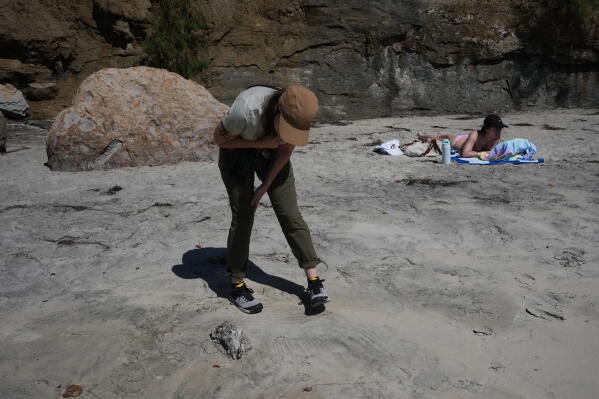
Marine ornithologist Tammy Russell and her team recently conducted a survey on a San Diego beach, discovering numerous seabird carcasses. Some birds were found tangled with kelp, while others were under rocks. This grim discovery highlights the impact of a prolonged marine heat wave affecting parts of California’s coast.
Monthly surveys, conducted by scientists and volunteers, gather data on beached sea life to identify environmental threats. The current heat wave significantly reduced cold, nutrient-rich surface water near the shore, crucial for krill, anchovies, and sardines. Seabirds like California brown pelicans, loons, and grebes struggle to find food, leading to starvation.
Tammy Russell, a postdoctoral scholar at the University of California, San Diego, noted how some cormorants have walked to shore, perishing within minutes. “It’s heartbreaking,” she shared. This alarming trend is visible across the coast. The recent El Nino development could exacerbate the situation. This natural warming in the central Pacific can alter global weather, affecting marine ecosystems.
“We don’t know how bad this is going to get,” said Russell, addressing concerns about the worsening die-offs.
The U.S. National Oceanic and Atmospheric Administration reported the El Nino in June, predicting it could reach unprecedented levels. Seabird die-offs aren’t new, but their frequency is rising due to global warming. Already, the West Coast has experienced a significant marine heat wave for over a year, the third time such warmth endured for such a long period.
On California beaches, high temperatures have broken records. Robotic gliders off Southern California recorded warm anomalies comparable to those during the 2023 El Nino. With the ongoing marine heat wave and the potential effects of this year’s El Nino, disruptions in marine food webs could occur, impacting species from gray whales to seabirds.
Seabirds are now searching for food in unusual areas. J.D. Bergeron, CEO of International Bird Rescue, noted how brown pelicans have been spotted at inland lakes. Lacking food, these birds seek sustenance near fishing boats or piers, often resulting in injury from fishing lines and hooks.
This spring, many emaciated seabirds were treated at rehabilitation facilities. While avian flu tests were predominantly negative, several birds succumbed to infections related to malnourishment. Senior scientist Krysta Rogers mentioned conditions other than ocean warmth affecting seabird mortality rates. In particular, Brandt’s cormorants and common murres faced high death rates after a strong 2025 breeding season.
Sampling efforts reveal that only a small proportion of seabirds dying at sea reach the shore. A similar event occurred in 2013 with “the blob,” a warm water mass off Alaska that affected ecosystems as far south as Baja California. During a strong 2015 El Nino, significant common murre casualties occurred.
Common murres, resembling thin penguins, need a diet equivalent to 10% to 30% of their body weight daily to maintain energy. Without adequate food, they may starve. Despite extensive die-offs, not all birds wash ashore. Studies confirmed that over half of Alaska’s common murres, around 4 million birds, perished during this warm spell, affecting the species’ recovery.
Climate and environmental topics addressed by the Associated Press receive backing from various private foundations. AP maintains all editorial control, focusing on their standards and transparency with philanthropic support.
 Supreme Court’s New Term Tackles Climate Liability and Key Legal Battles
  Tick Crisis on Martha’s Vineyard: A Growing Health Threat
  Colorado’s Emissions Regulation and Its Broader Implications
  The Threat of Melting Glaciers: A Call to Action
  Collapse of Hawai’i’s Hōlei Sea Arch Amidst Storms
  Los Angeles Faces Uncommon Heatwave in October