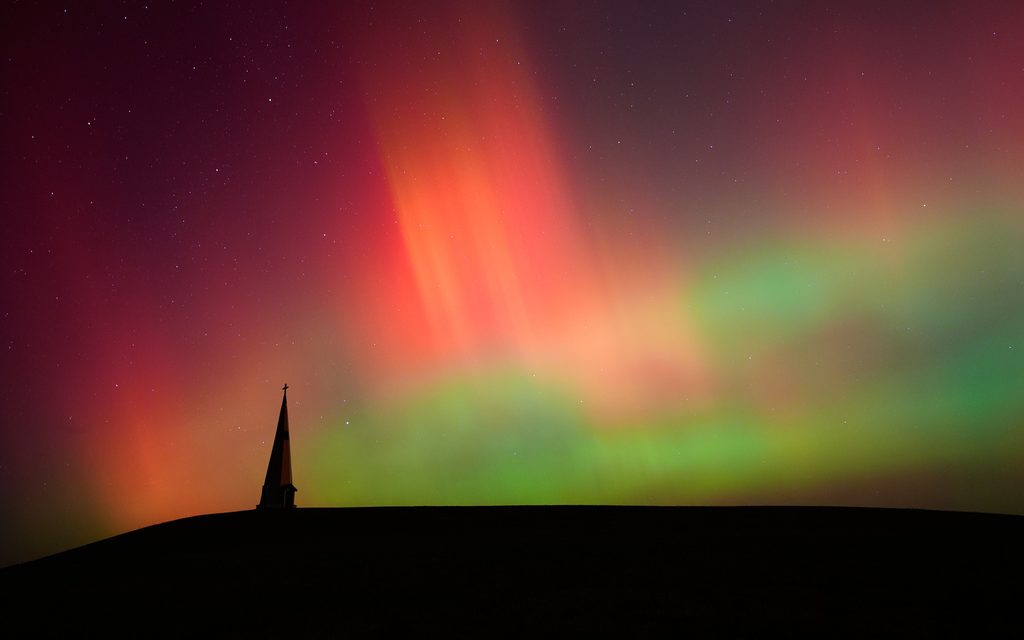
Many are anticipating fireworks or drone displays over the July 4 holiday, but nature might offer a spectacular alternative. Forecasters predict that some will have the chance to witness the northern lights on Friday.
The Space Weather Prediction Center (SWPC) of NOAA has been monitoring two significant sunspot groups throughout the week. One of these spots resulted in a solar flare reaching X1 strength, according to Shawn Dahl, a service coordinator at the SWPC. He mentioned, “X” represents the highest classification for solar flares, although “1” signifies the weakest in that category. The event was “rather impulsive,” meaning it was brief but released a substantial amount of energy.
Initially, it was unclear if the coronal mass ejection (CME) associated with this activity was heading towards Earth. However, by Wednesday, the SWPC confirmed that the CME might affect our planet and lead to “increased geomagnetic activity.” If conditions align, especially concerning the “orientation of the embedded magnetic field,” there is a possibility for moderate geomagnetic storming conditions. This scenario raises the chance for some to see the northern lights on the eve of Independence Day.
Potential Viewing Areas on July 3
If the SWPC’s forecasts hold, individuals in the northern U.S. might glimpse the aurora. Moderate, or G2, geomagnetic storms can bring the northern lights as far south as New York and Idaho. Residents in parts of Washington, Oregon, Idaho, Montana, North Dakota, South Dakota, Minnesota, Wisconsin, Michigan, Vermont, New Hampshire, New York, and Maine could witness the aurora with such a storm. Alaska generally has a consistent, albeit slim, chance of viewing the northern lights.
Forecasts from the University of Alaska Fairbanks also suggest that those in Wyoming, Nebraska, Iowa, Illinois, Indiana, Ohio, Pennsylvania, and Massachusetts might see the northern lights on their northern horizon.
The northern lights illuminate the sky beside the Saint Joseph the Woodworker Shrine on Nov. 11, 2025, near Valley Falls, Kansas. (AP Photo/Charlie Riedel, File)
Timing is crucial for visibility. If the strongest geomagnetic activity occurs before sunset, the aurora will not be visible. The SWPC predicts that conditions might intensify around 2 a.m. EDT and continue through the day. By sunset, activity may still be robust enough to manifest the northern lights for some time. There remains a chance, however, that necessary conditions might not fully develop.
For the latest forecasts, check the SWPC’s website. If the northern lights appear, increase your chances of seeing them by facing the northern horizon. If visibility proves difficult, use your phone. Modern digital cameras have lenses more sensitive to light than the human eye, making them better at capturing those green, pink, and red hues.
 Atlantic Ends September Without a Hurricane for First Time Since 1994
  Bobcat Sightings and Conservation Efforts in Illinois
 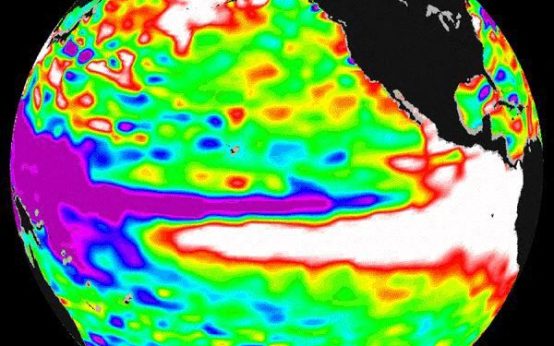 2026 El Niño: A Historical Comparison and Future Projections
  U.S. Records Warmest September in History
 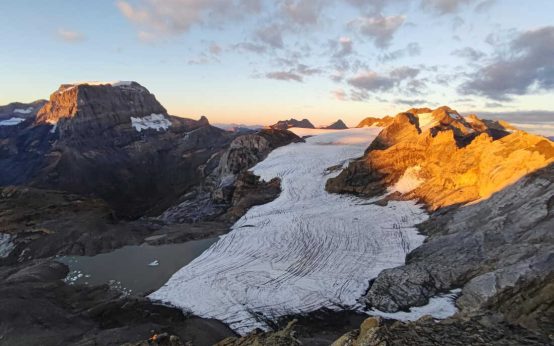 Swiss Glaciers Show Effects of Ice Loss Amid Global Warming
  Climate-Resistant Rock Glaciers: Hidden Water Resources