
The heat index measures how hot the air feels by factoring in both temperature and humidity. It is often noted that the heat index can represent a higher number than the actual temperature, sometimes significantly so. For instance, in Central Park, the temperature might read 98 degrees, but the heat index could be 105 degrees. This occurs because increased moisture in the air reduces the evaporation of perspiration from the skin, making it feel hotter.
The heat index is essentially an advanced form of the common saying, “it’s not just the heat, it’s the humidity.” The equation to calculate the heat index includes temperature (T) and relative humidity (H) and is expressed as:
(T × 2.049) + (H × 10.143) – (T × H × 0.225) – (T² × 0.007) – (H² × 0.055) + (T² × H × 0.001) + (H² × T × 0.001) – (T² × H² × 0.000002) – 42.379
This formula was developed by Lans Rothfusz, a retired National Weather Service meteorologist. He formulated this equation in 1990 while he was an intern at the Weather Service’s Southern Region Headquarters in Fort Worth.
Understanding the heat index is important during hot and humid weather, as it provides a more accurate sense of how the air will feel and helps individuals take necessary precautions.
 Senator Cramer’s Hold on Trump Nominees Due to Wetland Policy
  Champagne Producers Rush to Harvest Amid Record Early Start
  Heatwave Myths: Parmigiano Reggiano Cheese and Its Banking System Remain Unaffected
  San Jose’s Traffic: A Hidden Public Health Concern
 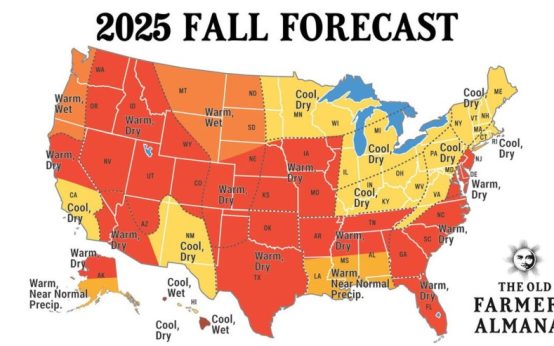 Analyzing Almanac Weather Predictions and Their Reliability
  Melting Glacier in Swiss Alps Uncovers Belgian Mountaineers’ Remains