Sunsets are arriving earlier, and mornings are turning crisper. The calendar indicates that the autumnal equinox is approaching. This also means the almanacs have shared their forecasts. Both the Old Farmer’s Almanac and the Farmers’ Almanac offer predictions, along with gardening tips and skywatching advice.
Current and Upcoming Predictions
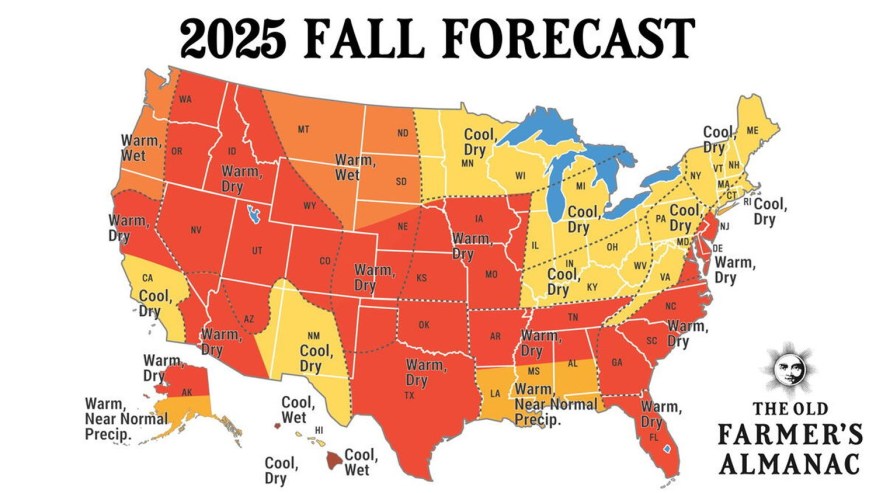
Last month, the Old Farmer’s Almanac released its fall forecast. It predicts a “warmer than average” fall with a “cool, wet” outlook in the Pacific Northwest and northern New England. The Plains, Rocky Mountains, and some central Gulf states might experience a warm, dry fall. Meanwhile, the Midwest, Ohio Valley, and East Coast are likely to see a cool and dry fall. These predictions are similar to last year’s.
The Farmers’ Almanac has also revealed its upcoming winter predictions. It forecasts “snow, sleet and surprises” across the U.S. The upper Plains and Midwest are expected to be “snowy,” while the Gulf and southern East Coast are “wet.” The South may get “wetter,” and New England might face “coastal storms.” These forecasts show slight differences from last year.
Accuracy and Skepticism
Meteorologist Rich Segal comments on the divided belief in these forecasts. While both publications claim high accuracy rates, research shows that only about half of the Farmers’ Almanac’s forecasts are correct. The Old Farmer’s Almanac, created in 1792, considers solar science, climatology, and meteorology. In contrast, the Farmers’ Almanac, dating back to 1818, focuses on the moon’s influence and historical weather patterns.
The extensive planning required for these predictions leads some to question their reliability. Segal suggests exercising caution with long-range forecasts, as even short-term predictions can be inaccurate.
NOAA’s Contributions and Observations
The National Weather Service will release its winter forecast in mid-October, which will still be subject to change. Operational Prediction Branch Chief Jon Gottschalck emphasizes that specific event predictions, such as major winter storms, are not feasible. Currently, NOAA’s temperature and precipitation outlooks are based on probability. For instance, the Pacific Northwest might have a warmer fall, while the southern Midwest and Ohio Valley could go either warmer or cooler.
NOAA, alongside the Farmer’s Almanac and the Old Farmer’s Almanac, considers factors like El Niño. Forecasters note a high probability of a strong El Niño developing, potentially affecting weather patterns by keeping hurricane activity low in the Atlantic. Typically, El Niño results in a warmer, drier northern U.S. and a wetter southern region. However, these impacts can vary annually.
Conclusion
The validity of almanac predictions remains subjective. As Segal notes, people who value these forecasts often appreciate their insights. NOAA will provide additional predictions for the winter months by mid-October. According to Sandi Duncan, editor of the Farmers’ Almanac, their method is continuously refined, but unforeseen weather variations can still occur.
 Supreme Court’s New Term Tackles Climate Liability and Key Legal Battles
  Tick Crisis on Martha’s Vineyard: A Growing Health Threat
  Colorado’s Emissions Regulation and Its Broader Implications
  The Threat of Melting Glaciers: A Call to Action
  Collapse of Hawai’i’s Hōlei Sea Arch Amidst Storms
  Los Angeles Faces Uncommon Heatwave in October