Historic Footage of Manhattan’s Earliest Skyscraper
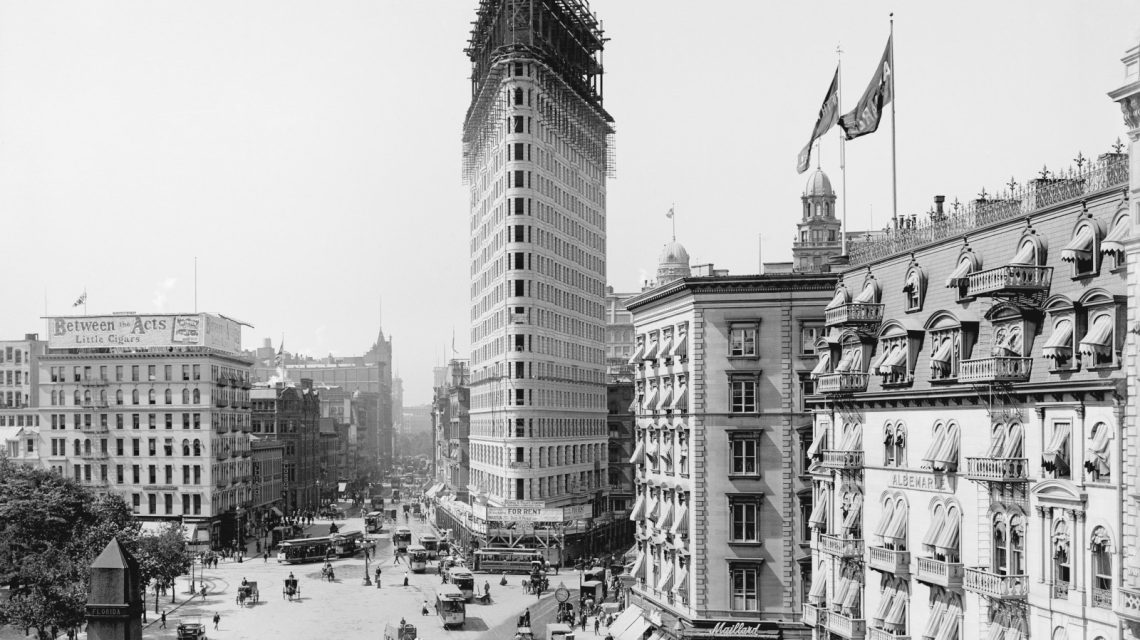
More than a century before Manhattan was dotted with towering skyscrapers, one of New York City’s earliest lofty buildings stood as a landmark. A black-and-white film captured on October 8, 1902, and made public by the Library of Congress, showcases a panoramic view of the recently completed Flatiron Building. The footage begins at street level, capturing the hustle of Manhattan streets. Gradually, the camera tilts upwards to reveal the 24-storey structure.
The Library of Congress describes the footage as showcasing “a view looking south from Madison Square, across the intersection of Broadway, Fifth Avenue, and Twenty-third Street, to New York’s famous skyscraper, the Fuller (or ‘Flatiron’) Building, with a panorama of the surroundings.” Remarkably, the filmmaker elevated the camera from the street level to the rooftop.
The Flatiron Building: A Pioneering Skyscraper
Completed in 1902, the Flatiron Building stands at 307 feet and was among the world’s earliest skyscrapers. Known for its distinctive triangular shape and its revolutionary steel-frame construction, the building quickly became an iconic structure in New York.
Recent Developments and Future Plans
Recently, the Flatiron Building began undergoing significant changes. A major milestone was reached last month when the landmark was illuminated for the first time in its 124-year history. This lighting marks a stage in its conversion into private residences. This movement is part of a broader initiative to revitalize and rethink historic edifices throughout New York City and the United States.
The American Institute of Architects notes that nearly half of America’s 125 million buildings are at least 50 years old. In addition, RentCafe reported that approximately 25,000 apartments were created through building conversions nationwide in 2024, reflecting a 50% rise from the previous year.
The Flatiron Building’s Influence on Urban Architecture
The Flatiron Building signified a shift in New York City’s architectural landscape during the early 20th century. According to historian Kevin Draper, founder of NY Historical Tours, the towering structure symbolized dramatic urban transformation. He noted how residents questioned the necessity of such tall buildings, expressing fears about their shadowing impact on places like Madison Square Park.
Draper explained how concerns over building heights are not new; similar debates occur today regarding the height of structures along Billionaire’s Row and their shadows over Central Park. Legislation discussions aimed at limiting skyscraper heights also echo past conversations from a century ago.
Upon its opening, the Flatiron Building dominated the skyline, easily surpassing surrounding buildings in height. Draper highlighted that the footage shows how overwhelmingly taller the Flatiron was compared to adjacent structures, a poignant contrast to its appearance today amid much taller towers.
Capturing Manhattan’s Daily Life in 1902
Besides architecture, the film offers a glimpse into Manhattan’s daily life at the start of the 20th century. Draper pointed out the bustling streets shown in the footage, emphasizing how people were always in a rush, a trait preserved in contemporary city life.
The transportation captured reveals a transitional city. Draper noted that only one early automobile, or horseless carriage, is visible, while several streetcars and horse-drawn carriages frequent the scene. These older transportation modes have largely vanished, with streetcars entirely absent and horse-drawn carriages now mostly serving as tourist attractions.
Architectural Advancements Leading To the Skyscraper Era
The Flatiron Building emerged during a critical time in New York City’s architectural history. Innovations in steel-frame construction and elevator technology were making unprecedented building heights achievable. Prior to the Flatiron, notable skyscrapers like the New York World Building and the Park Row Building had reshaped the skyline. However, the Flatiron Building stood apart due to its unique shape and strategic location at the intersection of Broadway and Fifth Avenue.
Now, more than 120 years later, the footage offers a nostalgic view of the landmark and signifies its role in the advent of urban architecture in New York City, marking the beginning of the Skyscraper Age.
For any architecture or design-related stories, reach out to [email protected]. Your story might be featured by Newsweek.
Contact for editors: Sirena Bergman and Gray R. Thomas
 Midwest Underground Railroad Network Gains National Recognition
  Art Collective Critiques Administration with Mall Installation
  American Hagwon: A Tale of Family and the Korean Diaspora
  Volunteer Enthusiasm Shines at Frank Lloyd Wright Home and Studio
  Bible’s Role in Times of War
  Arrival of Giant Pandas in Atlanta Marks Historic Agreement