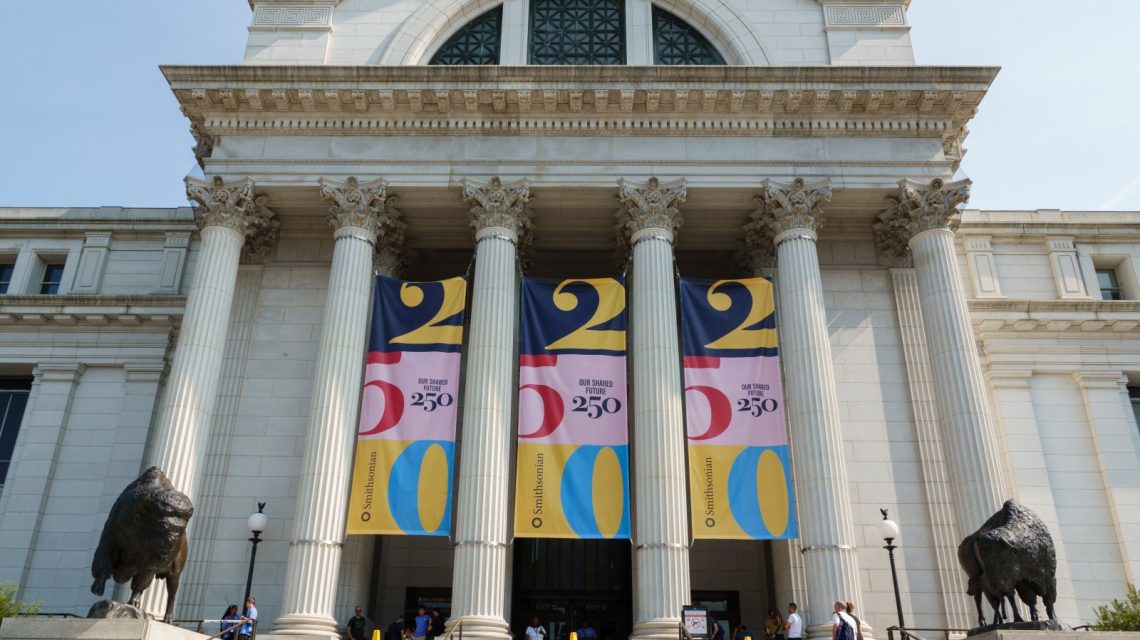
The Smithsonian Institution stands as the world’s largest museum, education, and research complex, offering free access to visitors from across the globe. For many years, it has been considered a prime attraction in Washington, D.C. and holds a special place in American hearts. Despite the relative youth of our nation, the Smithsonian captures the essence of America’s unique history.
Many Americans fondly remember their first visit to the Smithsonian, including the National Museum of American History (NMAH). For some, it sparked a lifelong interest and appreciation for the nation’s stories and artifacts. As generations grow, families often make the journey to D.C. to inspire the next generation with the lessons of American history.
Approaching America’s 250th anniversary, there is anticipation about how the museum might celebrate. There is curiosity about the exhibits and artifacts that could illustrate America’s founding and development. Yet, recent observations indicate a shift in the museum’s narrative to one that portrays a reimagined oppressor/oppressed story, with some critics feeling it presents an ‘unsettling’ view of American history.
Current leadership seems to focus more on condemnation of American history rather than celebration.
Recently, a report from the White House Domestic Policy Council and a House Oversight hearing showcased this drift. This sentiment was echoed by Director Anthea Hartig, who suggested that the museum should move beyond an ‘America First’ ideology and consider a broader view of the Americas. She proposed that U.S. history should not exclude other parts of the Americas, creating concerns about erasing clear national borders.
This approach appears institutionalized within the museum’s Center for Restorative History. Hartig indicated that this center aims to address historical harms. According to its website, the center utilizes restorative justice principles to amend exclusions from the national narrative. Furthermore, the institution has engaged with materials addressing concepts like ‘white supremacy culture’ and has revisited traditional aspects of societal foundations in a critical light.
These shifting priorities are visible in exhibits like ‘Girlhood (it’s complicated).’ The exhibit, designed to celebrate American women, instead highlights themes such as gun control and illegal immigration, alongside featuring a biological male in a space intended for women and girls.
The museum’s collections contain significant artifacts related to women’s history. Exhibits such as ‘First Ladies’ are highly popular, yet the focus on contemporary political themes detracts from honoring historical achievements.
The changes reflect a bureaucratic mandate requiring all exhibits to address issues like race and identity, gender, and environmental change, among others. Critics argue this checklist appears more like a political agenda rather than a guide for historical education.
The NMAH’s role should be to inspire visitors, particularly the younger generation, to contribute positively to the nation. Historical education involves understanding complex triumphs and struggles without fostering resentment towards heritage.
Funded by American taxpayers, the Smithsonian should focus on preserving history without pushing political narratives. These museums should be dedicated to recording America’s rich history, offering educational experiences free from ideological bias.
Representative Michael Cloud serves Texas’s 27th Congressional District. The views expressed in this article are the writer’s own.
 Readers React to Miss Manners Column
  Troy Swanson: Award-Winning Librarian Transforming Academic Libraries
  Lisdoonvarna Matchmaking Festival: A Unique Tradition
  Possible 19th-Century Shipwreck Exposed by Nor’easter in Nantucket
  Midwest Underground Railroad Network Gains National Recognition
  Art Collective Critiques Administration with Mall Installation