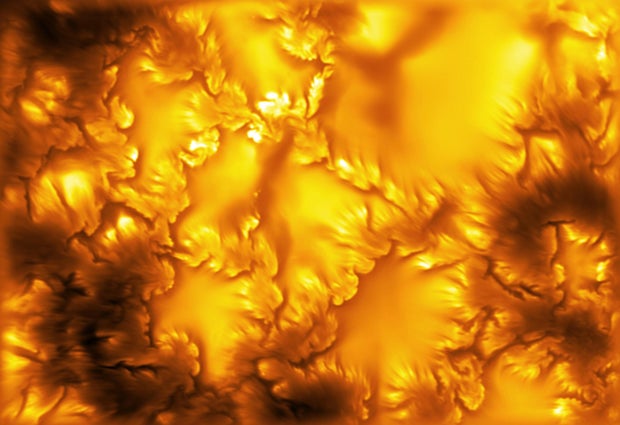
Scientists have achieved a breakthrough in capturing images of the sun’s surface, showing a dynamic and strange facade. Direct observation of the sun is harmful without eye protection, but researchers managed to study its surface using the National Science Foundation’s Daniel K. Inouye Solar Telescope. Situated in Maui, Hawaii, this telescope provided images of the sun’s outer shell at an unprecedented resolution.
The initial purpose of capturing these images was to test and refine the telescope’s capabilities. However, upon analyzing the results, researchers discovered unusual feathery patterns across the sun’s surface. According to the NSF’s National Solar Observatory, the images reveal a previously unseen solar landscape, featuring small-scale, dynamic swirls at the edges of magnetic regions.
An undated image provided by the NSF National Solar Observatory highlights these details, reminiscent of famous paintings such as Van Gogh’s Starry Night, noted Stanford University solar physicist Ruizhu Chen. Though not involved in the research, Chen found the imagery striking.
The ripples observed in the sun’s surface were caused by magnetized plasma moving at different speeds, creating a phenomenon similar to waves stirred by wind over water. Known as the Kelvin-Helmholtz instability (KHI), this guides fluid movement and has been seen on Earth and other planets like Jupiter and Saturn. Friedrich Wöger with the National Solar Observatory noted that such detail had never been observed on the solar surface before.
The study co-author, Dr. David Boboltz, expressed that the findings, backed by numerical simulation analysis, represent a significant advancement in understanding solar and stellar plasma dynamics and evolution. These observations are expected to serve as a foundation for future discoveries. The results were published in the journal Nature.
Understanding the sun’s inner workings is crucial as scientists aim to better track coronal mass ejections, which are massive energy bursts potentially directed at Earth. Such ejections can lead to solar storms, disrupting GPS communications and causing dazzling auroras.
NSF program director Dr. Jacqueline Keane highlighted the importance of observing the sun’s small-scale processes to comprehend space weather affecting Earth. She emphasized the challenge of observing these tiny vortices for decades. Combining a four-meter mirror with modern optics and instruments, the NSF Inouye Solar Telescope provides the needed resolution to uncover these ultrafine details, enabling discoveries previously out of reach.
 Climate-Resistant Rock Glaciers: Hidden Water Resources
  California Voters to Decide on $7.5 Billion State Research Fund
  Ancient Pottery Unearthed During Roadworks in Tbilisi
  U.S. Space Academy Announcement
  The Need for New Strategies in Oregon’s Wildfire Management
  Plastic Pollution in the Great Lakes: A Growing Concern