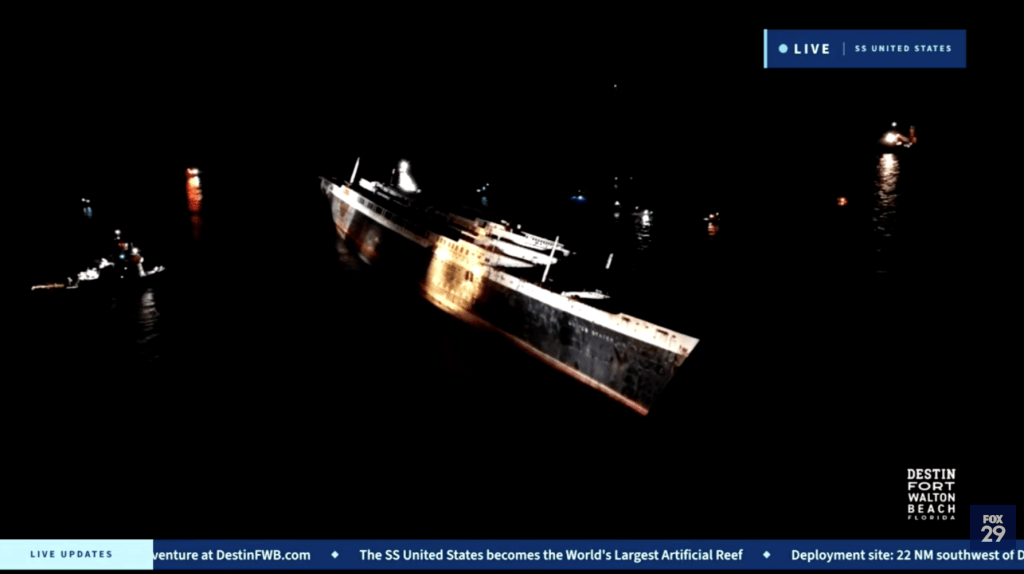
The iconic SS United States, once the fastest ocean liner, completed its final journey beneath the sea. This famed ship, longer than the Titanic and having crossed the Atlantic over 800 times, was deliberately submerged in the Gulf of Mexico. This transformation into an artificial reef marked a new chapter for the historic vessel.
The process of sinking the SS United States began on a cloudy afternoon off the Florida Panhandle coast. By the evening, much of the ship was still visible above the water. Organizers had expected the sinking to last about an hour. However, it was not until around 9 p.m. that the ship finally tilted and sank. Coleen O’Malley, president of Coleen Marine, reflected on the ship’s legacy, noting its resilience as a hallmark of the nation it was named after.
“She is an amazing lady who will not lay down without a fight.” – Coleen O’Malley
This controlled descent was part of a long-planned $13.5 million project. It aimed to attract divers and fishing enthusiasts while creating a habitat for marine life such as tuna and marlin. According to Nick Tomecek from Okaloosa County, the longer sinking process was due to the careful filling of 128 fuel and lubricant tanks with water to ensure the ship settled evenly on the sea floor.
A Historic Vessel with a Storied Past
The SS United States, launched in 1952, was once a marvel of technology. It hosted famous figures including Grace Kelly, Elizabeth Taylor, and Presidents Truman, Eisenhower, and Kennedy. In preparation for its final voyage, the 65-foot smokestacks were removed for a new museum celebrating the ship’s history.
The sinking adhered to strict environmental and safety regulations prohibiting explosives. Weather concerns led to the sinking being moved up by a day. The SS United States was designed with features to manage seawater for its boilers. These systems were removed, allowing water to flood the hull through specially cut openings.
The ship was submerged in roughly 180 feet of water, with the top deck about 60 feet below the surface. Such a depth makes it accessible for novice divers.
The Ship’s Legacy Continues Underwater
The SS United States joins over 500 artificial reefs near its final resting place. Previously, the largest artificial reef resulted from the scuttling of the aircraft carrier USS Oriskany in 2006. Nick Tomecek mentioned that an experienced diver could visit both sites in a day, emphasizing their appeal as diving destinations.
The SS United States was decommissioned in 1969. Previous attempts to repurpose the ship by hoteliers and cruise lines did not succeed. From 1996 onward, it remained docked in Philadelphia until its recent relocation.
Susan Gibbs, granddaughter of the ship’s designer, spoke of the ship’s enduring qualities of pride and resilience. While parts of the ship, such as the smokestacks, will anchor a new museum, its main body will continue to serve in a new capacity as a thriving part of the marine ecosystem.
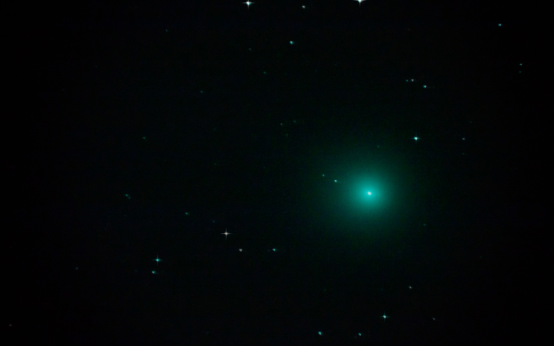 Scientific Debate Surrounds Mysterious Object Near the Sun
 Voyager 1 Reaches Light-Day Distance from Earth
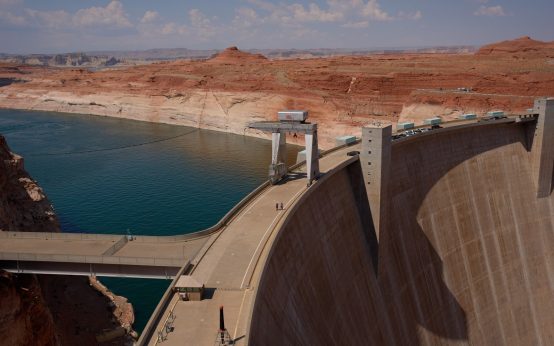 Record Low Hydropower Output in the Southwest
 The Value of Kindness: New Research Insights
 Data Centers Face Challenges in Vernon, Los Angeles
 Rams Captured Relaxing in Residential Area