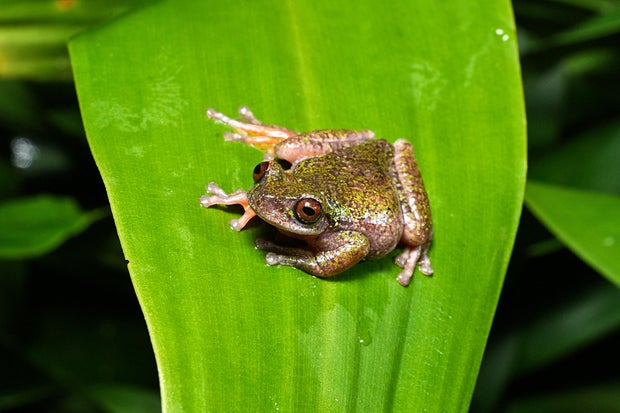
A small greenish frog species has been discovered in Costa Rica’s central Pacific region. This nocturnal amphibian, thriving in coffee plantations, faces risks from agricultural chemicals.
Discovery of the Tiny Frog
The frog measures less than 4 centimeters and is known as the “spring frog.” Researchers recently observed these dark green-spotted frogs in San Lorenzo de Tarrazu. Wagner Chaves-Acuna, a researcher, confirmed the discovery as a new species of tree frog endemic to Costa Rica, corroborated by colleagues from the University of Costa Rica and Argentina’s National Council for Scientific and Technical Research.
The frog, officially named “Rana de las nacientes” (Isthmohyla nacientes), was first seen in the 1960s but was mistakenly identified as another species.
Recognition and Characteristics
In 2021, genetic and morphological studies rediscovered and confirmed the frog’s identity. Also referred to as the “coffee frog,” males of the species have a translucent throat that inflates with their call. They are most active at night, often found on coffee shrubs, producing short, high-pitched calls. These frogs seek shade, moisture, and food in coffee plantations, preferring small insects over coffee berries.
Environmental Concerns
Pesticides used in coffee farming pose a risk to these frogs. Wagner Chaves-Acuna cautions that these chemicals can reach aquatic systems, affecting the tadpoles’ development. The species also faces various threats such as waste dumping, increased tourism, and vegetation loss due to protected area invasions, according to Costa Rica’s National Alliance for the Conservation of Amphibians and Reptiles (ANCAR).
 Climate-Resistant Rock Glaciers: Hidden Water Resources
  California Voters to Decide on $7.5 Billion State Research Fund
  Ancient Pottery Unearthed During Roadworks in Tbilisi
  U.S. Space Academy Announcement
  The Need for New Strategies in Oregon’s Wildfire Management
  Plastic Pollution in the Great Lakes: A Growing Concern