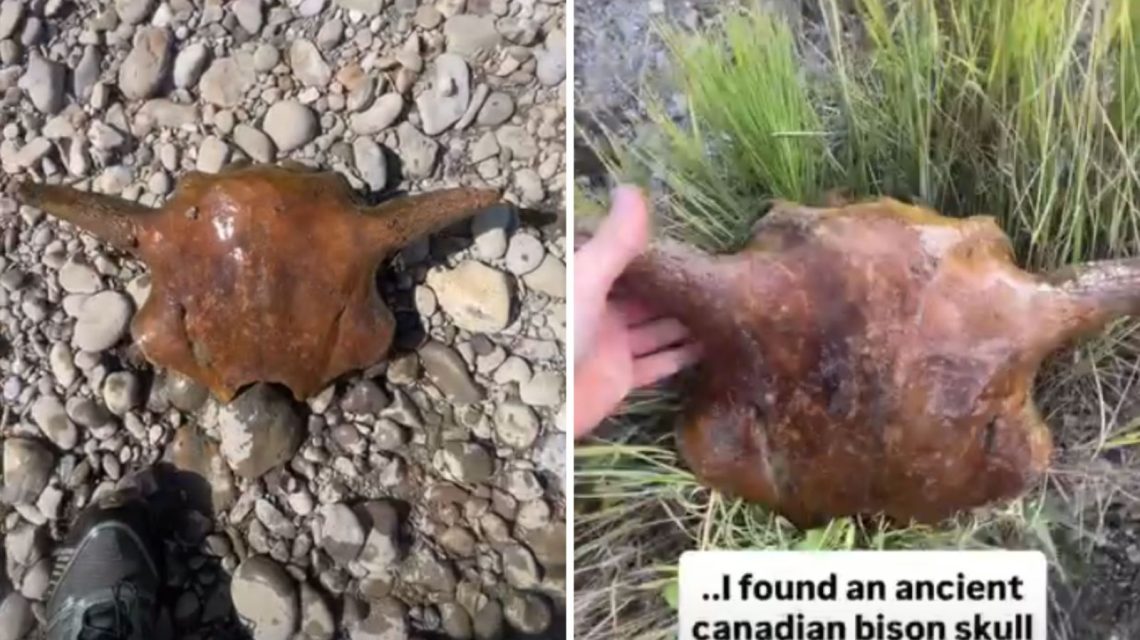
A fisherman in Alberta, Canada, encountered an unexpected find in a local creek. Dominic Boon, who resides near Banff, frequently explores the outdoors, keeping an eye out for intriguing artifacts. During a recent fly-fishing outing, Boon discovered something remarkable.
Filming with his phone, he recorded the moment as he approached the object protruding from the water. Initially, Boon’s companions speculated it was a cow skull. However, Boon’s curiosity led him to investigate further.
“As soon as I saw horns, I believed it was a bison,” he said.
Heavy Rain Reveals the Skull
The discovery occurred following an unusually rainy summer in Alberta. The capital city experienced record-breaking rainfall, which Boon believes may have unveiled the skull, potentially buried for decades.
He noted, “During June, [there was] unprecedented rainfall, and it washed all the banks and washed all fresh stuff down the creek.”
The skull, weighing a few kilograms, appeared significantly older than recent animal remains, prompting questions about its age.
A 5,000-Year-Old Mystery
Boon reached out to museum experts, including Dr. Chris Jass, the curator of Quaternary Studies at the Royal Alberta Museum. Dr. Jass confirmed the find as a bison cranium.
The skull’s age is uncertain, with estimates placing it as old as 5,000 years. Boon shared, “It could be that old,” acknowledging the mystery surrounding its history.
The skull’s estimated age is based on its physical features, including shape and eye sockets, suggesting it might be older than 150 years. Rapid burial may have preserved the skull, protecting it from decomposition and environmental damage.
Boon plans to take the skull to a museum, about three hours away, for further analysis. Experts could measure, weigh, scan, and photograph it to uncover more information.
“It’s just crazy,” Boon remarked about the discovery.
A Species Nearly Lost
The finding is a reminder of the bison’s historical decline. Plains bison once numbered over 30 million in North America, nearly vanishing in Canada by the late 1880s due to overexploitation and habitat loss. Wood bison also faced a severe decline, with numbers dropping from over 170,000 to around 200 by the 20th century.
Currently, Alberta hosts approximately 2,800 free-ranging wild wood bison. Plains bison occupy less than 1 percent of their former Canadian range. The skull’s discovery, regardless of its age, holds significance within this context.
Boon emphasized the unique circumstances of the find, which continue to captivate interest, whether the skull is 150 years old or thousands.
 The Threat of Melting Glaciers: A Call to Action
  Collapse of Hawai’i’s Hōlei Sea Arch Amidst Storms
  Los Angeles Faces Uncommon Heatwave in October
  Drought Drives Black Bears Closer to Human Activity
  Atlantic Ends September Without a Hurricane for First Time Since 1994
  Bobcat Sightings and Conservation Efforts in Illinois