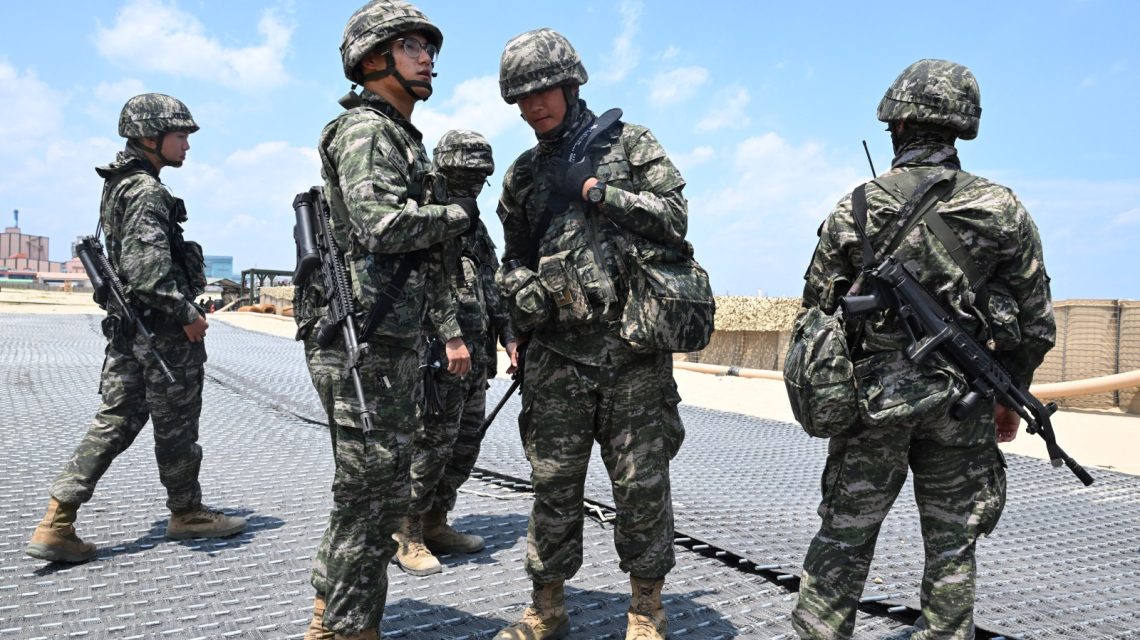
Donald Trump’s recent decision to reduce military exercises with South Korea might pave the way for renewed discussions with North Korea. This move has the potential to give the United States a chance to negotiate limitations on North Korea’s advancing nuclear capabilities, according to analysts.
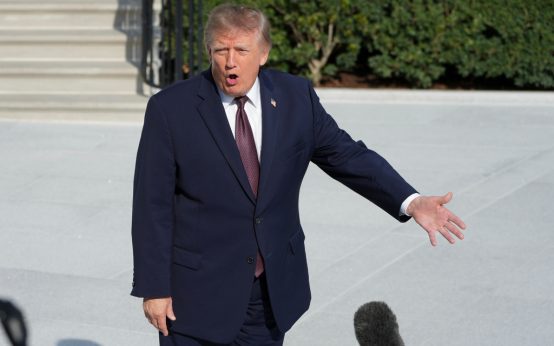
The U.S. president announced on Sunday that he instructed Defense Secretary Pete Hegseth to cut back the annual U.S.-South Korea military drills. Trump cited his good relations with North Korean leader Kim Jong Un and what he sees as Seoul’s lack of support regarding the conflict in Iran. Despite this announcement, exercises commenced on Monday as scheduled.
Trump attempted to negotiate denuclearization with Kim during his first term, meeting him three times without success. Since those efforts, North Korea’s nuclear arsenal has grown. A report from June 2026 by a Stockholm-based think tank states that Pyongyang possesses around 60 assembled nuclear weapons and could produce at least 30 more. Additionally, North Korea conducted ballistic missile tests recently, an action prohibited by the United Nations.
The announcement on Truth Social triggered concern among Democrats, Republicans, and South Korea. Critics worry that Trump’s move might embolden North Korea and question Washington’s reliability as an ally amidst global tensions. Evan Sankey, a policy analyst at the Cato Institute, said it raises the question of whether this signals a new approach to U.S.-North Korea talks. Although Kim might not abandon his nuclear weapons, discussions could lead to limits on his missile arsenal and fissile material stockpile, Sankey stated.
Jennifer Kavanagh, director of military analysis at Defense Priorities, termed Trump’s announcement as both necessary and strategically aligned with U.S. interests. Newsweek reached out to the White House and South Korean foreign ministry for further comments.
The U.S. and South Korea’s Military Relationship
South Korea hosts Camp Humphreys, the largest American military installation abroad, and regularly holds joint military drills with the U.S. The Ulchi Freedom Shield exercises began as planned, focusing on countering North Korea’s capabilities, including drones, GPS disruption, and cyberattacks. At least 18,000 South Korean troops participated, according to local reports. North Korea, however, condemned the drills as a rehearsal for war.
Trump asserted on Truth Social that the drills project hostility towards North Korea, which he claimed has been respectful. His comments sparked strong reactions, with Sen. Jack Reed criticizing Trump for flattering a dictator by reducing military exercises. Republican Sen. Thom Tillis argued the move only frees North Korean troops to assist Russia.
An editorial from South Korea’s Hankook Ilbo expressed concerns, stating the announcement highlights a weakening Korea-U.S. alliance. Sankey from CATO compared this development to Trump’s past cancellation of drills during negotiations with Kim in 2018 and 2019. Though there are no current U.S.-DPRK talks, reducing exercises might indicate a new diplomatic effort, he suggested.
Kavanagh from Defense Priorities stated joint drills with South Korea might not deter aggression from North Korea and China or contribute to regional stability. Instead, these exercises could provoke military build-ups and activities by both nations.
South Korea’s Security Independence
Kavanagh argued that U.S. resources and readiness might be strained due to unnecessary exercises with South Korea, especially with limited resources because of the war in Iran. According to her, shifting the responsibility for South Korean security entirely to Seoul would be more efficient.
South Korea’s president, Lee Jae Myung, urged completing the transfer of wartime operational control from the U.S. to South Korea. He also called for expedited efforts to acquire nuclear-powered submarines. The operational control issue traces back to the Korean War, which ended in an armistice rather than a peace treaty in 1953.
Sankey noted that talks between Washington and Pyongyang might also lead to stepping towards formally ending the Korean War, a valuable diplomatic objective for U.S. interests.
For further information, contact Newsweek editors Matthew Robinson and Cristina Diciu.
 U.S. Monitors Russian Plague Scare
  Trump’s Use of Public Funds for Political Ads Sparks Controversy
  Dennis Hastert’s Legacy: From Political Leader to Controversy
  Navigating the Challenges and Opportunities of Condo Ownership in California
  Rising Support for White Nationalism Among Young White Men
  Dennis Hastert, Former U.S. House Speaker, Dies at 84