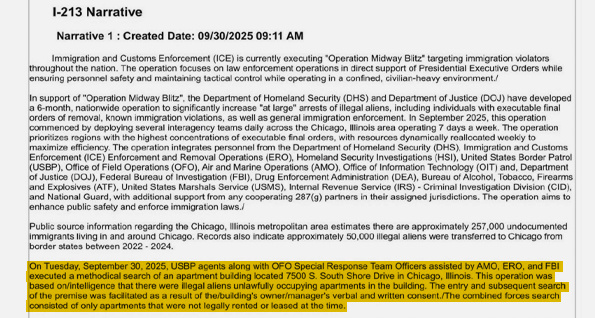
For several months, the Trump administration maintained that a dramatic midnight raid on a Chicago apartment complex was based on intelligence indicating the presence of the Tren de Aragua gang. However, no evidence supported this claim. Newly released documents suggest that the actual reason for the raid was far less dramatic: allegations of immigrants unlawfully residing in the building. The landlord who had federal officials targeting immigrants in Chicago had authorized them to search the premises.
Arrest records for two out of the 37 immigrants detained during the raid provide a clearer view of the motivation behind the controversial operation, during which agents descended from a Blackhawk helicopter, broke doors, and restrained U.S. citizens and immigrants alike. The records show that agents acted based on the “owner/manager’s verbal and written consent.” This consent allowed them to target units not legally rented. This narrative is repeated in both arrest reports concerning a Venezuelan man and a Mexican man.
According to Mark Fleming, an attorney with the National Immigrant Justice Center involved in a lawsuit against the government, the reasoning was not about gangs but about immigrants occupying apartments without permission. The Department of Homeland Security (DHS) records do not mention Tren de Aragua, yet officials frequently cited gang presence as the raid’s motivation. Immigrants were displayed before cameras while arrests were hailed as victories against terrorism. The government even claimed two arrested individuals were gang members without providing proof.
Documents obtained by ProPublica indicate the true motive was immigrant squatting allegations. ProPublica had earlier reported, based on various sources, that there was negligible evidence to support the government’s claims. Four months following the raid, federal prosecutors still haven’t filed charges against any arrested individuals.
Fifteen of the detained immigrants interviewed by ProPublica denied gang involvement. They admitted there was criminal activity in the building, which included the murder of a Venezuelan last summer, but there was no indication of gang members residing there.
The arrests are part of litigation concerning possible government violations of a 2022 consent decree restricting warrantless arrests. This decree remains, though the government contests it. Previously, government attorneys acknowledged that many detained immigrants might have been arrested improperly. Due to a court order, DHS is giving arrest records to attorneys requesting release or removal of restrictions for some immigrants from that night, including the Venezuelan and Mexican men involved.
A recent motion from immigrant rights attorneys highlights that the government justified warrantless arrests by wrongfully labeling immigrants as flight risks. This claim, based on accusations like property disregard and attempts to flee law enforcement, lacked basis according to arrest narratives.
Most of the detained immigrants from the raid have since been deported or had to abandon efforts to remain in the U.S. The property owner, Trinity Flood, and the management company, Strength in Management, have not commented on their involvement. A DHS spokesperson reiterated in previous statements that the raid was performed legally.
Questions arose about whether Flood and the property manager had alerted federal agents as a strategy to remove squatters. City inspection failures plagued the building for the prior two years. Last month, a housing discrimination investigation was launched against Flood and the management company over allegations of using federal agents for illegal eviction. State officials are investigating claims that management blamed Venezuelan tenants for security failures and amplified gang-related stereotypes to label them criminals.
After the raid, management workers discarded tenants’ belongings and cleared apartments. State officials await responses from Flood and Strength in Management as part of ongoing investigations. Many detained immigrants expressed anger over learning management facilitated the federal raid.
Among them, Jean Carlos Antonio Colmenares Pérez and his cousin, Daniel José Henríquez Rojas, described the abrupt and demeaning nature of their arrest and deportation. Similar sentiments were echoed by other families dispersed due to the raid.
The complex housed mainly African American and Venezuelan tenants. Some reported paying rent despite its poor conditions because they thought they were paying authorized agents from the management company. However, some tenants collected rent fraudulently. A U.S. citizen admitted to renting out empty units and pocketing the money.
Facing foreclosure, Flood reported her company had invested significantly in the building but city inspections exposed continued deterioration. A county judge eventually ordered another management company to take control, requiring the remaining residents to relocate.