Artificial intelligence is actively transforming China’s job market, influencing multiple sectors and affecting numerous workers, including computer programmers and other roles. People like Fei Zhaojun have witnessed firsthand the impact of AI on employment. Fei, a former computer programmer in Beijing, was laid off alongside 160 colleagues due to AI’s growing capabilities in coding jobs.
China’s government endorses AI integration, encouraging widespread use in varied industries. Economists express concerns that accelerated AI adoption could weaken the economy, the second largest globally. This shift extends beyond coding roles, infiltrating areas like script writing and physical tasks.
Shujing He, a senior analyst at Plenum, notes that anti-AI sentiment appears lower in China compared to other regions, with people mostly neutral or positive about AI’s role. While some fear job replacement, others explore AI-enabled ventures. Fei himself is contemplating new paths, opting to create vlogs during his career break.
The level of interest in AI among those displaced from traditional roles is remarkable.
In Chengdu, part-time translator Du Qinchun participates in AI model training for translation, acquiring more work temporarily, although industry pay has declined substantially. The prevalence of AI in translation demonstrates a trend, as fewer students pursue foreign language programs.
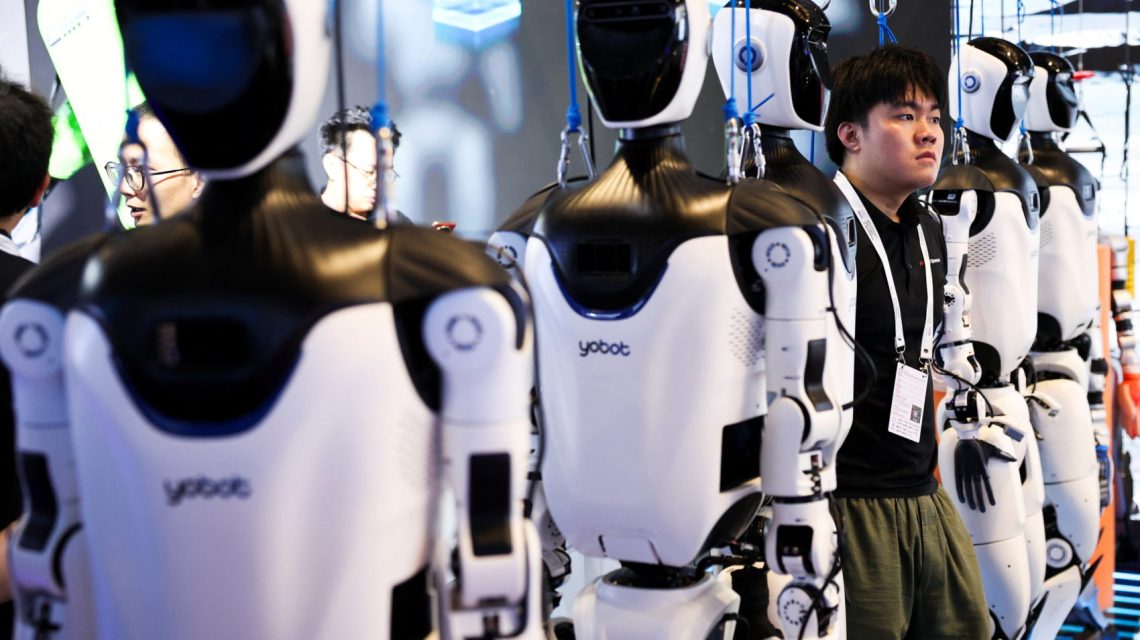
Industrial enterprises in China are increasingly adopting AI models. The percentage of enterprises using AI rose notably last year, indicating rapid innovation in industrial AI applications. Humanoid robots now perform tasks like sorting parcels, directing traffic, and making coffee. Food delivery bots emerge as potential competitors to millions of workers.
The short drama industry experiments with generative AI, leading to a decrease in live-action video series for mobile phones. Yet roles narrowly concentrated in multimedia creation and software development face higher displacement risks.
The International Labor Organization highlights a gender disparity in employment risks, identifying that women in automation-prone sectors, such as electronics assembly, face greater challenges. AI’s influence extends to consumer behavior, affecting economic growth amid housing market struggles.
Under the “AI Plus” initiative, the Chinese government aims for AI integration across industries, potentially boosting productivity. Cornell University’s Eswar Prasad stresses AI’s disruptive employment impact, which could affect social stability, despite tech industry innovation.
Job market dynamics remain uncertain. Urban unemployment hovers around 5%, while youth unemployment, excluding students, is significantly higher. As China’s aging population expands, automation might partially address workforce shrinkage.
Some individuals embrace AI, leveraging its capabilities in new entrepreneurial ventures. Wang Zhicheng, a former scriptwriter, utilizes AI while working independently on children’s books, acknowledging AI-generated content’s limitations.
Yang Zheng, a high school chemistry teacher, views AI as an aid to student learning, despite occasional inaccuracies. AI’s capacity to interact in real time can be beneficial for students seeking immediate answers to questions.
Supporting trusted journalism is essential for ensuring democratic health and facilitating informed discussions.
 Trump’s 2024 Campaign Targets Young Men Through Cryptocurrency
  How Modern Windows Improve Home Insulation
  State Department Simplifies Passport Process with Online Applications
  Senate Democrats Block Data Center Bill Over Efficiency Concerns
  Future Cities: Ambitious Projects Aiming for Innovation and Sustainability
  High-Profile Hearing and AI Developments: Key Political Moves