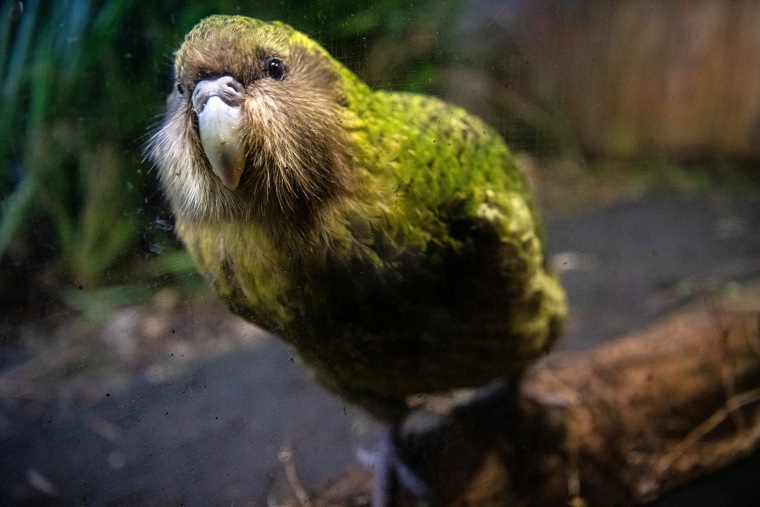
On September 1, 2026, the New Zealand Conservation Department announced a significant increase in the population of the kakapo parrot, one of the world’s most endangered species. A total of 90 chicks have been born this season, bringing the population to a record 325 birds. This growth marks a milestone, considering that the youngest chick is now 150 days old, allowing it to be counted as independent.
The kakapo is native to New Zealand and is distinct for several reasons. It is flightless and moves with a waddling gait, making it vulnerable to ground predators. It is also the heaviest parrot species, with males weighing up to 9 pounds. A notable feature is its yellow-green blotched plumage and large gray beak. Kakapos have an impressive lifespan, often living between 60 and 90 years.
“There is still a long road of recovery ahead,” said Deidre Vercoe, manager of the department’s kakapo recovery operations. “But ninety chicks in a single season is a record.” In the past, achieving such numbers took 16 years.
The Kakapo Recovery Programme initiated in 1995 with just 51 birds, spearheading efforts to overcome challenges such as low genetic diversity, infertility, and poor hatching success. Over 13 breeding seasons, the program has focused on predator-free habitats. Each kakapo in the program is equipped with a radio transmitter for monitoring.
Historically, kakapo numbers fell due to human introduction of predators like cats and rats. Consequently, the birds are now mainly on protected offshore islands, thriving on Rimu tree berries, which affect their mating cycles.
Conservation strategies trialed this season included reducing egg and chick checks and supplementary feeding. “Our focus is increasingly on determining where intensive intervention is still needed and where we can return to more natural levels of kakapo breeding outcomes,” explained Tāne Davis from the kakapo recovery group.
“Early predictions suggest there may not be such a long wait between breeding seasons,” added Vercoe. Modeling indicates a possible two-year gap between breeding seasons. Looking forward, the group is already preparing for the next breeding season in 2028.
 Climate-Resistant Rock Glaciers: Hidden Water Resources
  Senators Reach Bipartisan Agreement on Permitting Reform
  Experts Warn of Critical Period for the Colorado River
  Future Cities: Ambitious Projects Aiming for Innovation and Sustainability
  Supreme Court Case Suncor vs. Boulder: Implications for Accountability in Climate Change
  Hawaii Faces Impact of Record El Niño Through Recent Hurricanes