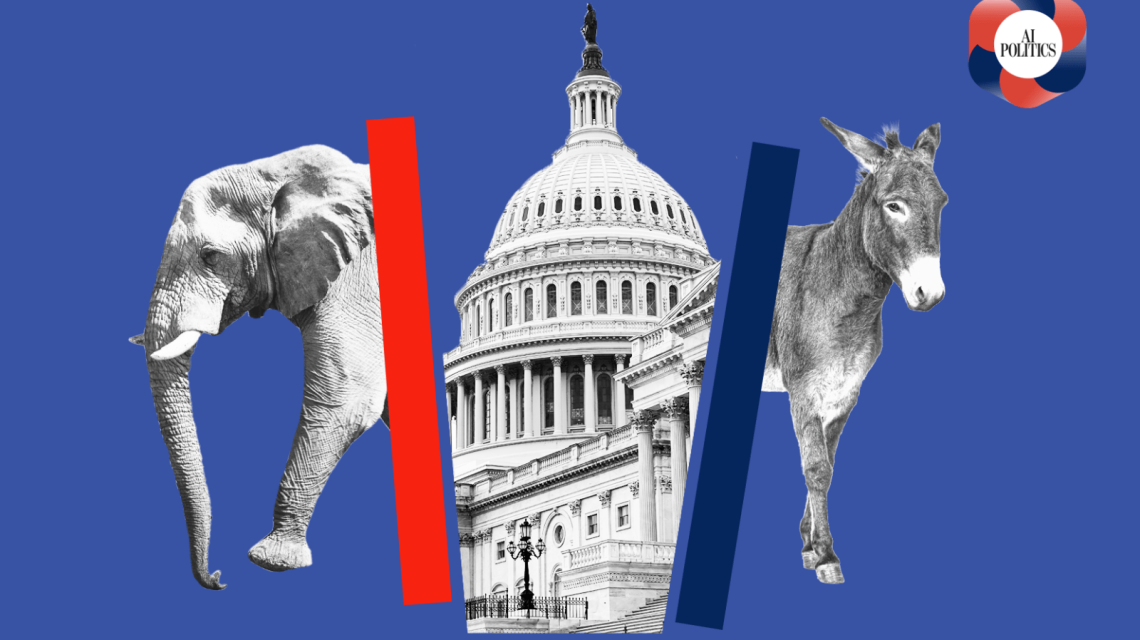
Newsweek’s AI Policy Scorecard revealed a significant divide within Congress regarding artificial intelligence (AI), but this division does not align clearly with traditional party lines. The upcoming Election Day will test whether AI-related issues influence political realignment. On November 10, Newsweek will host a webinar titled “Midterms Review: How AI Policy Shaped the 2026 Elections.” This live event will analyze election results and revisit the findings of the AI Policy Scorecard.
The project assessed the public records of all 537 Congressional members across five key areas: Regulation & Governance, Data Centers & Energy, Jobs & Economy, Safety & Privacy, and National Security & China. The ratings serve as a pre-election benchmark for a debate that defies typical party alignments.
The scorecard uses a scale ranging from AI Skeptic (1) to AI Booster (5). On average, Democrats score 2.60, identified as Lean Skeptic, while Republicans score 3.26, or Lean Booster. Few lawmakers are at the extremes: 18 are AI Skeptics and 10 are AI Boosters. Most, 191 legislators, occupy the Mixed category near the midpoint. Additionally, nine Democrats are Lean Boosters, and 25 Republicans are Lean Skeptics.
“This is not yet following the typical polarized political dynamics of so many other issues,” noted Nathaniel Persily, a Stanford Law School professor and co-leader of the American Political Science Association’s task force on AI and politics.
Persily will join Brent Buchanan, CEO of Cygnal, a Republican survey research firm, and Nick Penniman, CEO of Issue One, a crosspartisan political reform group, for the webinar. Issue One focuses on elections, money in politics, and technology reform.
An area where clearer distinctions emerge is in the data centers category. Republicans average 3.5, contrasted with Democrats at 1.9. Despite this, opposition to new facilities crosses party lines. Buchanan noted that data centers became a significant issue in voters’ eyes, influencing perceptions of candidates’ allegiance, whether to special interests or the common citizen.
“It’s a proxy issue of, ‘Is this person in the pocket of special interest or is this person for people like me?’” Buchanan explained.
Financial influence is also a component of the debate. Issue One reported that 11 major technology and AI companies, along with trade associations, expended $41.8 million on federal lobbying in the first half of 2026. Furthermore, over $27 million was directed to New York’s 12th District Democratic primary by groups linked to OpenAI and Anthropic.
Following Election Day, the panel will investigate how AI-related topics appeared in campaigns, the resulting political coalitions, and the issues that resonated with voters. They will also discuss the implications for lobbying, advocacy, and political spending.
Gabriel Snyder, Newsweek’s executive editor for enterprise, will moderate the live discussion on Tuesday, November 10, at 2 p.m. ET. Interested participants can register for the webinar using the link provided.
 Judge Orders Trump Administration to Open 2027 Diversity Visa Lottery
  Karoline Leavitt Discusses Working with Trump and Her Career Transition
  Political Heavyweights Campaign in Michigan Senate Race
  EPA’s Renewable Fuel Proposal Gains Attention Ahead of Iowa Elections
  Documentation of Immigration Enforcement: Disappeared in America Initiative
  Iowa Senate Race Heats Up as New Polls Show Close Contest