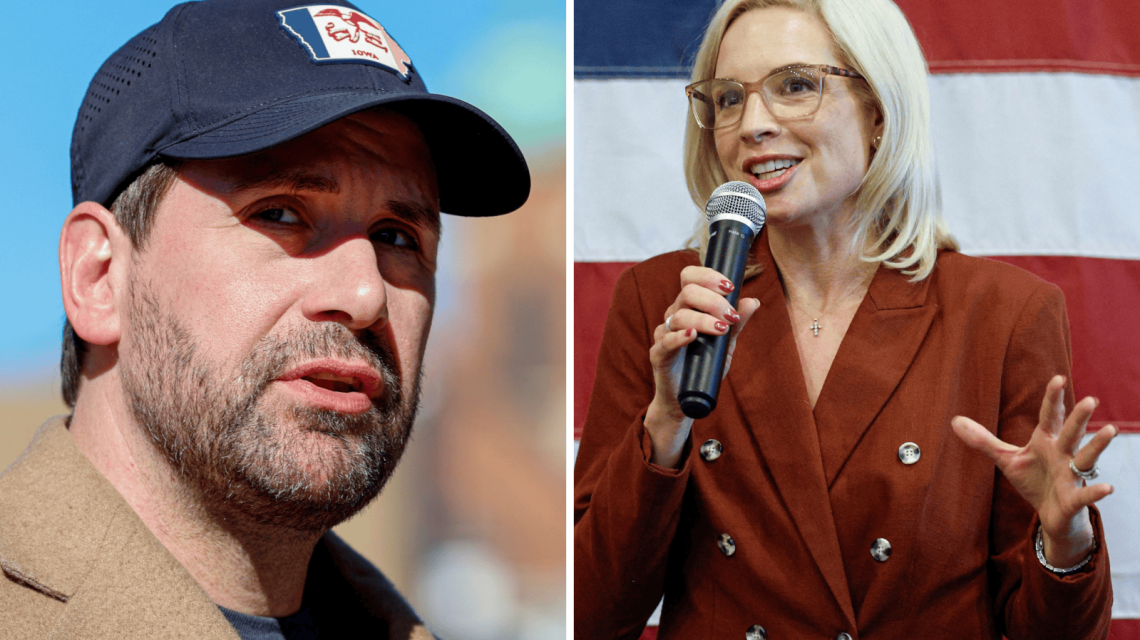
In Iowa’s tightly contested U.S. Senate race, undecided voters are gradually forming opinions. The competition between Democrat Josh Turek and Republican Ashley Hinson remains neck-and-neck. This race is one of the most competitive in the country, with both candidates vying for the seat vacated by retiring Republican Senator Joni Ernst.
Polls indicate a close race following their debate on October 7, where issues like tariffs, immigration, and voting records were central. The second debate on October 13 saw discussions on the Iran war, tariffs, and immigration once more. Initially, the percentage of undecided voters was high, reaching double digits. Independent voters, known for not being affiliated with any particular political party, form a significant part of Iowa’s electorate. They are most likely to vote for candidates across different parties.
Even as the number of undecided voters decreases, the gap between Turek and Hinson stays narrow. Different polls show varying leads. The Trafalgar Group’s most recent poll, held from October 13 to 15 among 1,094 likely voters, indicates nearly 46% supporting Hinson and 44% backing Turek, with more than 6% undecided. This is a shift from their September poll, where more than 10% were undecided. In that earlier poll, Hinson led by 44% to Turek’s 42%.
Marist’s polling shows a similar trend. Their September poll of 1,050 registered Iowa voters found 5% undecided, whereas a later poll of 1,100 registered voters in October showed 4% undecided. In September, Turek led Hinson by 50% to 42%, a lead that narrowed in October to a three-point lead at 48% to Hinson’s 45%.
A YouGov poll demonstrated significant shifts among undecided voters. In October, they surveyed 2,245 likely voters from October 6 to 12, finding 4% undecided, with 47% supporting Turek and 46% supporting Hinson. The undecided percentage dropped from their September poll, where 11% of 2,169 registered voters were undecided, with 44% supporting Turek and 43% for Hinson.
“The race is so tight that it is hard to know how the undecideds will break,” John Geer, a professor specializing in public opinion at Vanderbilt University, told Newsweek. “In this nail-biter, it will be turnout that likely drives the outcome more than the undecideds. Do Republicans vote in high enough numbers to get Hinson across the finish line? Or are Democrats so motivated that they turn out in record numbers carrying Turek to victory?”
Geer noted that the race is too close to predict with certainty. No further debates are planned between Turek and Hinson. President Donald Trump plans to support Hinson with rallies in Iowa on October 22 and November 1.
Election Day is set for November 3, with early voting already underway until November 2. As of now, 2% of Iowa’s over 2 million registered voters have cast early ballots, according to an NBC News tracker.
Iowa plays an essential role in the 2026 midterms, influencing control of the House and Senate. Although the state has voted Republican for the Senate since 2008, its history of voting for both Republican and Democratic presidents makes it competitive. Trump has won Iowa in recent presidential elections, but before that, Obama succeeded twice.
Timothy Hagle, an expert on Iowa politics at the University of Iowa, mentioned that undecided voters are crucial for this year’s election. “I suspect that few Democrats and Republicans are among the undecided voters. That means most of them are No Party voters,” he said. Hagle highlighted that late-deciding voters don’t always go to one candidate, especially when there’s no incumbent involved.
In 2014, when Republican Joni Ernst first ran, independents split their votes between her and the Democratic candidate Bruce Braley. This year, other tight Senate races include Texas, Michigan, Ohio, and Alaska, where outcomes are uncertain. Geer cautioned about a potential partisan tide, suggesting one party might win multiple close races. He noted that past elections, like Trump’s wins in battleground states, showed the impact of such tides despite poll predictions.
 A Brief Tenure in the Brady Press Briefing Room
 Review of Afghanistan Withdrawal Expected Amidst U.S. Political Climate
 Ukraine Faces Challenges as U.S. Policy Shifts
 Assistant Attorney General Dhillon Defends Investigation of Noncitizen Voters
 Trump Sues BBC for Defamation Over Documentary
 Trump Administration Reaches Settlement with UNC