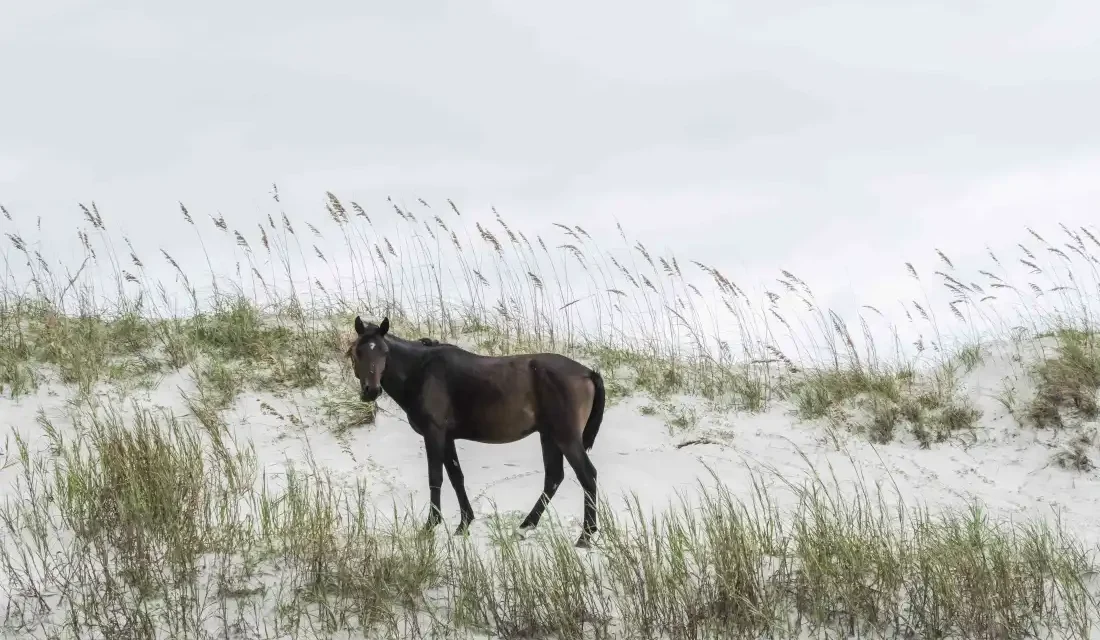
A wild horse grazes on available food on Cumberland Island, Ga., on October 8, 2026. The National Park Service, which has managed the island since 1972, recently proposed a land exchange with descendants of Thomas Carnegie, a wealthy Gilded Age industrialist who built homes on the island.
Cumberland Island stretches 18 miles and is one of the largest, ecologically diverse barrier islands on the Atlantic coast. The island hosts salt marshes, maritime forests, and a vast pristine beach, only accessible by ferry. The National Park Service has managed the Cumberland Island National Seashore since 1972, covering about 9,800 acres of wilderness that an act of Congress designated to remain in a primitive state.
Beyond the protected wilderness, visitors can find Native American relics, Spanish mission remnants, antebellum plantation ruins, and the homes built by Thomas Carnegie and his wife, Lucy. Carnegie descendants still live or vacation on private property here, and the park service has proposed a land swap that would permit new construction, creating tensions among stakeholders who differ in preserving the island’s heritage.
Land Swap Proposal
Park Superintendent Melissa Trenchik has been advocating for the plan, showing media areas under expansive oak groves. The proposal would transfer parkland to two branches of Carnegie descendants for developing up to eight new private homes. This area overlooks a salt marsh and the Naval Submarine Base Kings Bay.
They obviously want to be with this incredible view.
Trenchik aims to consolidate private ownership on the island’s west side, so the park can focus on interpreting natural and cultural resources along the Atlantic beachside. This could prevent development in sensitive areas. Over 12,500 public comments have been submitted on the proposal.
Trenchik explains that further development on private land is possible without action. She notes that new homes will have permanent conservation limits and cannot exceed 35 feet in height. Critics argue the 15,000-square-foot allowance, including driveways and outbuildings, is not modest. Joseph Manning of Defenders of Wildlife criticizes what he calls a swap for McMansions.
Opposition and Support
Manning views the land swap as part of broader land privatization under the Trump Administration, citing similar issues at other national parks. He sees these exchanges benefiting specific interests rather than expanding public access.
Barclay McFadden, a Carnegie descendant, expressed disappointment with the portrayal of his family. He emphasizes his family’s history on the island and their stewardship in preserving it. Plans include building homes for future generations, acknowledging previous opportunities to sell their land to developers.
Jamie Ferguson, another Carnegie descendant, supports the legacy of protecting the island. He co-owns the Greyfield Inn, a former Carnegie mansion, now a bed and breakfast. Ferguson values the island’s historical and cultural significance and believes the land swap can enhance access to crucial sites like The Chimneys.
Cultural and Environmental Concerns
Naturalist Carol Rucksdeschel, living privately not owned by the Carnegies, opposes the land swap, fearing increased development. She continues emphasizing the importance of maintaining the island’s primitive wilderness, where nature prevails.
Rucksdeschel also opposes plans to double daily visitation. Despite acknowledging the Carnegie family’s love for the island, she argues for preserving its wilderness state, envisioning a return to nature.
 Record Low Hydropower Output in the Southwest
 Data Centers Face Challenges in Vernon, Los Angeles
 Rams Captured Relaxing in Residential Area
 Global Climate Finance and the Developing World: A Turning Point
 Hidden Plastics in Everyday Items
 The Final Journey of the SS United States