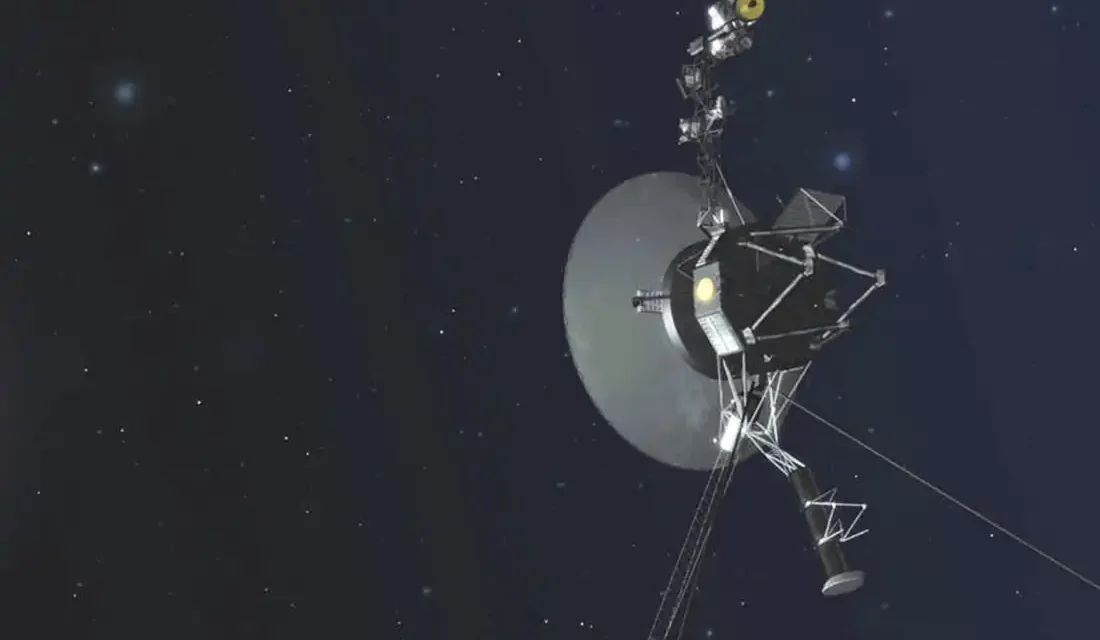
NASA’s Voyager 1 stands as the farthest-traveled human-made object in space. On Wednesday, it achieves a new milestone by reaching a distance equal to one light-day away from Earth. This momentous occasion is marked by the “Shine Bright for Voyager’s Light-Day” celebration organized by NASA.
The agency encourages the public to participate in the event on Tuesday night by sending Voyager’s call sign, V-G-R, into the sky using Morse code. This can be done with a flashlight, phone light, or any light source capable of blinking. The signal consists of:
- V: Three quick flashes, one long flash
- G: Two long flashes, one quick flash
- R: One quick flash, one long flash, one quick flash
Understanding a Light-Day
A light-day refers to the distance light travels in 24 hours, which exceeds 16 billion miles. Voyager 1, launched on September 5, 1977, has been on its journey for nearly 50 years.
During its mission, Voyager 1 conducted flybys of Jupiter and Saturn. In 1979, it discovered Jupiter’s faint ring system. The following year, it captured detailed images of Saturn’s rings and moons. On February 17, 1998, it surpassed Pioneer 10, becoming the most distant human-made object.
Voyager 1, along with its twin Voyager 2, is among the only spacecraft to operate outside the heliosphere. It reached the interstellar boundary in 2012 and continues to measure magnetic fields, particles, and plasma waves beyond the solar system’s protective shield.
Continuing the Interstellar Mission
Earlier this year, NASA decided to shut down the Low-energy Charged Particles experiment, or LECP, on Voyager 1 to conserve power. This decision allows the probe to remain functional longer. Presently, Voyager 1 still operates two science instruments: one for measuring magnetic fields and another for detecting plasma waves.
The spacecraft also carries the Golden Record, an interstellar “time capsule,” which aims to communicate Earth’s story to potential extraterrestrial beings. This record, a gold-plated disc, includes 115 images, natural sounds like surf and wind, as well as greetings in 35 languages. The record provides instructions on playing it and information about the probe’s origin.
Voyager 1 is anticipated to achieve “light-day status” at 5:16 a.m. ET on Wednesday, marking 49 years, two months, and 11 days of travel.
 The Jensen Huang Controversy: Silicon Valley’s Divided Opinion
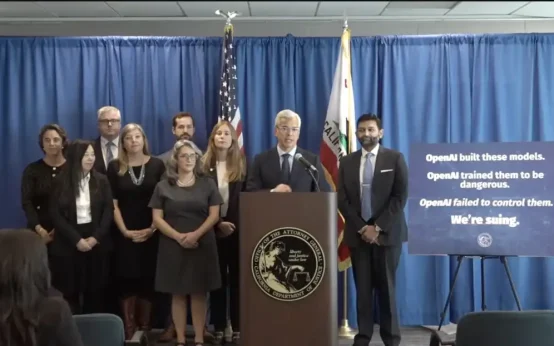 California Lawsuit Against OpenAI: Key Details and Implications
 Updates on Key International and Domestic Events
 E.l.f. Cosmetics Breaks Makeup World Record at TwitchCon
 Understanding Credit Freeze, Fraud Alert, and Identity Monitoring
 U.S. Restricts Remote Access to AI Chips Amid National Security Concerns