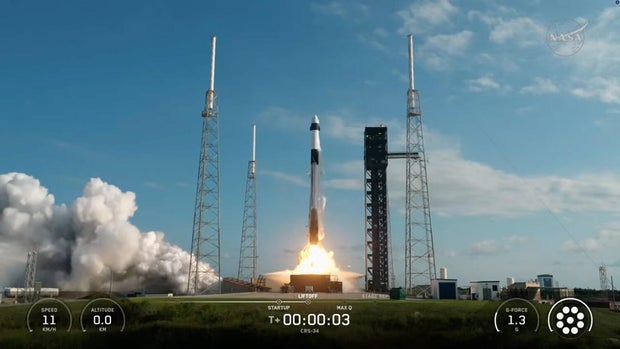
On May 15, 2026, SpaceX successfully launched an unpiloted Dragon cargo ship carrying 6,500 pounds of supplies and equipment to the International Space Station (ISS). This shipment included nearly a ton of research materials for approximately 50 different science investigations.
The launch, delayed by three days due to adverse weather conditions, occurred at 6:05 p.m. ET. The Falcon 9 booster ignited at pad 40 of the Cape Canaveral Space Force Station, aligning with the station’s orbit to facilitate the mission.
After liftoff, the rocket’s first stage, which had been used six times previously, separated two and a half minutes into the flight. It successfully returned to an on-target landing near the launch site. Meanwhile, the second stage carried the Cargo Dragon to its intended orbit, where it was released nine minutes and 20 seconds post-launch.
This mission mark’s SpaceX’s 638th Falcon 9 launch since the rocket’s first flight in 2010. It is the company’s 56th launch of the year and the 611th successful booster recovery. The first stage landed smoothly at Landing Zone 40, demonstrating the reliability of SpaceX’s technology.
‘This mission will be the first time a Cargo Dragon spacecraft heads to the ISS for a sixth time, marking an important milestone,’ said Bill Spetch, ISS operations integration manager at the Johnson Space Center. The Cargo Dragon is transporting over 6,000 pounds of crucial supplies and experiments to the Expedition 74 crew aboard the ISS.
The delivery comprises various items, including water purification systems and materials for studying space weather. If all progresses as planned, the Cargo Dragon will automatically rendezvous with the ISS early Sunday, docking at the Harmony module at approximately 7 a.m.
Once at the station, the spacecraft will be unloaded by Crew 12 commander Jessica Meir, pilot Jack Hathaway, ESA astronaut Sophie Adenot, and cosmonaut Andrey Fedyaev. The team also includes Sergey Kud-Sverchkov, Sergey Mikaev, and NASA’s Chris Williams as part of the seven-member Expedition 74 crew.
The Cargo Dragon is delivering over 3 tons of equipment including 1,363 pounds of crew essentials, over 1,000 pounds of hardware, 282 pounds of spacewalk components, 186 pounds of computer gear, and 1,834 pounds of research gear.
‘The ISS has facilitated more than 4,000 science experiments and technology demonstrations,’ said Liz Warren, deputy chief scientist for the space station program. ‘This international effort involves over 5,000 researchers from 110 countries, making the ISS a cornerstone for future space exploration and missions like Artemis and Mars explorations.’
This mission sets the stage for key future operations. In July, Soyuz MS-29 will launch from Kazakhstan with three astronauts to replace current crew members. Subsequent launches include a Russian Progress cargo ship in September, and NASA’s Crew 13 in September aboard a SpaceX Crew Dragon. Three additional cargo flights are anticipated by year-end, with crew rotations resuming in early 2027.