Gregg Frazer, a historian at The Master’s University in California, often finds himself addressing challenging topics about America’s founding and religion. He states that neither side fully appreciates his perspectives. According to Frazer, the founders did not establish a Christian republic. Key figures among the founders either questioned essential Christian doctrines or were vague enough to leave historians debating.
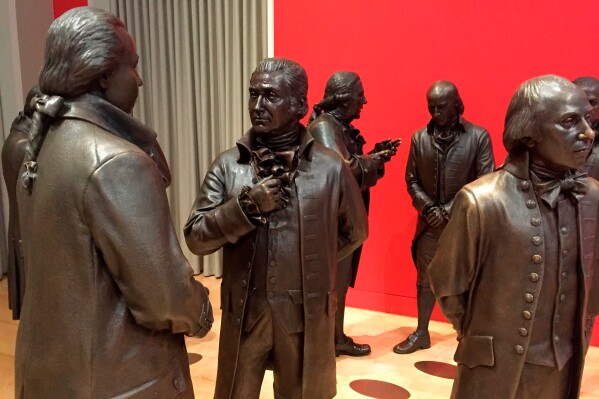
Frazer’s conclusions can disappoint Christian audiences. However, he emphasizes that the founders were not merely rationalist deists or anti-religious skeptics either. These views can upset those advocating for a complete separation of church and state. Many founders held religious beliefs that influenced their actions, including life-size bronze sculptures of the Constitution signers at Philadelphia’s National Constitution Center.
The upcoming 250th anniversary of the Declaration of Independence intensifies debates about religion in America’s founding. Celebrations like America 250 have prompted some to affirm that the U.S. had a Christian beginning.
President Donald Trump has contributed to this narrative by promoting events like “America Prays,” set for the National Mall in Washington. Prominent Christian groups participate, underscoring claims of a Christian founding. Cabinet members, such as Defense Secretary Pete Hegseth, echo these claims, asserting that America has Christian roots embedded in its ‘DNA.’
Critics challenge this narrative vigorously. Americans United for Separation of Church and State argue America wasn’t founded as a Christian nation in any meaningful legal or constitutional sense, warning against reinterpretations designed to reshape laws.
A 2022 Pew Research Center report indicated 60% of U.S. adults think the founders intended America to be a Christian nation. John Fea, author of “Was America Founded as a Christian Nation?” asserts that people seek historical validation for their political agendas, ignoring historical complexities.
While public prayers have played roles in significant moments such as President Truman’s handling of crises, Fea emphasizes that economic and political issues like taxation and representation were foremost during independence.
Christian Impact on America’s Founding
Mark David Hall argues Christianity significantly influenced America’s founding. While some founders did not embrace traditional beliefs, Christianity left a mark, especially concerning human dignity and systems preventing power concentration.
Early presidential proclamations of prayer and state church sponsorship after the Constitution’s ratification suggest religion wasn’t meant to be completely absent. The First Amendment ensures religious freedom without endorsing a national religion.
Historians like Frazer note the Constitution omits specific religious references apart from dating in “the year of our Lord” 1787. Supreme Court rulings have grappled with applying church-state separation principles in diverse areas.
Frazer highlights that Biblical references were absent in the Constitutional Convention’s proceedings and influential Federalist Papers. Ideas on equality, accountable governance, and religious freedom drew from Enlightenment thought.
The Declaration of Independence contains religious language, attributing rights to a “Creator” and invoking “divine Providence.” Founders employed terms palatable to both Christians and other philosophical groups.
The Complexity of America’s Religious History
The question of whether America was intended as a Christian nation is multi-faceted. Some regard the colonial era as the true founding, predating 1776. Religious institutions were central in colonial documents, but colonies varied in practice with competing ambitions.
During the Great Awakening, evangelical fervor spread, though church membership steadily declined. Protestantism encompassed diverse beliefs, some leaning towards Unitarianism.
Rationalism and freemasonry influenced the educated elite, including Jefferson and Franklin. Some founders were devout Christians like John Jay and Patrick Henry, while others questioned Jesus’ divinity.
Frazer dismisses the idea that most founders were deists. He labels them “theistic rationalists,” believing in an involved God, as evidenced by Washington’s belief in divine Providence.
The importance of religion in civic virtue was recognized by skeptics and believers alike. Franklin supported church and synagogue projects, illustrating freedom of religious practice as enshrined in the First Amendment.
Frazer distributes materials warning against misrepresenting America’s Christian identity as harmful. Distorting the essence of Christianity, he argues, risks blurring its true meaning.
Associated Press religion coverage is partly supported by collaboration with The Conversation US, funded by Lilly Endowment Inc.
 Historical Events in Chicago on October 3
  Martina Navratilova’s Enduring Influence in Tennis and Beyond
  World Porridge Making Championship: A Unique Scottish Tradition
  Readers React to Miss Manners Column
  Troy Swanson: Award-Winning Librarian Transforming Academic Libraries
  Lisdoonvarna Matchmaking Festival: A Unique Tradition