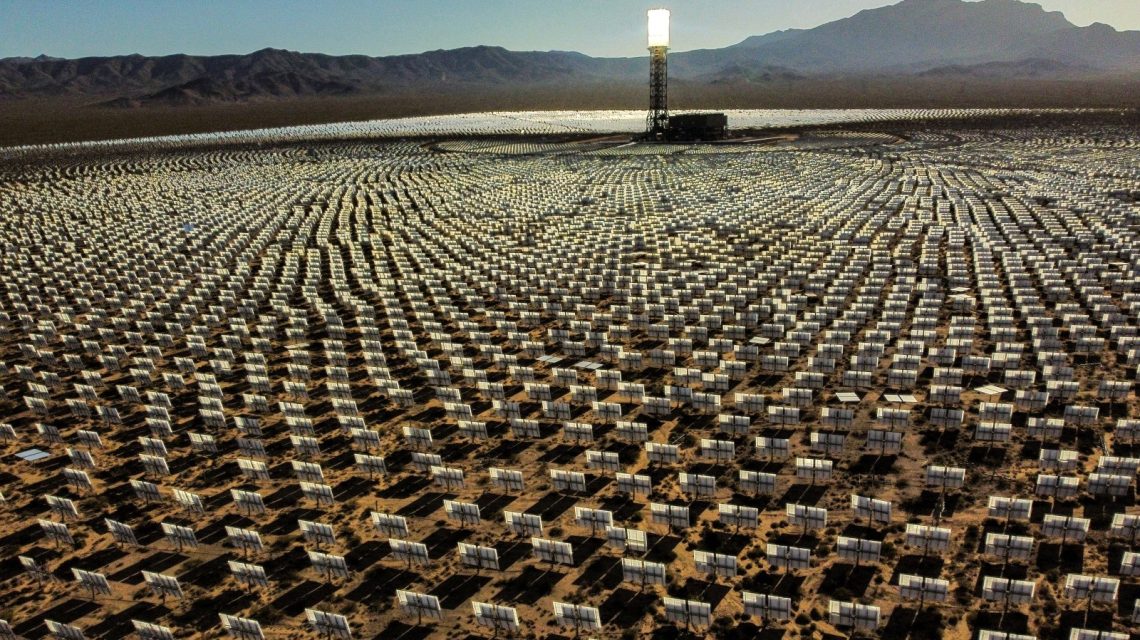
The closure of the Strait of Hormuz highlights the risks of relying on foreign energy sources. Unpredictable events in distant regions can ripple through to affect American workers and the economy. This is why President Trump has worked to reestablish American energy dominance, reducing dependence on unstable foreign sources.
President Trump identified this vulnerability early in his term. His policies made the U.S. a net energy exporter and aim to further boost domestic production and grid resilience. The United States possesses abundant energy resources, and exploiting all available types, including solar power, is crucial.
Solar power is especially significant due to its implications for national security and competition with China. China aims to dominate the global solar manufacturing and battery supply chains. If the U.S. does not lead in solar energy, it risks dependence on a source controlled by Beijing.
China’s focus on solar energy is partly because it can store solar energy in batteries and use it whenever needed. The U.S. Department of Energy notes that stored solar electricity can be tapped even after sunset, serving as a continuous energy source. This makes solar energy, paired with storage technology, affordable and quick to build, allowing rapid scaling of energy capacity.
In any security crisis, the U.S. must hold the advantage in energy technology, not China or other adversaries. A report from Time emphasizes that energy weaponization now involves diverse tools, such as control over infrastructure, shipping routes, and critical supply chains. The U.S. must control its own energy supply by ramping up domestic production across all sources.
Part of revitalizing American manufacturing involves diversifying supply chains and increasing domestic rare-earth metals production, essential for renewable energy technology. China currently manages 70% of global rare-earth mining and 90% of processing. The U.S. should not rely on adversarial powers for critical materials like lithium, used in electric vehicles and batteries for drones.
Onshoring lithium production can enhance economic resilience and cement the U.S.’s role as a global leader. Additionally, the U.S. must modernize its energy grid to avoid reliance on centralized sources vulnerable to disruptions. A diversified and distributed grid is crucial for resilience during crises.
President Trump is actively strengthening the national power grid and increasing domestic energy resource production. More must be done to eliminate regulatory obstacles that hinder energy development, such as solar power. In fossil fuels, the U.S. is a net producer of oil and natural gas, sustaining around 11 million American jobs.
There is no need to import resources that the nation already possesses abundantly. Domestic energy production is vital not just for national pride but as a pillar of economic stability and national security. It should continuously be regarded as such.
Ambassador Robert O’Brien served as the 27th United States National Security Advisor and is currently a member of the President’s Intelligence Advisory Board. The opinions shared in this article belong to the author.
 British Police Arrest Man Suspected of Terror Plot
  Activists Push for Nationwide Ban on Child Marriage in the U.S.
  Investigation into Alleged Incident at Cornell University
  Rising Drone Threats Highlight Vulnerabilities in Moldova’s Airspace Defense
  Bolivia Faces Security Test Amid Unrest
  Incident on FlyDubai Flight Raises Security Concerns