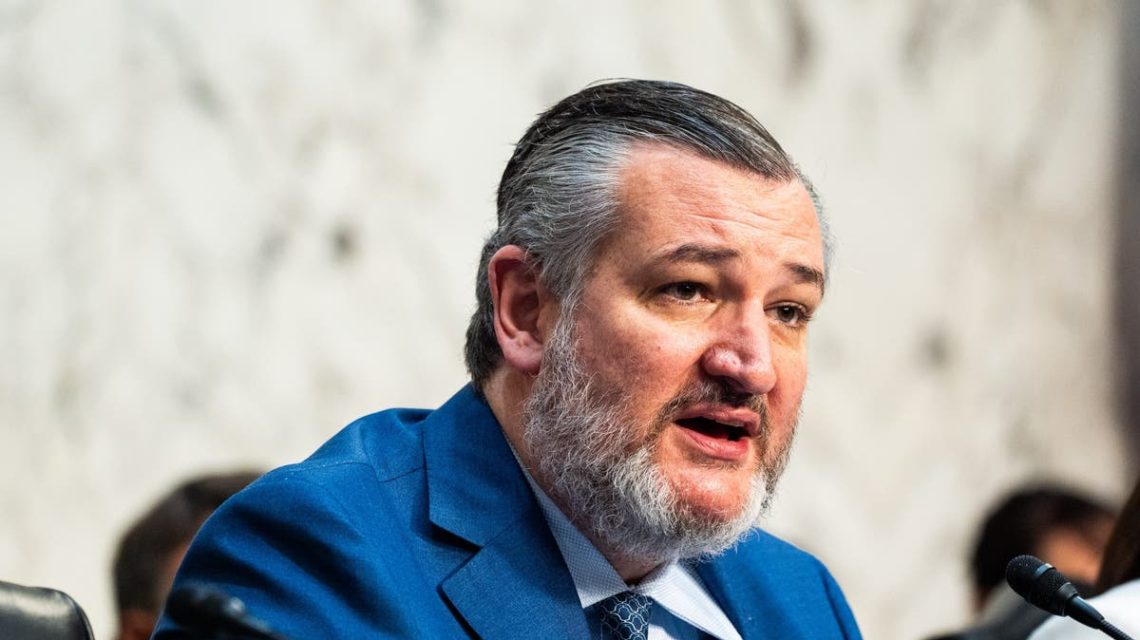
America’s competition with China in artificial intelligence (AI) has stirred intense debate, particularly as election periods near. Senator Ted Cruz of Texas highlights the issue of orchestrated propaganda in this race.
Recently, AI policies and the role of data centers have surfaced as significant topics in Congress and among American households. Senator Cruz, who chairs the Senate Commerce Committee, spoke to Fox News Digital about a strategic campaign against data centers. This campaign aims to manipulate public opinion.
“It’s similar to how some Middle Eastern countries funded anti-fracking efforts. The aim was to make the U.S. reliant on foreign oil,” Cruz stated. “The same manipulation is seen in opposing data centers, pushing reliance on Chinese AI.”
At a Senate Commerce, Science, and Transportation Committee hearing, Cruz engaged with tech leaders, including OpenAI’s Sam Altman and AMD’s Lisa Su. The discussions underscored concerns about Chinese influence and misinformation in AI development.
China’s Influence and AI Propaganda
No direct funding from China into U.S. data center policies has been confirmed. However, OpenAI recently blocked several ChatGPT accounts. These accounts, likely from China, aimed to sway opinions on data centers and their impact on electricity costs.
OpenAI stated it banned these accounts after identifying their covert operations to promote misleading narratives, misleadingly influencing American debates on AI policies.
The Economic Stakes of the AI Race
Senator Cruz emphasized the economic importance of this AI race for the U.S. He argued that if China takes the lead, AI could be used for control and surveillance, reflecting Communist Party values.
“If China wins, AI applications will focus on espionage, propaganda, and surveillance,” Cruz warned. “If America leads, AI will uphold values of free speech, individualism, and privacy.”
Cruz criticized Democrats for their opposition to AI developments and alignment with industries like Anthropic. He accused these players of seeking antitrust exemptions to collaborate with the government on AI development.
Effective Altruism and the AI Debate
Cruz linked this opposition to leftist philosophies and the emerging tech concept known as “effective altruism.” He suggested that these groups use AI to advance their ideologies.
“We see a money-driven push where large companies seek government benefits,” Cruz said. “These AI giants want to set regulations to limit competition.”
Parker Thayer from Capital Research Center labeled effective altruism as part of the “AI doomerism movement.” Billionaire Dustin Moskovitz and his wife Cari Tuna were identified as key financial backers of this ideology. They founded Coefficient Giving, previously Open Philanthropy.
Coefficient Giving’s AI Agenda
Coefficient Giving is heavily invested in AI, committing hundreds of millions to AI safety and policy advocacy efforts. The organization aims to allocate $1 billion towards AI initiatives by 2026.
The group’s 2021 grant application outlined its interest in funding projects related to effective altruism, AI safety, and global risks.
Preston Mizell is a writer covering these developments for Fox News Digital.
 The Trump Team’s Challenge to the Military Leadership
  Maryland First State to Restrict Electronic Pricing in Grocery Stores
  Activists Push for Nationwide Ban on Child Marriage in the U.S.
  Democratic Hopes and Historical Warnings in 2026 Senate Race
  Republicans Face Challenges Amidst Cost of Living Concerns
  A Different Kind of Fall for Congress This Year