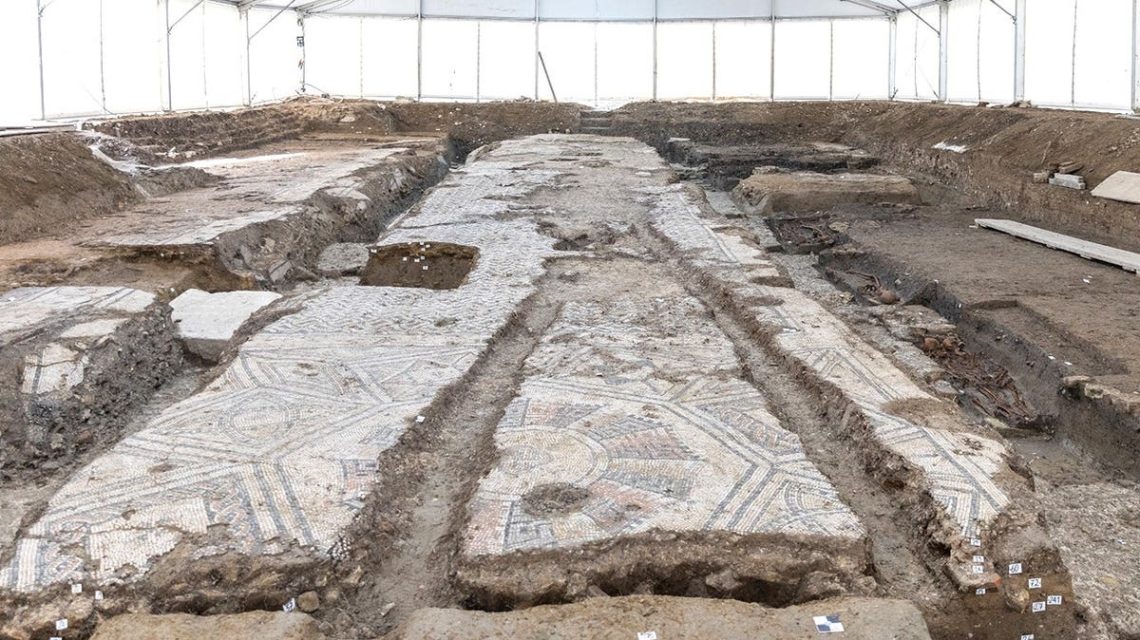
Archaeologists in Italy have discovered the remains of the earliest known Christian church in Oderzo, located approximately 40 miles northeast of Venice. The discovery was made public in a June press release by the Archaeological Superintendency of Archaeology, Fine Arts and Landscape for the Metropolitan Area of Venice, along with the Provinces of Belluno, Padua, and Treviso.
The site was excavated near a former fish market, revealing intricate polychrome mosaic floors and human burials adjacent to the church’s foundation walls. Oderzo, previously known as Opitergium, dates this church to the fourth and fifth centuries A.D., falling within the Late Roman period.
Excavation commenced last November to facilitate a residential redevelopment project in Oderzo’s historic center. Archaeologists determined that the building was a large rectangular structure, measuring about 75 feet in width and at least 98 feet in length. It featured a central aisle accompanied by two side aisles.
The foundations of the church were notably thick, measuring up to 1.2 meters, and were constructed using brick bonded with mortar. Wooden piles were driven into the soil to enhance stability, an ancient construction technique.
The eastern portion of the church remains unexcavated, indicating that the complex might be larger than currently identified. As part of ongoing investigations, archaeologists uncovered four burials, containing the remains of seven individuals. These remains are currently under study by anthropologists, and further specialized analyses are anticipated to offer more insights into the cemetery and the people interred there.
The timeline for when the church ceased being in use is undetermined. However, evidence points to its abandonment, with building materials stripped before partial destruction during the Middle Ages. This church is believed to be the earliest known Christian worship site in Oderzo, corresponding to when Christianity was becoming prevalent in the Roman Empire.
Officials have described the find as “exceptionally significant,” noting its importance in the historical understanding of ancient Opitergium during the Late Roman and Early Medieval periods.
Italy’s historical wealth has led to several archaeological discoveries lately. One notable find this summer was a hidden chamber under Hadrian’s Villa in Tivoli, thought to be the oldest structure at the estate. Earlier in the spring, construction in northern Italy led to uncovering an ancient sanctuary’s remains near Ponso.
 Climate-Resistant Rock Glaciers: Hidden Water Resources
  California Voters to Decide on $7.5 Billion State Research Fund
  Possible 19th-Century Shipwreck Exposed by Nor’easter in Nantucket
  Ancient Pottery Unearthed During Roadworks in Tbilisi
  U.S. Space Academy Announcement
  The Need for New Strategies in Oregon’s Wildfire Management