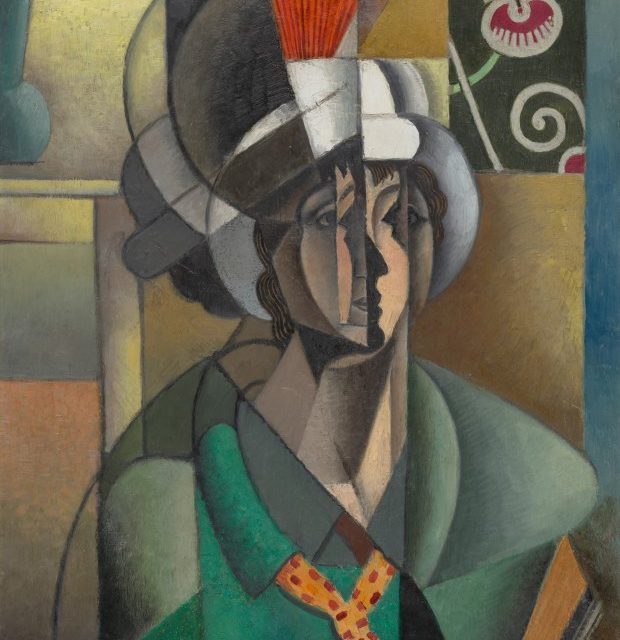
For three decades, descendants of Jewish art collectors have sought the return of artworks looted by the Nazis during World War II. Recently, the Art Institute of Chicago announced the restitution of a 1913 painting, Woman with a Fan by Jean Metzinger, to the heirs of its original owner.
According to Jacques Schuhmacher, executive director of provenance research at the museum, the painting belonged to the Lewenstein family in Amsterdam. It was sold in a forced sale in 1940 under Nazi occupation. This discovery was made with the help of Mondex Corp., a Canadian company focused on recovering looted artworks. Mondex represents the heirs in this case.
A statement from Mondex reveals Emanuel Lewenstein’s passion for art, fueled by a family fortune from a sewing machine company. His collection included contemporary Dutch art and old masters, notably an impressive collection of Rembrandt prints.
Lewenstein passed away in 1930, and after his wife’s death, their art collection was inherited by their two adult children, Wilhelmine and Robert. Both fled Nazi-occupied Netherlands, leaving the collection behind. The art was then sold at an auction house known for selling looted artworks.
Provenance research involves tracking an artwork’s history, a task Schuhmacher describes as challenging due to scattered records. The Art Institute has approximately 300,000 objects, some with gaps in provenance. However, gaps do not automatically suggest looted origins. The museum acquired Woman with a Fan in 1959 and describes Metzinger as a leading theorist of Cubism, known for his colorful, shape-focused style.
Interest in provenance grew in the 1990s, following a U.S. State Department conference highlighting Nazi-era looting. The Art Institute subsequently investigated the painting, realizing its WWII provenance gaps and hoping to fill them. Mondex eventually provided key information, aided by a faint pencil inscription on the painting’s back, readable thanks to infrared photography. The name ‘Paul Citroen,’ a cousin of Lewenstein and influential in the collection’s development, helped connect the painting to the Lewenstein family.
Schuhmacher emphasized clear evidence in this case, contrasting with another dispute over an Egon Schiele drawing, Russian War Prisoner. Acquired by the Art Institute in 1966, the drawing’s ownership was challenged but lacked evidence of Nazi-era confiscation. The museum holds that the drawing passed through Grünbaum’s family post-war and was sold to a gallerist.
Schuhmacher, leading provenance research at the Art Institute for two years, noted the rarity of dedicated departments for such specialized tasks. The museum is now arranging the logistics of returning the Metzinger painting to the rightful heirs.
 Dutch Review Board’s Euthanasia Ruling and International Debate
  Israeli PM Commends Heroic Actions in Flight Emergency
  Rabbi and Jewish Leaders Criticize Adam Brody for ‘Genocide’ Comment
  Flydubai’s Emergency Landing Highlights Cockpit Security
  Former Israeli PM Naftali Bennett Commends Passengers and Crew for In-Flight Heroism
  Diplomatic Complexities Unfold at U.S. National Archives Visit