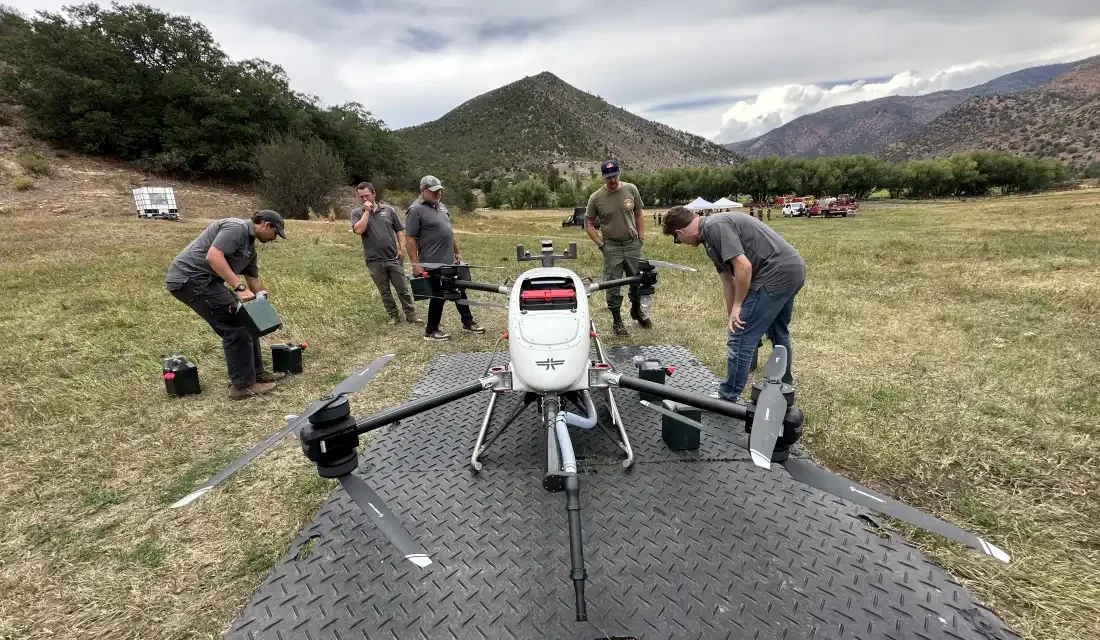
Fire crews in Aspen, Colorado have started training with new drones that are capable of carrying and dispensing fire-suppressing foam. These drones, manufactured by Seneca, represent a potential shift in firefighting techniques.
On an overcast day in late summer, Aspen Fire Protection District personnel gathered in the mountains of western Colorado. They monitored a volunteer firefighter piloting a large drone. These machines, resembling oversized insects, measure about 10 by 12 feet, comparable to a small U-Haul trailer.
While drones have long assisted in monitoring wildfires, Seneca’s technology promises a new level of engagement. The drones could potentially use AI to help extinguish fires. Upon completing training, Aspen Fire Protection District will be the first in the nation to independently operate these drones.
Advanced Drone Operations
Developed by Seneca, the drones are designed for swarm operation. Similar to small fire engines, a group of five can transport between 500 to 1,000 gallons of fire-suppressing foam. Aspen firefighters have noted their ease of use, joking about their simplicity by comparing them to toys operated by children.
When fully operational, Aspen will pioneer the use of independently run firefighting drones. These have previously been used only in California, and always with support from Seneca’s team. Andy Fisher, deputy chief of Aspen Fire, expressed a hope the drones will reach areas otherwise inaccessible, like remote forest fires sparked by lightning.
Potential and Challenges
Aspiration surrounds the drones’ potential to quickly access and mitigate fires in difficult terrain. Aspen, surrounded by dense forests, poses a unique fire risk. The drones can navigate challenging landscapes and offer a range of 5 to 10 miles, doubled when empty. Using AI-supported sensors, the drones can release water or retardant precisely.
According to Stuart Landesberg, Seneca’s founder, these drones cannot replace large air tankers but can significantly support existing resources. They are more affordable than helicopters, potentially making aerial firefighting less costly. Over the next five years, Aspen Fire will invest $2.5 million, with private donors helping fund the initiative.
Watching and Waiting
Many firefighters and departments nationwide are observing Aspen’s progress. Joe Stutler, a veteran fire commander, remains hopeful but cautious. He appreciates the safety the drones might offer, especially during nighttime operations when manned flights are limited.
Despite the promise, Stutler points out that the drones have yet to be tested in real wildfire scenarios. Although interested in trying them, he emphasizes that ground crews remain essential. He notes that even large water or retardant drops rarely extinguish fires completely.
Regulatory Steps and Future Plans
The FAA recently granted Aspen Fire a waiver to fly the drones up to 200 feet in Pitkin County. Regulations prevent flights over populated areas, requiring constant visual supervision. Ground observers must always maintain contact with the drone pilots.
If proven useful, Aspen Fire plans to expand the waiver to deploy the drones throughout the state. The department aims to enhance firefighting efficiency and safety using this innovative technology.
 The Daily Routine of Klook’s CEO Focused on Fitness and Efficiency
 The Jensen Huang Controversy: Silicon Valley’s Divided Opinion
 California Lawsuit Against OpenAI: Key Details and Implications
 Updates on Key International and Domestic Events
 E.l.f. Cosmetics Breaks Makeup World Record at TwitchCon
 Understanding Credit Freeze, Fraud Alert, and Identity Monitoring