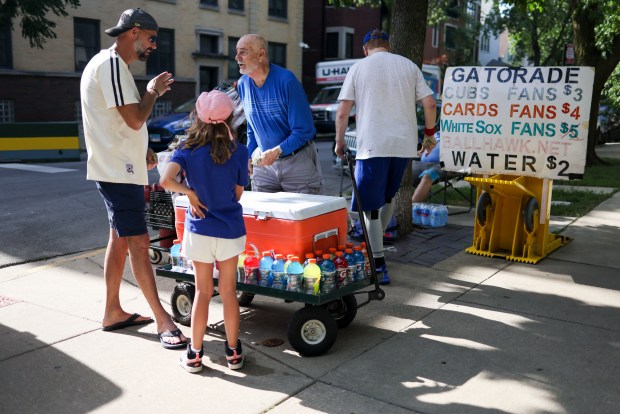
On a late June day, a strong wind swept over Wrigley Field, making the flags sway. Moe Mullins, a familiar figure, arrived over three hours before the game’s first pitch, as usual. He unfolded his camping chair under an ash tree at the corner of Waveland and Kenmore, by the left field bleachers, where the old neighborhood of Wrigleyville slowly stirred to life.
Gradually, street vendors set up their stands and the patio at nearby Murphy’s began to fill. Spectators aligned along the brick walls, eager for the bleacher gates to open. For those quiet moments, however, Moe had this small corner to himself, a vestige of old-time Wrigley in the midst of an evolving landscape.
The Chicago Cubs were celebrating their 150th year in the National League. For 110 years, they’ve called Wrigley Field home, with its corners retaining a touch of nostalgia amid nearby changes. Buildings around have been scooped up by the Cubs, their rooftops now pricey and less quaint. Trendy spots have cropped up around, even the famous Wrigley marquee touts a corporate sponsorship.
Mullins, known as the unofficial ‘mayor’ of this quaint corner, has seen the wave of changes.
Yet, the corner stays true to its roots. It’s a place of lawn chairs and lifelong fans exchanging banter. Dave Davison sells Gatorade at $3 for Cubs fans, $4 for Cards fans, and “stay thirsty” for White Sox enthusiasts.
This spot hosts a mixed set of characters – die-hard fans, townies, ballhawks, local workers, dog walkers with free treats, and curious tourists sensing the good vibes. Among the most notable are regulars like Ken Keefer, Bob Krause, and Mary Ellen Gourley, who have a long history with the bleachers. They walk from this corner to their seats for every game. However, a sense of inevitable change lingers as the ballhawks diminish in number.
Moe Mullins and Davison represent the enduring spirit of the old guard, with fewer successors stepping up. A longstanding Wrigley tradition is quietly fading. During a pause, a man on a stadium tour spotted and acknowledged Mullins, who started collecting baseballs in 1958.
Mullins shouted back to reveal a haul of over 6,400 baseballs. With a pause for emphasis, he boasted having caught 246 game home runs. Though he claimed to have eased up, it was evident that the thrill remained.
A seasoned veteran like Mullins can’t shake off the memories and frustrations of baseballs that eluded him. Memories of pivotal games linger, such as his near-catch of Ernie Banks’ 400th and his tussle for Sammy Sosa’s 62nd. These stories retain their vividness for him.
The ballhawks sculpt stories without watching games. They read the sound of the bat and crowd reactions. The once robust fraternity of a dozen regulars is shrinking. Some have moved, others passed away. A few remaining meet less frequently.
Mullins and Davison keep the tradition alive, the corner holding foundational tales and a spirited camaraderie. The flow of the game continues, with Mullins having a daily pool predicting game outcomes and engaging with fellow attendees.
Despite changes, the corner keeps its essence intact, a small space of enduring charm. Mullins envisions distributing his treasured baseballs to local kids one day, spreading joy akin to his childhood experiences.
Mullins’ home serves as a private museum for his prized baseballs. The trophied baseballs narrate stories of a lifetime immersed in the game. When considering his history and future under the Wrigley lights, Mullins, joined by Davison, affirms their intent to stay rooted, regardless of the changing scene around them.
 Stephen A. Smith Discusses Houston Texans’ Critical Matchup Against Dallas Cowboys
  CC Sabathia Anticipates Yankees’ Game 1 Pitcher for ALDS After Beating Red Sox
  Atlanta Dream Progress to WNBA Semifinals
  Los Angeles Lakers Focus on Defense in Luka Doncic Era
  Los Angeles Chargers Face Criticism Amid Team’s Poor Start
  White Sox’s Pope Hat Promotion Shines Amid Playoff Push