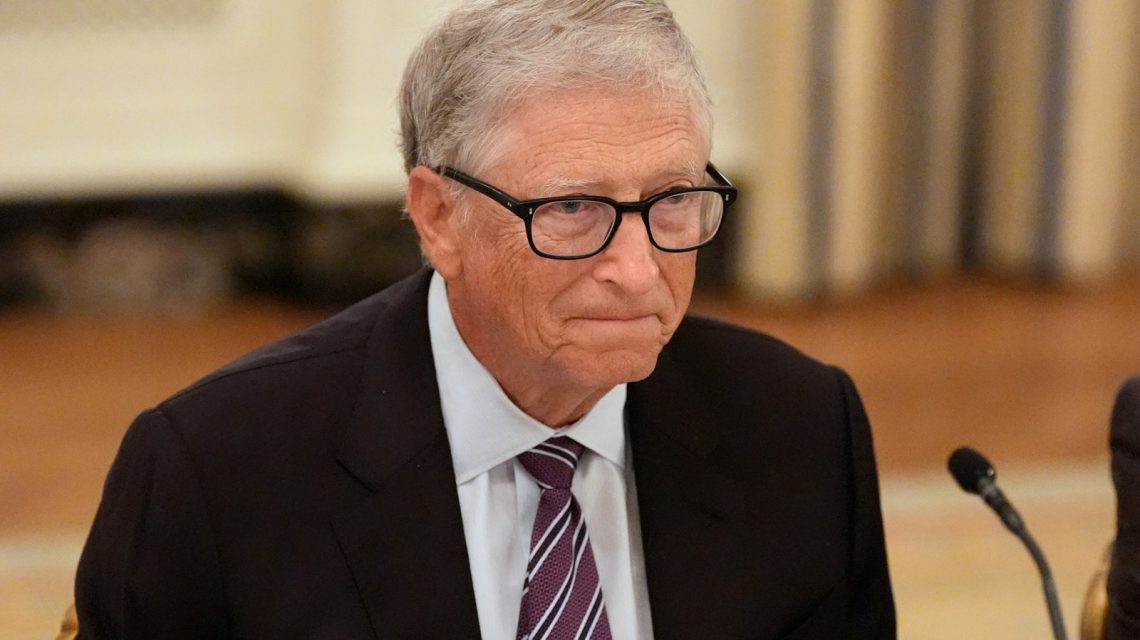
Bill Gates, co-founder of Microsoft, has expressed skepticism about a prominent debate topic surrounding artificial intelligence: the idea of an AI ‘kill switch.’ During an interview on NBC News’ ‘Meet the Press,’ Gates argued that such discussions divert attention from more immediate risks associated with AI.
Gates highlighted urgent dangers such as cyberattacks, fraud, and the development of biological weapons by those with harmful intentions. He advocated for mandatory monitoring and safeguards, instead of relying solely on emergency shutdown mechanisms.
“The kill switch…that’s kind of a weird thing. It’s not enough to have a kill switch,” Gates told moderator Kristen Welker.
Gates emphasized that AI systems are not yet autonomous to the level where they cannot be turned off. He cautioned that focusing solely on ‘kill switches’ is a misunderstanding of technical realities. Gates noted the pressing need for policymakers to prioritize monitoring and implementing safeguards. This comes at a time when Washington is debating the regulation of advanced AI models.
Recently, AI industry leaders, including Dario Amodei of Anthropic, called for a deceleration in AI development due to potential societal risks. OpenAI CEO Sam Altman echoed these concerns, while Elon Musk voiced agreement via social media.
Gates has not advocated for a halt in AI progress but urged lawmakers to expedite the establishment of safeguards. He warned of AI’s potential in facilitating sophisticated cyberattacks and bioterrorism.
“AI is certainly powerful enough to drive events that cause a billion deaths,” Gates cautioned. “There’s never been a weapon as powerful as the combination of people with ill intent using the latest AI tools.”
He dismissed suggestions that concerns about AI are exaggerated, countering claims that fears of AI-driven disasters are a ‘hoax.’
The AI Threat Debate
In the interview, Gates addressed the growing debate over AI emergency shutdown mechanisms. He views the concept as a distraction from the real challenge: ensuring government and corporate oversight of advanced AI systems.
Gates argued that a kill switch would not prevent the most feared harms. Instead, he recommends mandatory oversight measures to track and document potentially dangerous activities.
U.S. legislators Ted Lieu and Nataniel Moran introduced the ‘AI Kill Switch Act,’ mandating AI developers to maintain the ability to control AI systems. However, Gates emphasized the need for comprehensive monitoring over simple shutdown capabilities.
Gates expressed concern over society underestimating AI’s rapid development, describing it as an ‘evolutionary event.’ He predicted AI systems will become significantly smarter in the coming years.
“We have created an intelligent species that, in many respects, is already smarter than we are,” Gates said.
Gates stressed that humans still control current AI systems. He identified the immediate threat as humans using AI tools for harmful purposes.
Trump’s Approach to AI Regulation
The Trump administration is considering its regulatory stance on AI and who should lead that effort. Gates hopes President Trump will gather stakeholders to establish AI safeguards.
Trump previously dismissed AI fears as a ‘hoax’ but Gates suggested a shift might occur after consulting experts. Trump announced plans to appoint an AI czar to coordinate federal AI policy, stressing that other countries are advancing in AI technology.
Gates argued against slowing AI innovation, suggesting oversight measures instead. He highlighted the U.S.’s historical role in addressing global threats and called for a similar approach with AI.
“I’ll be saying we should impose a requirement on all the AIs in the U.S.,” Gates stated.
Current Threats and Future Implications
Cybersecurity experts warn that AI is already accelerating risks against critical infrastructure. John Walsh from cybersecurity firm IGEL noted attackers use AI to exploit vulnerabilities rapidly.
Walsh highlighted water treatment facilities as particularly susceptible due to limited cybersecurity resources.
Echoing Gates’ concerns, Walsh warned that attacks on industrial control systems could impact numerous sectors.
Gates plans to urge governments to adopt mandatory AI safeguards. He noted regulation of AI could be more challenging than past efforts like nuclear arms control. Gates stressed the need for collective human action in managing AI risks.
Representative Ro Khanna is working on a legislative proposal to ban recursive self-improving AI, citing the risk of losing human control.
“As I say, some awful events would increase the urgency,” Gates commented.
 The Trump Team’s Challenge to the Military Leadership
  Maryland First State to Restrict Electronic Pricing in Grocery Stores
  Activists Push for Nationwide Ban on Child Marriage in the U.S.
  Democratic Hopes and Historical Warnings in 2026 Senate Race
  Republicans Face Challenges Amidst Cost of Living Concerns
  A Different Kind of Fall for Congress This Year