
In April 2025, the U.S. imposed tariffs on China, leading Beijing to restrict exports of rare earth elements and magnets. This move threatened supply chains worldwide, marking the beginning of a campaign that persists. Similarly, when the U.S. and Israel conducted strikes against Iran in February, Tehran retaliated by expanding the battlefield to the Gulf states.
Last month, European Union defense ministers gathered in Brussels to address the growing threat of grey-zone attacks. Even Switzerland, usually reserved in its international stance, has raised alarms about Russian activities. August saw the discovery of a drone loaded with explosives at Germany’s Leipzig Airport, highlighting a troubling trend. Beijing, Tehran, and Moscow are increasingly employing horizontal escalation to challenge U.S. influence. Horizontal escalation involves extending conflicts to new geographic areas or domains of competition, posing a complex challenge for American policymakers.
The U.S. tends to organize its policies vertically, with distinct domains such as NATO, trade, and Taiwan. In contrast, America’s adversaries are leveraging horizontal tactics, operating across these domains. Despite differing capabilities and objectives, China, Russia, and Iran each aim to disrupt the U.S.-led international order. Xi Jinping has often spoken of ‘major changes unseen in a century,’ a sentiment he expressed to Vladimir Putin in 2023 in Moscow, encouraging Russian cooperation.
These nations sometimes collaborate to achieve their goals. Tehran has supplied Moscow with drone capabilities during Russia’s vulnerable phase in Ukraine. Russia, conversely, has aided Iran with military resources, reportedly assisting in developing supersonic cruise missiles. China has mitigated U.S. pressure on Russia and Iran, supplying Moscow with dual-use items for its defense industry and buying sanctioned Iranian oil.
Support among U.S. adversaries persists even without formal coordination. Russia consumes Western air defense supplies, Iran engages American military assets in the Middle East, and China’s military buildup demands U.S. attention in the South China Sea. These actions drain American resources, revealing a vulnerability in U.S. power. While U.S. alliances enhance American strength and reach, they also provide adversaries with multiple targets.
To counter this, the U.S. and its allies must deny adversaries easy opportunities for horizontal escalation. Vulnerable areas should be diversified, indestructible ones hardened, and military capabilities increased. Allies need to assume more responsibility. Resilience alone, however, is insufficient. The U.S. cannot protect every vulnerability, and overextending efforts give adversaries an advantage.
Washington and its allies must develop horizontal escalation strategies. Russian sabotage on European infrastructure should prompt costs in other domains, including arms to Ukraine, financial restrictions on Russia, and asset seizures for sanction violations. Adversary action locations should not dictate consequence locations. As EU Defense Commissioner Andrius Kubilius noted, “pain should be at the same level.” Germany, for instance, responded to the Leipzig incident by sending more defense missiles and drones to Ukraine.
Similar logic applies with China and Iran. Economic coercion shouldn’t only meet economic retaliation, and grey-zone attacks shouldn’t necessarily be addressed at the site. U.S. responses need to instill uncertainty in adversaries about American and allied reactions. Horizontal escalation can fortify U.S. ally bonds, as adversary actions create shared causes among disparate partners. China’s response to U.S. tariffs spurred Washington and Europe into a critical minerals partnership. China’s involvement with Iran and Russia’s assistance to North Korea also encourage Gulf states and Asian allies to reevaluate ties with Beijing and Moscow.
Through horizontal conflict expansion, adversaries may inadvertently broaden the coalition against them. Combating horizontal escalation demands ally defense against sabotage and coercion, greater deterrence responsibility, and closer coordination in technology and supply chain protection. American leadership and reliability are crucial to maintaining openness as a strength for the West, rather than a vulnerability. As adversaries adapt, the U.S. and its allies must be prepared to similarly implement horizontal strategies.
 Unrest in France: Student Protests Reveal Deeper Issues
  Pope Leo XIV Condemns Use of Death Penalty in Light of Planned Livestream Execution
  Hurricane Simon Approaches Mexico’s Pacific Coast as Category 4
 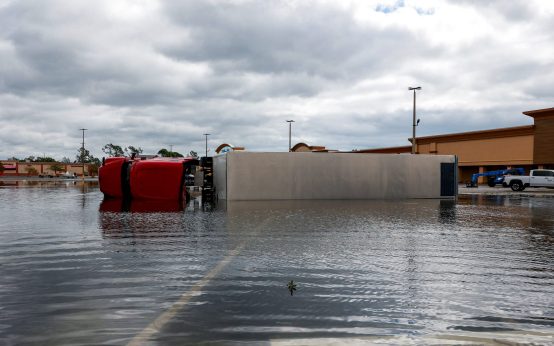 Severe Weather Impact Across United States and Mexico
  Substances Found in Ole Miss Students Before Their Deaths Linked to Local Store
  Bill Maher Criticizes Zohran Mamdani’s Response to Oct 7 Anniversary