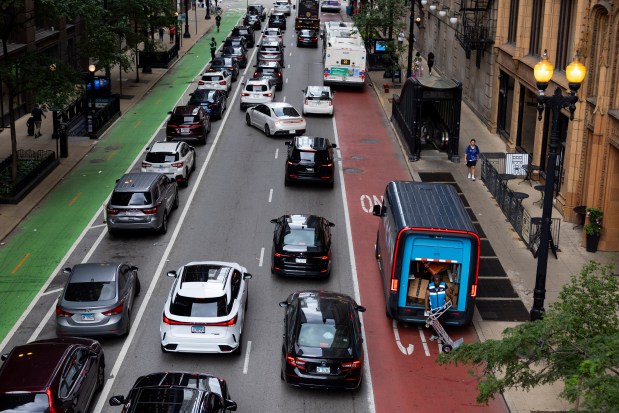
The Smart Streets program in Chicago aims to make downtown streets safer by targeting those who block bike and bus lanes. The program has identified major package delivery companies as frequent violators, including Amazon Logistics, FedEx, and UPS. Many Chicagoans are familiar with trucks and vans idling in busy areas like the Loop.
The city’s program, designed to reduce crashes and improve safety, involves deploying cameras on city vehicles and buses to capture violations. The Department of Finance then issues tickets. Since the program began about a year and a half ago, the city has issued thousands of warnings and fines, totaling nearly $2.6 million, to those who impede bike lanes, bus lanes, and stops.
Data shows that from November 2024 to early this May, Amazon Logistics, FedEx, and UPS incurred substantial fines, amounting to a combined $460,000. This sum excludes violations by independent contractors working with these companies. Businesses contracting with FedEx, such as Trans One Inc. and Northwest Express Inc., also faced fines, with amounts reaching $48,000 and $30,000 respectively.
“Safe and responsible delivery is a priority in every community we serve,” stated Leigh Anne Gullett, an Amazon spokesperson, explaining that independent businesses handle compliance with local laws.
Bike lane ticket prices increased to $250 after the 2022 death of a young child in a bike lane incident involving a parked ComEd truck. The program also issues fines for other violations like expired meters, which are not included in this analysis.
Delivery companies acknowledge the challenges of urban deliveries and emphasize efforts to minimize infractions. Andrew Russell of FedEx mentioned the difficulties of parking in cities like Chicago but stressed the importance of following traffic rules. UPS pointed out efforts to reduce street time by consolidating deliveries and using efficient routes.
The program seems effective in encouraging compliance. According to Erica Schroeder from the Chicago Department of Transportation, most drivers do not repeat violations after receiving a ticket. Recidivism has dropped from 15.6% before the program to 7.6% as of January 2026.
Since its inception, the city has issued zero-fine warnings and about 16,802 tickets for bus and bike lane violations. The overall number of violations might be closer to 30,000 based on the city’s internal data, despite some discrepancies noted by the Tribune.
Mike Belsky, the city comptroller, emphasized public safety as the primary goal of the fines, not revenue generation. The city is actively pursuing companies with unpaid fines through legal channels if necessary.
Tickets range from $90 for bus lane standing violations to $250 for blocking bike lanes. The pilot program, launched in 2024, covers a significant downtown area and aims to expand further. The Chicago Transit Authority (CTA) has equipped six buses with cameras and plans to outfit more. Enforcement will focus on specific bus routes to improve efficiency and safety.
The program’s future depends on city council action, but officials express optimism about its benefits. CTA’s acting President, Nora Leerhsen, highlighted the safety implications of blocked bus stops for disabled riders, emphasizing the program’s importance in ensuring access and safety.
Advocates, like Christina Whitehouse of Bike Lane Uprising, underscore the dangers of blocked bike lanes, which force cyclists onto roads, posing safety risks. Her organization collects data on such obstructions to raise awareness and encourage compliance.